Reading Corners · THE GUIDE
Assemble a Folding-Screen Reading Haven for Shared Living Rooms
Carving out a quiet reading retreat in an active, shared living room requires thoughtful spatial definition. A multi-panel woven cane folding screen offers an adaptable, non-permanent divider that establishes visual privacy without isolating you from the household. Natural cane mesh softens line-of-sight distractions and filters harsh ambient light while allowing household airflow to pass through. Paired with a comfortable standalone lounge chair and intentional task lighting, this freestanding arrangement creates an inviting nook that can be folded flat whenever entertaining calls for an open layout.
Jump to the checklist ↓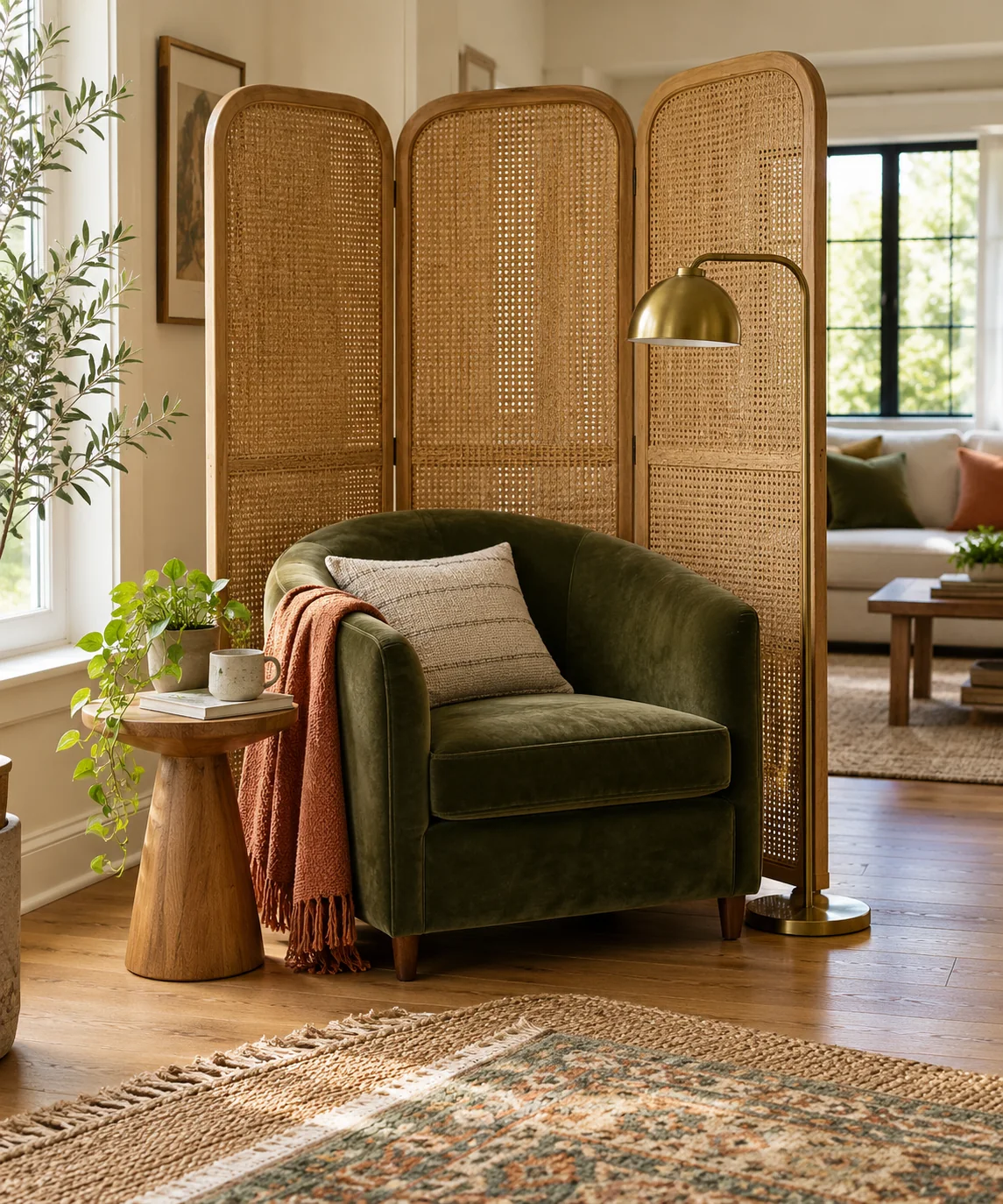
Mapping Room Flow and Spatial Zoning
Identify an underused corner positioned away from primary household traffic lanes and high-activity zones. A folding screen requires adequate floor clearance to maintain stable folds without intruding into walkways. Ensure your setup leaves doorways, heating vents, and storage access completely unobstructed. Maintain generous clearance around the exterior of the screen so family members can navigate the living room easily without bumping into the partition.
Positioning Angles for Screen Stability
Never extend a multi-panel folding screen completely flat, as freestanding screens rely on accordion folds to remain upright on the floor. Set the outer panels at balanced angles relative to the center panel to establish a steady, self-supporting footprint. Position the folds to obscure direct sightlines toward busy areas such as entryways or kitchens. Keep the screen away from heavy drafts or pet play zones where accidental impact could cause it to tip.
Chair Selection and Internal Layout
Inside the screen boundary, position a supportive armchair oriented inward toward your reading position. A chair with a compact or mid-height profile pairs well with standard residential screens, keeping furniture visually contained within the nook. Add a small drink table or stool on your dominant side for books and reading glasses. Keep the footprint uncluttered so you can stand and sit comfortably without jostling the screen or nearby walls.
Managing Lighting and Visual Comfort
Woven cane softens peripheral movement and reduces harsh glare from across the room. Supplement this enclosure with an adjustable floor lamp positioned slightly behind or beside the chair backrest. Select an opaque or directional shade that concentrates light downward onto your book rather than scattering brightness outward. This focused illumination keeps your reading zone bright while preventing unwanted light spill across shared living spaces.
Reversible Storage and Routine Care
The primary advantage of a folding screen is its reversible, non-permanent nature. Dust the woven panels periodically using a soft brush attachment on a vacuum to prevent fiber buildup. When hosting gatherings or reconfiguring the room, fold the panels compact and store the divider flat against an open wall or behind a sofa. Check hinge screws regularly for looseness, and place self-adhesive felt pads beneath the panel bases to protect floor finishes from friction marks.
YOUR STARTING POINT
A little checklist.
Original editorial guidance. Images are AI-generated concepts, not photographs of completed projects. Our sources and approach.
Questions to consider
Does a woven cane screen block household sound?
A woven cane screen does not provide acoustic soundproofing or block television noise. Its main benefit is visual separation; by blocking peripheral household motion, it reduces sensory distractions and creates a calmer personal atmosphere for reading.
How can I improve screen stability in a home with pets?
Keep the screen arranged with deep, pronounced folds rather than shallow angles, and position it against a solid wall at one end for added backing. Place the screen away from active pet running routes, and avoid hanging throws or accessories on panels that could alter balance.
How much floor space does a screen reading nook require?
The necessary space depends on chair dimensions and screen width. Ensure there is sufficient room to open the screen with supportive angles, fit the chair comfortably inside the perimeter, and leave clear clearance for rising without contacting the panels.