Laundry Space Organization · THE GUIDE
Build a Low Platform to Elevate Appliances for Laundry Basket Clearance
Elevating residential washing machines and clothes dryers to create under-machine parking for laundry baskets is an attractive organizational concept for compact utility rooms. However, laundry appliances—especially modern high-spin front-loading washers—generate substantial dynamic loads and vibrational forces during operation. Custom-built elevation platforms introduce operational and structural risks if they do not account for manufacturer guidelines, floor framing capacity, utility line lengths, and emergency shutoff access. Before planning any raised appliance arrangement, property owners must evaluate manufacturer specifications, dynamic weight requirements, drain hose geometry, and ergonomic limitations rather than relying on improvised wooden framing.
Jump to the checklist ↓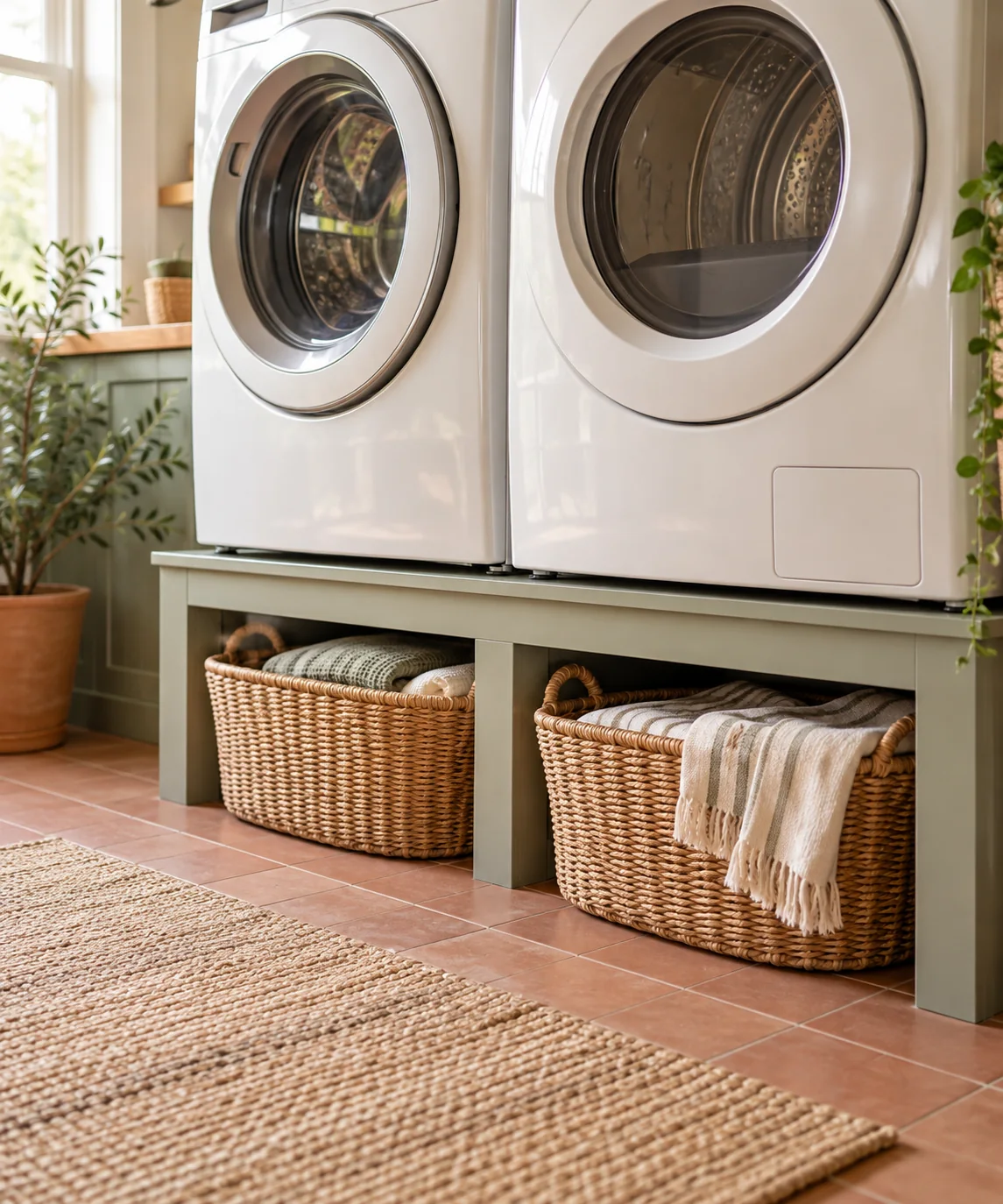
Manufacturer Guidelines and Warranty Compliance
Before considering any elevation solution, consult the installation manuals for your specific washer and dryer models. Most appliance manufacturers design proprietary pedestals that mechanically bolt to machine chassis to safely handle high-torque spin cycles. Building an uncertified platform or using non-approved supports can void manufacturer warranties and violate local mechanical codes. Some manufacturers explicitly prohibit elevating certain top-loading or stacked configurations due to elevated centers of gravity and increased tipping risks. Confirming that your appliance models are approved for elevation is the necessary first step before undertaking any design changes.
Dynamic Loads and Structural Floor Assessment
Washing machines cannot be evaluated solely on their empty weight. A standard residential washer contains heavy concrete counterweights and can hold tens of gallons of water alongside wet textiles, easily exceeding several hundred pounds during a cycle. At spin speeds exceeding 1,000 RPM, unbalanced laundry creates significant dynamic lateral and vertical forces. A raised platform amplifies these vibrations if the underlying subfloor lacks sufficient stiffness. In multi-story buildings or homes with standard joist spans, elevating dynamic machinery can transmit severe acoustic rumbling or structural fatigue through floor framing. Consult a structural professional if you are unsure of your floor's capacity to support dynamic machinery.
Utility Connection Clearances and Hose Geometry
Elevating appliances changes the relative distance to essential utility connections, including hot and cold water supply valves, electrical outlets, dryer exhaust ducts, and drain standpipes. Water hoses must never be stretched taut or kinked, as continuous machine vibration can fatigue brass fittings or loosen threaded connections, causing catastrophic indoor leaks. Furthermore, washing machine drain pumps are rated for specific maximum and minimum discharge heights. Elevating the washer base alters the standpipe clearance, which can impede pump drainage or cause backflow siphoning if the hose configuration violates manufacturer elevation tolerances.
Vibration Dampening and Leveling Stability
Appliances operating on elevated surfaces require rigorous leveling to prevent walking, frame racking, and premature motor bearing failure. Both the platform deck and the appliance feet must be dialed in across both horizontal axes using a precise spirit level. Secondary vibration pads or rubber isolation cups should only be used if recommended by the appliance manufacturer, as overly compliant rubber can sometimes amplify resonance frequencies rather than dampening them. Routine inspection of appliance feet, locking jam nuts, and platform stability is essential to catch subtle shifts before machines shift out of alignment.
Ergonomic Realities and Accessible Clearance
While an elevated platform provides clearance for laundry hampers, raising appliances fundamentally alters daily loading ergonomics. Front-loading doors and detergent pull-out drawers are lifted, which can benefit taller users but may place detergent compartments out of comfortable reach for other household members. Conversely, elevating top-loading washers is generally impractical, as lifting wet clothing out of a deep elevated drum strains shoulders and lower backs. When clearance below machines is desired, shallow rolling wire baskets or purpose-built low-profile storage trays often provide organized hamper parking without the safety complexities of elevating heavy machinery.
YOUR STARTING POINT
A little checklist.
Original editorial guidance. Images are AI-generated concepts, not photographs of completed projects. Our sources and approach.
Questions to consider
Can I build a wooden platform to raise a stacked laundry tower?
Stacked washer-dryer units have a high center of gravity and should not be placed on uncertified wooden platforms. Raising stacked units significantly increases tipping hazards and makes upper dryer controls and lint filters difficult and unsafe to reach.
What happens if a washing machine is elevated too high above the drain standpipe?
Washing machine drain pumps are engineered to pump water up to a specific maximum height, typically between 36 and 96 inches from the floor depending on the model. Exceeding this limit strains the pump motor, causes slow drainage errors, or leaves dirty water in the tub.
Why do elevated washing machines vibrate more than floor-mounted units?
Elevating appliances moves their center of mass farther from structural subfloors, amplifying rotational forces. If the platform or underlying floor framing has any flex, resonance from high-speed spin cycles causes noticeable shaking and potential appliance walking.