Reading Corners · THE GUIDE
Build an Angled Book Wall in an Irregular Living Room Corner
Irregular floor plans with 135-degree obtuse corners often frustrate standard furniture layouts, leaving awkward dead zones that feel disconnected from the main room. Rather than attempting costly custom carpentry, you can assemble a balanced literary alcove by deploying two slim vertical tower bookcases along the intersecting planes. When positioned thoughtfully, these uprights frame the corner angle into an intentional architectural feature. Paired with a compact club chair, the resulting nook maximizes shelf capacity, introduces cozy spatial definition, and preserves essential walking clearance across the adjoining living areas.
Jump to the checklist ↓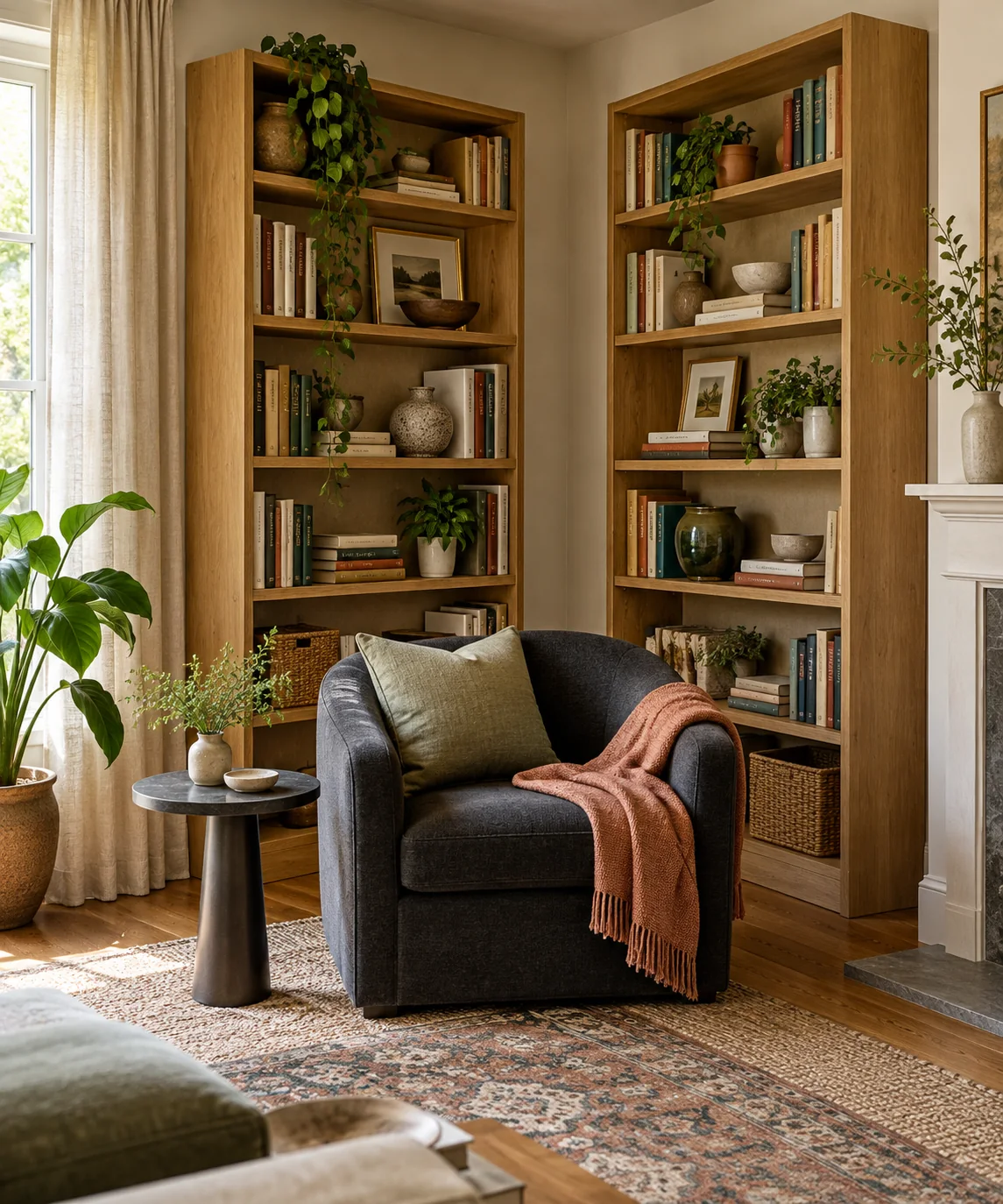
Mapping the 135-Degree Corner Geometry
Unlike standard 90-degree right angles, a 135-degree wall corner spreads outward, creating a wider, shallower footprint that requires careful spatial planning. Use painter's tape along the floorboards to map out the exact footprints of both bookcase units before assembling or placing heavy furniture. When positioning two flat-backed rectangular towers along an obtuse angle, their inner front corners will meet while leaving a triangular rear gap against the drywall. Rather than forcing awkward trim modifications or custom carpentry, keep this rear space open to accommodate ventilation and clear wall baseboards safely.
Selecting Modular Tower Footprints
Shallow bookcases generally integrate best along wide-angle walls, as deeper units can protrude into primary walkways and crowd nearby doorways. Compare product dimensions carefully to ensure the unit widths fit comfortably within each wall segment without overlapping trim, baseboard heaters, or light switches. Selecting matching upright vertical shelving towers in identical heights and finishes creates visual continuity across the corner. This consistent profile establishes a deliberate, organized appearance that bridges the irregular wall transition without obstructing natural room traffic.
Managing the Corner Intersection Gap
Where two modular bookcases meet at an obtuse angle, their outer sides naturally diverge. To achieve a balanced look, position both towers so their inner front edges remain aligned symmetrically with the wall intersection, leaving enough clearance to prevent the outer frames or cabinet doors from binding. Allow sufficient operating space so that shelves remain accessible from both sides. Avoid forcing standard prefabricated units tight against each other at non-standard angles, as misaligned corners highlight irregularities and make retrieving books difficult.
Seating Alignment and Circulation Paths
Once the shelving positions are established, integrate a compact reading chair angled outward to face the broader living area. Verify that the chair's position allows comfortable clearance around adjacent coffee tables, reading lamps, or main walkways. The seating should be placed far enough forward from the bookcases to permit an adult to browse lower shelves without feeling boxed in or shifting furniture. Test the walking route past the corner to ensure the chair does not create an awkward pinch point during daily household movement.
Anti-Tip Anchoring and Weight Distribution
Tall, narrow shelving units present serious tip-over hazards and must always be secured directly to wall framing or solid masonry using manufacturer-provided anti-tip brackets. Distributing weight evenly with heavier volumes like reference hardcovers or storage bins on bottom shelves provides functional organization, but lower-shelf loading does not replace physical wall anchoring. Follow the manufacturer's installation instructions for your specific wall material, and use qualified hardware designed for the unit's loaded weight. For rental properties, consult property management regarding approved drywall anchor systems before loading shelves.
YOUR STARTING POINT
A little checklist.
Original editorial guidance. Images are AI-generated concepts, not photographs of completed projects. Our sources and approach.
Questions to consider
How should the triangular void behind angled bookcases be handled?
Leave the triangular gap open to maintain air circulation behind the furniture. If routing cords for reading lamps through the space, ensure cables remain unpinched and free from sharp shelf edges or heat sources.
Will positioning bookcases at an obtuse angle crowd a modest living room?
Using shallow bookcases designed for smaller footprints preserves floor space better than deep cabinetry. Checking sightlines and doorway clearances beforehand ensures the angled layout remains functional.
Can tall freestanding bookcases remain stable without wall anchoring?
No. Tall vertical shelving towers must always be anchored to the wall structure using anti-tip hardware. Placing heavy books on lower shelves helps balance weight, but it does not prevent tip-over accidents.