Dining Nooks · THE GUIDE
Choose Half-Round Dropleaf Tables for Flush Wall Placement
Small dining rooms and kitchen corridors demand furniture that balances seating capacity with effortless movement. A half-round dropleaf table—often referred to as a demilune dropleaf—serves this need by pairing a straight back edge with a curved perimeter. When positioned flush against a wall, the flat side maximizes floor space, while the curved front eliminates sharp corners that disrupt foot traffic. By raising or lowering the dropleaf extension, you can easily shift between an unobtrusive two-person breakfast ledge and an expanded surface ready for dining.
Jump to the checklist ↓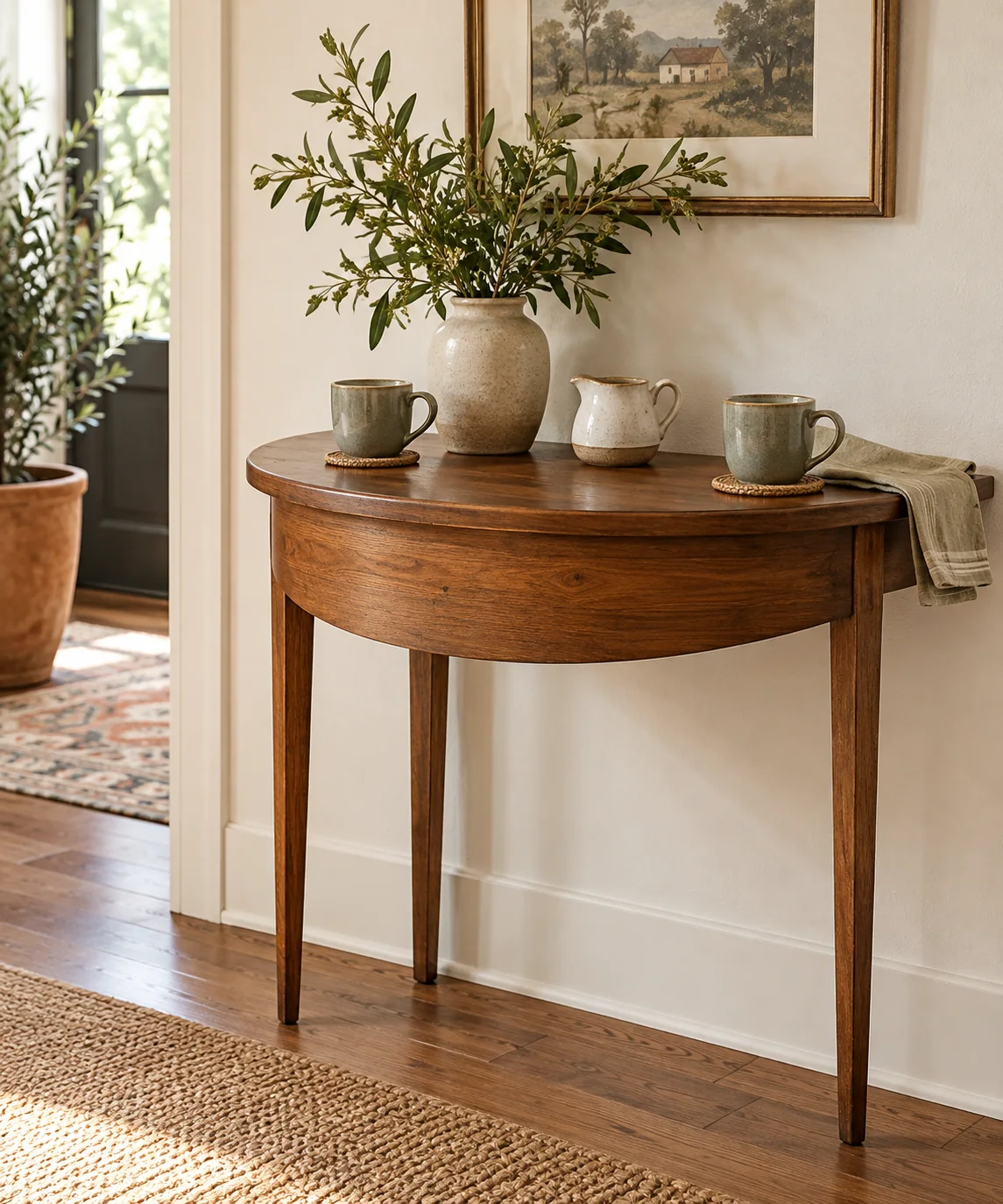
Spatial Advantages of the Demilune Profile
Rectangular tables placed against walls introduce ninety-degree corners that can intrude into primary circulation paths. A demilune or half-round table softens this perimeter by combining a flat rear edge with an arc-shaped front. Placing the straight edge against a flat wall preserves walkway width while eliminating sharp corner projections. This geometry is especially useful along narrow kitchen dining corridors, near entryway transitions, and in compact studio layouts where maintaining continuous foot traffic paths is essential.
Evaluating Dropleaf Support Hardware
Half-round dropleaf tables typically utilize either swing-out gatelegs or under-table folding support brackets to uphold the leaf extension. When assessing a table model, examine the manufacturer's specified weight limitations and hinge hardware construction. Wooden gateleg assemblies pivot from the lower frame to contact the floor directly, offering grounded support but requiring clear floor swing space. Metal friction or spring-assisted brackets keep floor space open for seated diners' legs, though they depend entirely on secure anchorage to the primary table frame.
Measuring Dimensions and Wall Alignment
Commercial demilune dropleaf tables vary widely in proportion, frequently ranging between thirty and forty inches along the rear edge, with leaf depths determined by the manufacturer's specific arc radius. Before selecting a piece, map the fully extended perimeter against baseboards, nearby passage clearances, and adjacent cupboard doors. Standard baseboard molding may create a slight offset between the wall and the table base; selecting a design with tabletop overhang allows the upper surface to sit nearer to the wall without destabilizing the base against trim.
Coordinating Seating with Curved Table Outlines
Seating along a rounded table surface requires attentive chair selection. Wide, angular dining chairs often fail to tuck neatly against an arced edge and may crowd adjacent place settings. Armless side chairs with curved backrests or compact round stools align more naturally with the demilune curvature. When the leaf remains folded against the wall, two stools or chairs can sit angled along the arc. Extending the leaf opens supplementary perimeter room, though total seated capacity depends on chair base widths and table leg spacing.
Long-Term Hardware and Surface Care
When not serving as an eating surface, a wall-aligned demilune functions effectively as a side console for trays, lighting, or books. To protect floors, verify that any pivoting gatelegs have smooth, non-marking glides or felt pads suitable for your specific flooring type. Check mechanical fasteners and hinge screws periodically, as repeated raising and lowering can cause screws to back out slightly over time. Rather than applying aftermarket coatings over unknown factory finishes, preserve the tabletop using non-abrasive cleaners and coasters under warm or damp dinnerware.
YOUR STARTING POINT
A little checklist.
Original editorial guidance. Images are AI-generated concepts, not photographs of completed projects. Our sources and approach.
Questions to consider
How many diners can a half-round dropleaf table accommodate?
When folded flush against a wall, a demilune table generally accommodates one to two diners along the curved front. When fully extended away from the wall or into the room, larger variants may seat three to four people depending on overall diameter and chair profiles.
How can I prevent a gap between the table and wall caused by baseboards?
Look for tables where the top surface overhangs the rear legs or pedestal by at least the thickness of your baseboard molding. Alternatively, keep the small intentional gap clear to prevent dust accumulation and avoid forcing table legs against delicate woodwork.
Are swing-out gatelegs sturdier than folding brackets?
Gatelegs transfer load directly to the floor, which can reduce strain on the main frame. However, they alter under-table foot space. Quality cantilever brackets keep floor space unobstructed, provided you adhere strictly to the manufacturer's load limits.