Reading Corners · THE GUIDE
Create a Low-Profile Corner Seat from Interlocking Storage Cubes
Transforming an underutilized corner into an informal reading nook does not require heavy built-in cabinetry or custom carpentry. By arranging three low modular wooden storage cubes into an L-shaped base, you can establish an accessible seating area that doubles as immediate book storage. Topped with dense canvas floor cushions, this low-profile arrangement offers a grounded, relaxed lounge spot for afternoon reading. The modular format allows flexible reconfiguration whenever room requirements shift, making it an adaptable spatial solution for small apartments, secondary bedrooms, or quiet alcoves that need practical functionality without visual crowding.
Jump to the checklist ↓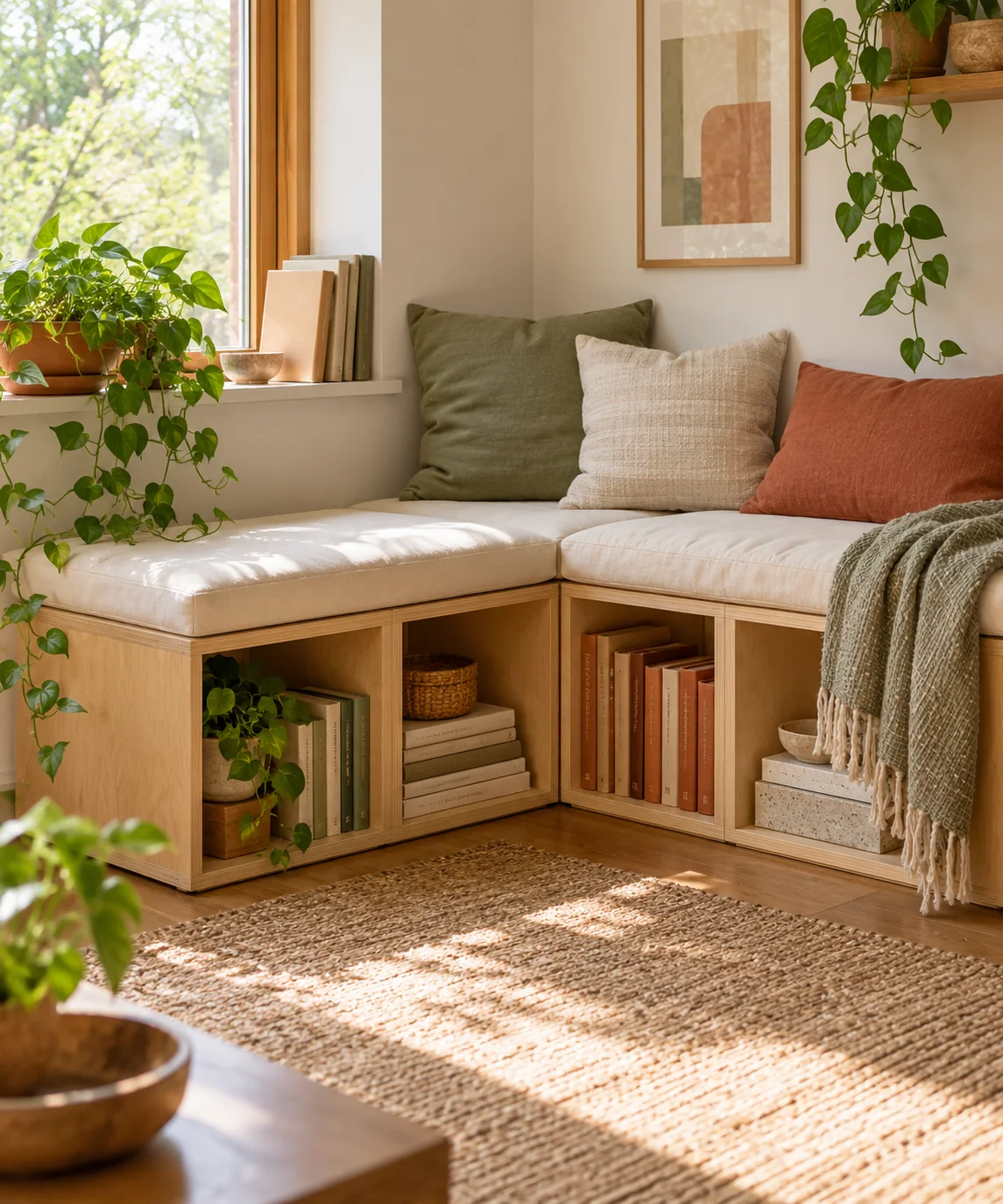
Selecting Sturdy Modular Storage Units
When adapting modular storage units into casual seating, only select cubes explicitly tested and rated by the manufacturer for seated weight capacity. Lightweight composite boards with hollow honeycomb cores lack the structural integrity to support dynamic seated loads and may split or collapse. Inspect solid wood or dense birch plywood modules to ensure right-angle corners and clean, splinter-free edges. Verify that outer dimensions match across all units to create an even, consistent surface plane that supports seating cushions without rocking or uneven contact points.
Planning the Corner Layout
Position one cube into the corner alcove and extend the adjacent cubes outward along the adjoining walls to form an L-shaped arrangement. This layout maintains an open footprint while utilizing corner space that is often left empty. Ensure sufficient clearance remains around the front perimeter so users can sit down and stand up without brushing against coffee tables or blocking room access. If baseboards or floor moldings prevent the cubes from sitting flush against the wall, insert flat felt spacers behind the frames to stabilize the contact points without marring wall paint.
Securing the Base and Padding
Place non-slip rubber grip pads under each cube to reduce sliding on polished timber, tile, or laminate flooring. Check the manufacturer's connection hardware, such as linking bolts or purpose-built bracket connectors, to hold the modular cubes firmly together rather than relying on loose friction or fabric straps. For the top surface, choose dense, tailored foam cushions encased in durable canvas or upholstery fabric. Placing a thin non-slip rug pad between the wooden top panel and the cushion underside keeps the seat from shifting forward during use.
Distributing Book Weight Safely
Use the lower open cubbies to store heavy hardcover books, reference guides, and manuals. Arranging dense paper volumes in the base compartments lowers the overall center of gravity, adding ballast that helps keep the modular units grounded. Keep book spines aligned slightly behind the front lip of each compartment to protect bindings from accidental scuffs from passing footwear. Use freestanding bookends to keep volumes upright rather than leaning sideways, ensuring books can be removed and returned without destabilizing adjacent rows.
Evaluating Ergonomics and Intended Use
A low seating platform resting between fifteen and nineteen inches from the floor offers an informal reading retreat well-suited for relaxed lounging. However, lower seating heights require greater knee flexion when transitioning to a standing position compared to standard armchairs or dining chairs. Place firm pillows or bolsters against the adjoining wall to provide necessary lumbar support during prolonged reading sessions. For individuals requiring upright ergonomic support or easier mobility access, pair standard-height seating nearby as a complementary option.
YOUR STARTING POINT
A little checklist.
Original editorial guidance. Images are AI-generated concepts, not photographs of completed projects. Our sources and approach.
Questions to consider
Can standard decorative storage cubes be used as seating?
No. Many decorative storage cubes are manufactured from thin composite board intended only for lightweight display and will fail under seated weight. Always confirm the manufacturer explicitly rates the unit for seating loads before use.
How can I prevent seat cushions from sliding off the wood top?
Place a section of non-adhesive rubber grip matting or rug underlay between the wooden cube surface and the cushion base. The added surface friction prevents the cushion from migrating forward during use.
What is the best way to connect adjacent modular cubes securely?
Use manufacturer-supplied connection bolts or low-profile furniture joining brackets through pre-drilled holes. Relying on adhesive tape or hook-and-loop straps cannot reliably resist lateral shifting under active seating loads.