Small Kitchen Organization · THE GUIDE
Deep Corner Cabinet Lazy Susan Strategy
Blind corner kitchen cabinets present one of the most frustrating storage puzzles, often hiding forgotten dry pantry staples in deep, shadowy recesses. Installing twin rotating hardwood turntables directly onto the existing fixed shelves offers an efficient, non-destructive remedy that bypasses complicated specialty hardware. By introducing two independent rotating platforms rather than a central-pole mechanism, you maximize circular usable surface area while preserving the structural integrity of your original cabinetry. This methodical layout brings buried grains, legumes, and baking supplies straight to the front of the cupboard opening with a gentle flick of the wrist.
Jump to the checklist ↓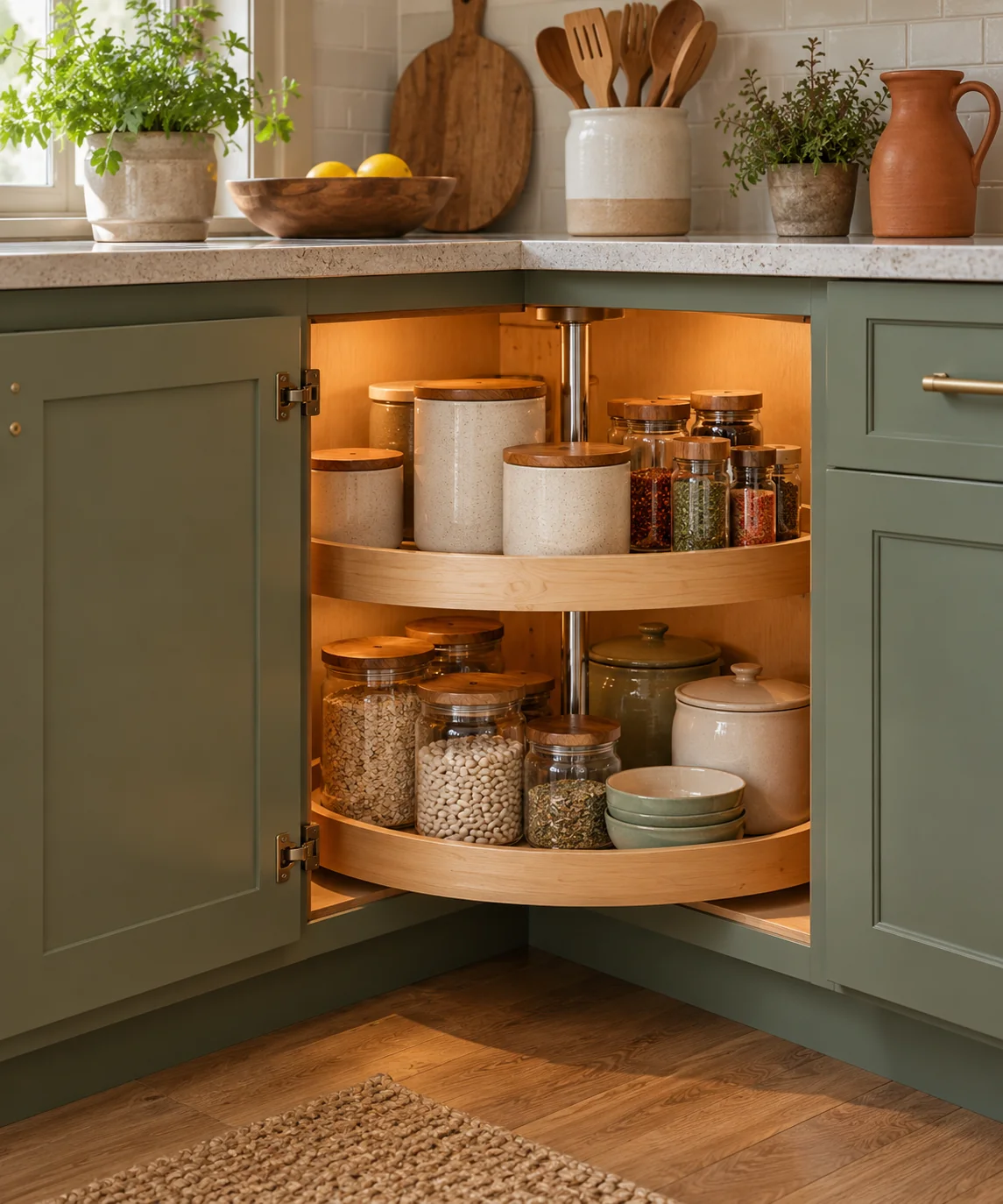
Cabinet Door Opening and Clear Interior Geometry
Blind corner cabinets feature an offset access door alongside an enclosed pocket extending behind adjoining cabinetry. Before purchasing standalone turntables, take precise measurements of the clear door opening diagonal, as any turntable must pass through this aperture without forcing. Inside the cabinet, measure the depth from front frame to back wall, as well as the lateral width of the blind pocket. Fixed interior shelves and protruding shelf-support pegs also reduce usable vertical clearance, so verify that both the turntable base and intended storage canisters clear upper shelves comfortably.
Front and Blind-Pocket Turntable Placement
Placing independent rotating platforms on a fixed shelf requires realistic planning for reach and visibility. Positioning one turntable directly behind the door opening provides effortless access to frequently used cooking staples. A second turntable can sit deeper inside the blind recess for overflow stock, but remember that reaching past the front turntable requires adequate hand clearance. Leave sufficient open spacing between both units so rotating jars on the forward disc do not collide with containers stored on the rear platform.
Weight Distribution and Turntable Loading
Standalone turntables rely on internal ball-bearing tracks that function best under balanced weight. Center heavier items, such as large canisters of flour, granulated sugar, or bulk grains, directly over the turntable's central pivot point. Distribute smaller condiment bottles, baking powder tins, and spice jars symmetrically around the outer perimeter. Unbalanced loading strains the rotation mechanism on one side, causing platform tilt and unnecessary resistance against the cabinet shelf surface.
Perimeter Rims and Container Stability
Choose turntables designed with an integrated raised rim of at least one to one-and-a-half inches. When rotating a turntable by hand, taller containers can wobble, especially when transitioning across slight shelf irregularities or during sudden stops. A sturdy lip prevents jars and round canisters from sliding over the edge into the dark, hard-to-reach recesses beneath or behind cabinet shelving. Keep tall, slender glass bottles grouped near the center or supported by wider neighbouring canisters to minimize tipping.
Turntable Maintenance and Shelf Cleaning
One advantage of unattached lazy susan trays is their complete reversibility and ease of maintenance. Because they rest freely on the shelf without mechanical screws or center poles, you can easily lift them out for routine cleaning or reorganize them as storage needs change. Wipe laminate or composite turntables with a damp cloth and mild dish soap to remove flour dust or syrup residue. Clean the underlying cabinet shelf thoroughly before replacing the units to prevent grit from grinding beneath the turntable base.
YOUR STARTING POINT
A little checklist.
Original editorial guidance. Images are AI-generated concepts, not photographs of completed projects. Our sources and approach.
Questions to consider
How do standalone turntables compare to pole-mounted lazy susans?
Standalone turntables rest directly on existing shelving, requiring no drilling, bracket installation, or structural alterations. They allow flexible positioning and straightforward removal for cleaning, though they do not provide the interconnected dual-level spinning action of factory-installed pole systems.
How can I prevent a standalone turntable from shifting on smooth shelves?
Look for turntables fitted with non-skid rubber feet on the underside. If the turntable base shifts when rotated, place a pre-cut square of non-adhesive grip shelf liner directly beneath the rotating base to maintain stability on smooth laminate or wood.
What items are best suited for corner cabinet turntables?
Uniform pantry containers such as canister jars of beans, rice, dried pasta, and baking staples perform reliably on rotating trays. Avoid stacking loose items, and position tall, slender bottles toward the middle where they are less prone to tipping during rotation.