Small Kitchen Organization · THE GUIDE
Deep Pot and Skillet Divider Rack Inside a Low Drawer
Stacking frying pans and saucepans inside deep base drawers often causes chipped enamel, scratched non-stick coatings, and frustrating clatter during cooking. Stacking also means unnesting several heavy pieces just to reach one everyday skillet. An adjustable vertical divider rack holds pans, lids, and shallow cookware on edge, organizing drawer contents for quick identification and retrieval. Planning this layout requires measuring cookware profiles, checking handle positions against drawer clearances, and respecting cabinetry hardware ratings to keep cookware organized while protecting drawer runners from undue strain.
Jump to the checklist ↓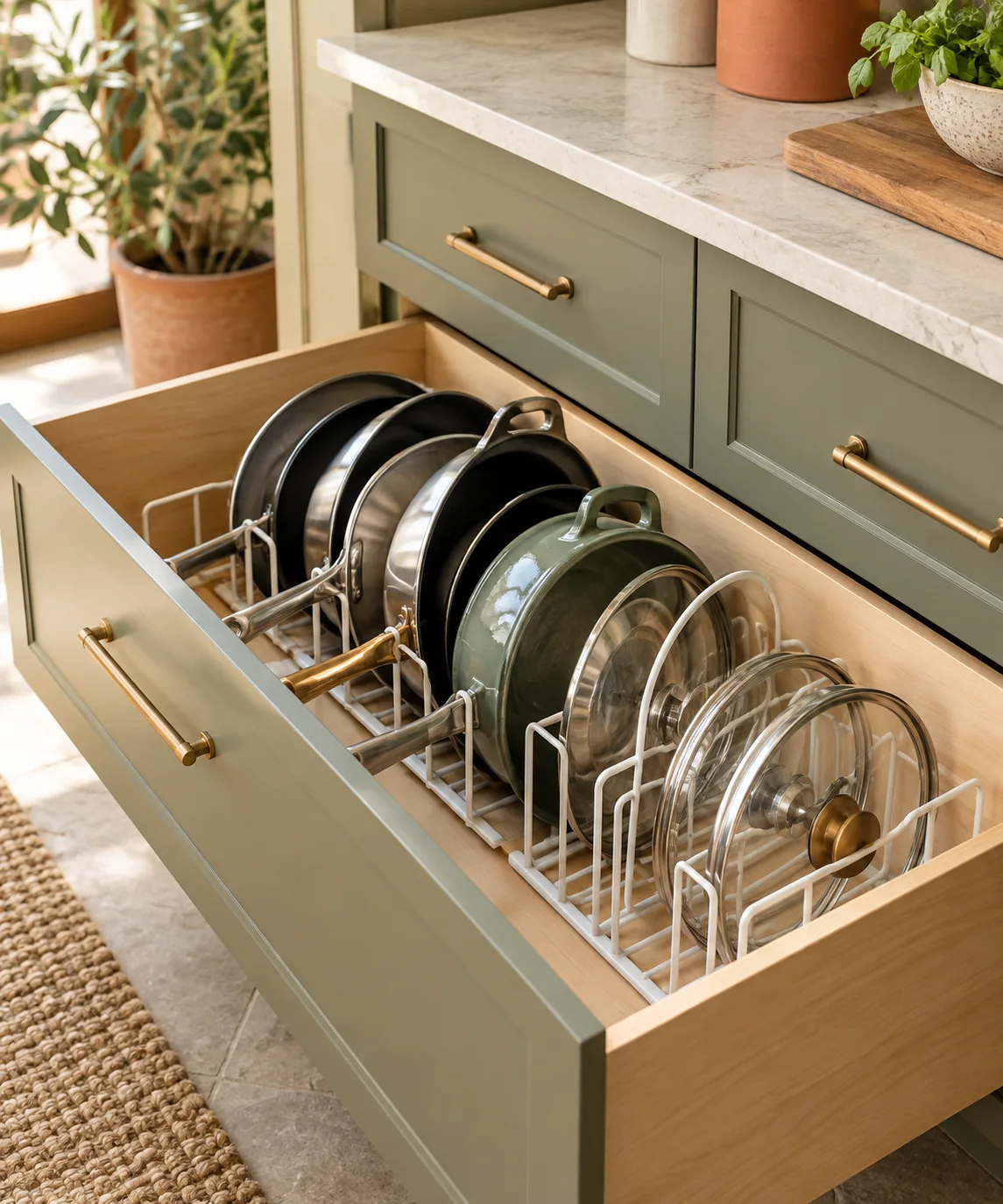
Measuring Drawer Profiles and Cookware Clearances
Begin by measuring interior drawer width, depth, and the vertical clearance between the drawer bottom and the cabinet frame above. Stand your widest pan vertically on its rim to check whether its outer diameter fits within the available drawer height. Be sure to account for handles: long, straight handles may extend higher than the pan rim or stick out past the drawer sides, requiring them to be angled diagonally or parked toward the back corner to clear the face frame.
Adjusting Dividers to Fit Cookware Variety
Choose a divider system with repositionable wire rungs that adapt to different cookware depths. Shallow frying pans, glass lids, and deeper sauté pans each require distinct spacing to stand comfortably without leaning excessively. Position dividers so each item rests upright with sufficient clearance on either side to be lifted straight out without scraping adjacent cookware, keeping handles aligned to prevent them from catching on the drawer opening.
Assessing Layout Stability and Motion
Before filling the drawer completely, test the spacing with your primary cookware pieces. Insert the divider frame, place a skillet and a saucepan into their designated slots, and open and close the drawer at normal speed. Observe whether pans remain upright without rolling or shifting when the drawer starts and stops. Adjusting divider spacing slightly closer to the pan walls can provide better lateral support if items wobble during drawer travel.
Protecting the Drawer Base with Non-Adhesive Liners
A loaded cookware rack concentrates metal weight onto narrow rails or small contact feet. Placing a durable, non-adhesive grip mat across the drawer bottom helps protect the drawer floor against scuffs, scratches, and vibration wear. The textured surface also adds friction, preventing the freestanding divider rack from shifting forward or backward during rapid drawer opening, keeping the entire organization system neatly in place.
Adhering to Drawer Weight Boundaries
Cookware adds substantial weight to cabinetry hardware. Review the manufacturer documentation or cabinet builder specifications for your specific drawer glides to understand their rated capacity, keeping in mind that the rating includes the drawer box itself. Reserve vertical drawer racks for everyday fry pans, stainless steel saucepans, and lightweight lids. Store exceptionally heavy cast-iron Dutch ovens or large stockpots on sturdy base shelves rather than on moving drawer slides.
YOUR STARTING POINT
A little checklist.
Original editorial guidance. Images are AI-generated concepts, not photographs of completed projects. Our sources and approach.
Questions to consider
What can I do if a skillet handle prevents the drawer from closing?
Try rotating the pan so the handle rests along the back wall or points diagonally toward an open drawer corner. If the handle still contacts the upper frame, store that specific item flat on a base shelf and use dividers for shorter cookware.
Can cast iron skillets be stored vertically in a drawer rack?
Lightweight or medium skillets may be stored vertically if the rack provides rigid support and your drawer glides are rated for the total loaded weight. For very heavy skillets, stationary cabinet shelving is generally preferable.
How do divider racks protect glass lids from chipping?
Racks with protective vinyl, silicone, or durable powder coatings cushion rim edges against direct metal-on-metal impact. Selecting coated dividers and leaving slight clearance between slots prevents glass rims from knocking together during drawer use.