Warm Neutral Living Rooms · THE GUIDE
Define an Open Living Space with a Flatwoven Jute Border Rug
Open studio layouts require clear spatial boundaries to prevent furniture arrangements from blending into an undefined expanse. A flatwoven jute rug detailed with a tailored cotton border grounds the central living zone without overwhelming tight floor dimensions. The natural, light golden tones of dried plant fibers provide warm tactile texture beneath bare feet, harmonizing effortlessly with linen seating and blonde wood tables. Because flatweaves possess minimal pile height, they visually define conversation zones while permitting easy movement around furniture edges. Implementing this foundation establishes balanced proportions across multi-purpose spaces while maintaining an airy, uncluttered aesthetic.
Jump to the checklist ↓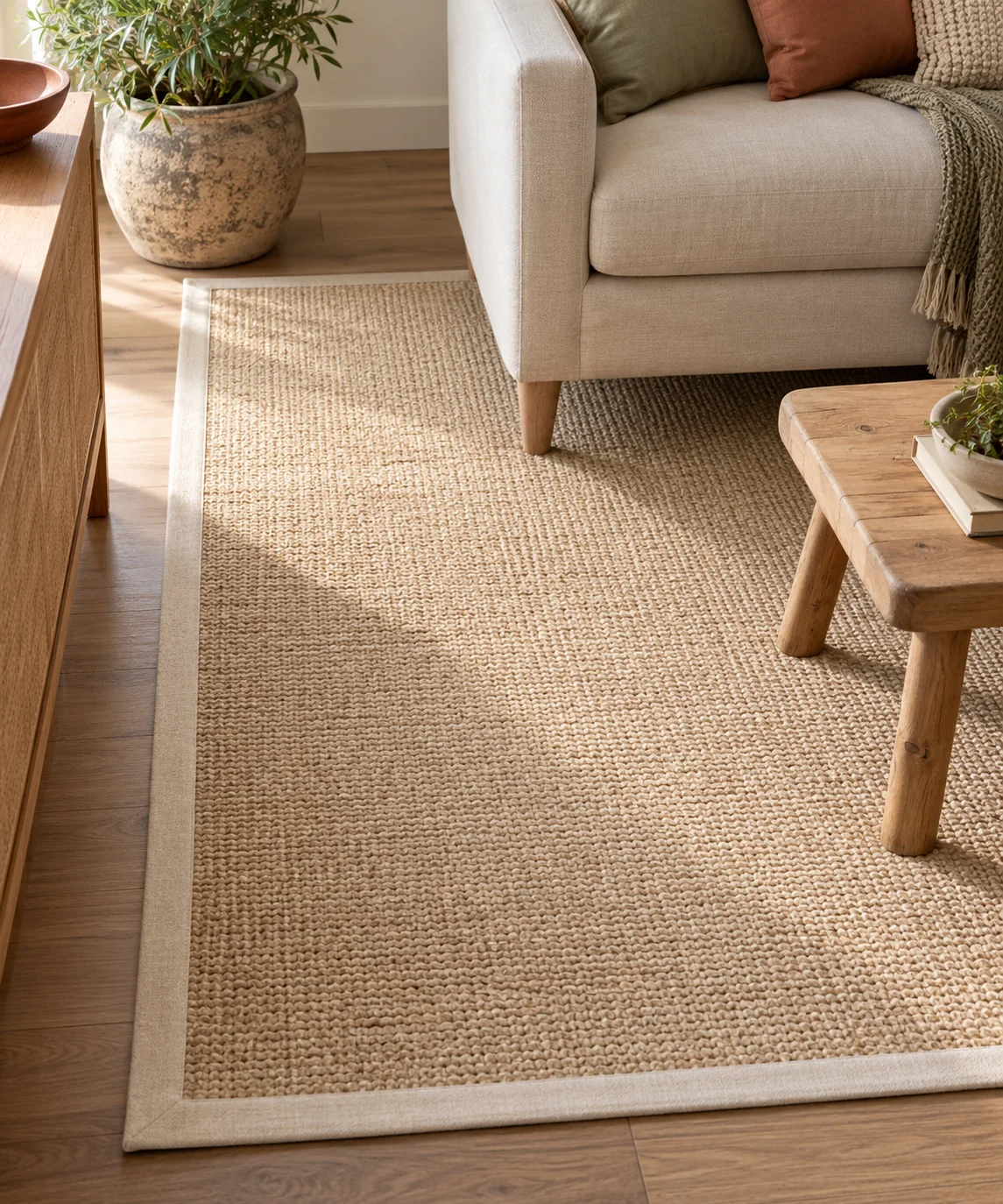
Establishing Proportions and Furniture Anchoring
To define a studio seating zone cleanly, select a rug size that accommodates the front legs of the sofa and primary accent seating. Placing the front legs of furniture onto the woven surface establishes a unified visual boundary without requiring an oversized rug that dominates the entire room. Leaving an intentional border of bare floor exposed between the rug edge and surrounding perimeter walls helps balance the room's proportions, maintaining an open and uncluttered spatial flow.
Leveraging Flatweave Low-Profile Advantages
Flatwoven jute rugs feature a dense weave with minimal vertical pile, making them practical for compact living areas and multi-purpose studio layouts. The low profile allows occasional tables, floor cushions, and timber stools to sit level without wobbling. Furthermore, flatweaves provide minimal threshold rise beneath interior doors or low cabinet drawers that swing across the living perimeter, reducing transition catches along high-traffic routes connecting seating to adjacent entryways.
Selecting Underlays for Different Flooring Types
Natural jute fibers are inherently coarse and shed fine plant dust that can work beneath the rug under normal foot traffic. Pair the flatweave with a dedicated non-slip rug pad cut slightly smaller than the rug perimeter to protect underlying floors from abrasion and prevent shifting. Always confirm material compatibility with your specific flooring manufacturer: while felt pads with natural rubber backings perform well on many cured hardwoods and tile, rubber can chemically react with plasticizers in luxury vinyl plank (LVP) and cause permanent yellowing. In those spaces, an all-felt or manufacturer-approved synthetic pad should be used.
Managing Natural Shedding and Daily Care
New jute rugs naturally shed fine organic fibers during their initial months of regular household use. Vacuum the surface regularly using suction only; rotating beater bars can snag woven loops and fray edge bindings prematurely. Lift the rug periodically to sweep or vacuum dust that filters down through the weave. For wet spills, immediately blot the area using a clean, dry cloth to lift moisture before it penetrates the plant fibers, avoiding heavy water saturation that can cause natural jute to swell, watermark, or ripple.
Framing Spaces with Contrasting Fabric Borders
A tailored cotton or canvas border along the rug edge creates a crisp visual frame that distinguishes living zones from sleeping or dining areas. The stitched fabric binding also protects the outer plant fibers from premature edge wear and unravelling. Selecting a border tone that echoes an existing neutral element in your room, such as upholstery piping, linen drapery, or woodwork, unifies the palette naturally without requiring physical partitions or visual clutter.
YOUR STARTING POINT
A little checklist.
Original editorial guidance. Images are AI-generated concepts, not photographs of completed projects. Our sources and approach.
Questions to consider
Is a jute border rug soft enough for lounging on the floor?
Jute is naturally softer than coarse plant fibers such as sisal or coir, but it still has a firm, textured surface. Layering a soft cotton throw, sheepskin, or low floor cushion provides comfortable supplemental padding for direct floor lounging.
How can I flatten curling rug corners after unpacking?
Gently reverse-roll the rug corners for several hours, then lay the rug flat on its pad. Placing smooth, heavy items such as flat boards or weighted book stacks on curled edges helps relax the woven plant fibers.
Can a jute rug be used near an open kitchenette in a studio?
Jute can be placed near studio kitchenettes as long as it remains outside direct liquid and cooking splash zones. Because dried plant fibers absorb grease and moisture rapidly, position the rug perimeter away from active sink and prep zones to prevent stubborn staining.