Reading Corners · THE GUIDE
Define an Open-Plan Reading Corner with a Bold Circular Rug
Expansive, open-concept living rooms frequently struggle with visual cohesion, allowing lone armchairs and reading spots to look adrift across broad floors. Placing a bold circular braided rug beneath a seating arrangement instantly establishes an intimate, well-defined room-within-a-room. The curved perimeter breaks up repetitive rectangular floor lines, establishing an unmistakable visual island dedicated solely to quiet concentration. When paired with a supportive lounge chair and a miniature book pedestal, this compact circular foundation organizes open square footage into an intentional, highly functional sanctuary without requiring partitions, screens, or permanent structural room dividers.
Jump to the checklist ↓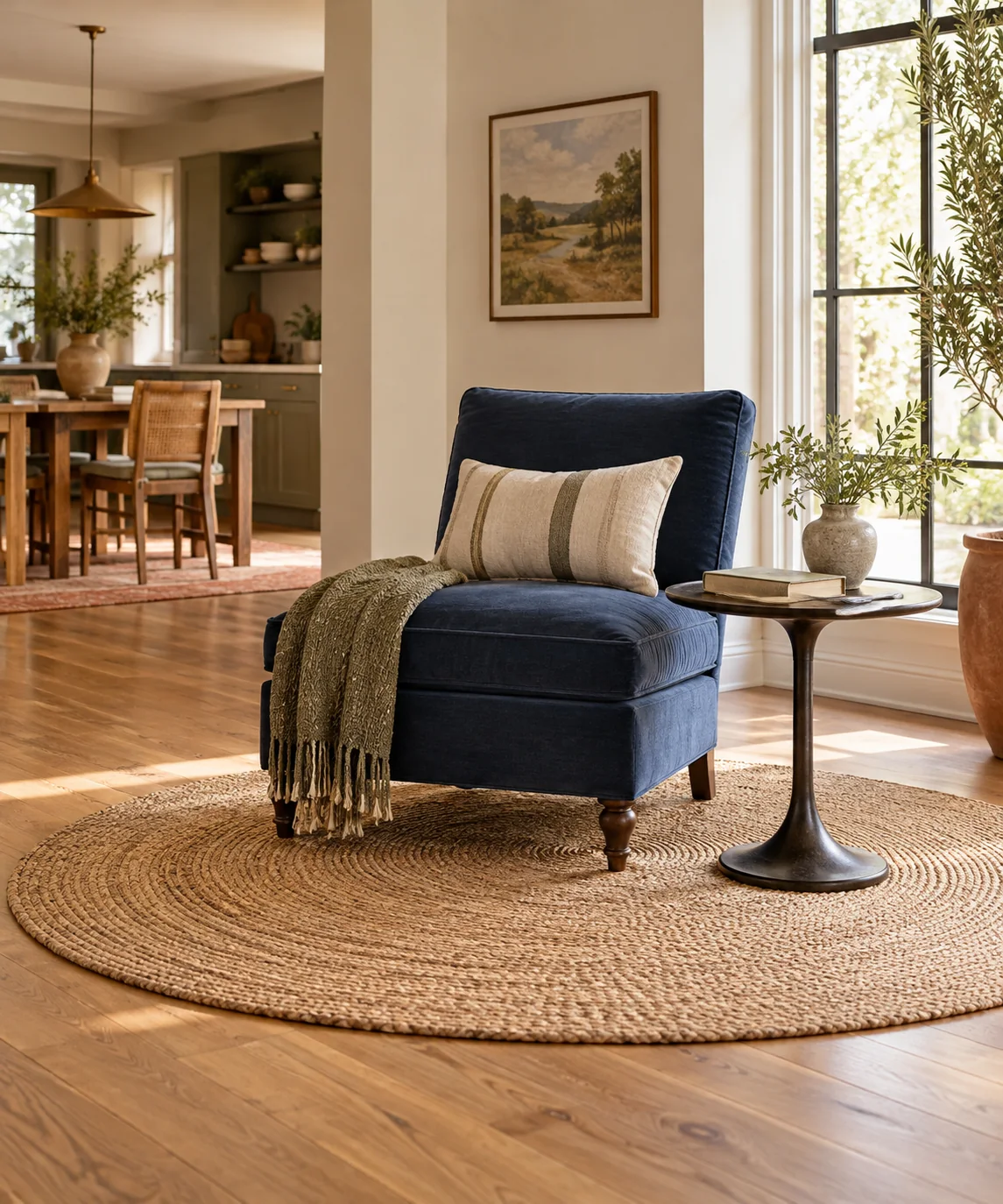
Selecting the Correct Rug Diameter
Choosing the right circle dimensions prevents your reading nook from appearing crowded or swallowed by open flooring. A four- to five-foot diameter braided rug provides an ideal footprint for a solitary reading arrangement. This scale accommodates the front legs of an accent chair alongside a small book pedestal while leaving a neat perimeter border of exposed floorboards. Avoid undersized three-foot mats, which look like stepping pads rather than purposeful anchors.
Establishing Material and Color Contrast
Select a rug that contrasts prominently with your underlying hard surface. Thickly coiled natural jute, twisted sisal, or deeply dyed wool braid creates noticeable tactile and visual differentiation against smooth polished hardwood or uniform tiles. A high-contrast boundary clearly signals to the eye that this area serves a distinct contemplative purpose, visually separating quiet reading moments from nearby dining, cooking, or general family entertainment spaces.
Positioning the Pedestal and Lounge Seating
Anchor the reading chair so its two front feet rest completely on the braided rug, grounding the furniture piece securely. Angle the seat slightly toward natural window illumination or away from high-traffic household entry paths. Place a slender pedestal table within easy arm reach, slightly forward of the chair armrest, providing a dedicated stable rest for a single book and a cup of tea without obstructing ingress.
Installing Floor Protection and Anti-Slip Pads
Circular braided floor coverings tend to shift, wrinkle, or rotate under the uneven lateral force of getting in and out of an armchair. Always place a dedicated, dense rubberized felt rug pad cut precisely one inch smaller than the rug circumference directly beneath it. This non-adhesive pad grips smooth floor finishes, prevents fiber abrasion on wood surfaces, and eliminates curling edges that could cause household tripping.
Routine Fiber Care and Visual Maintenance
High-friction reading islands collect localized shoe grit and falling fiber dust beneath heavy chair legs. Vacuum your braided rug bi-weekly using a suction-only setting, as rotating beater brushes fray traditional braided stitching over time. Rotate the circular mat 180 degrees every six months to distribute foot traffic patterns and furniture leg indentations evenly, preserving balanced color tone and prolonging the useful life of natural textile fibers.
YOUR STARTING POINT
A little checklist.
Original editorial guidance. Images are AI-generated concepts, not photographs of completed projects. Our sources and approach.
Questions to consider
Should all furniture legs sit on the round rug?
No. Resting only the front legs of your lounge chair on the rug anchors the arrangement securely while saving floor footprint, keeping the circle visually balanced alongside a small pedestal table.
How do I stop a braided rug from sliding on wood floors?
Always place a dense, non-slip rubberized felt pad directly beneath the rug. Avoid thin mesh liners, which bunch up easily under the concentrated point loads of chair legs and foot movement.
What diameter works best for a single reading chair?
A diameter between four and five feet offers the most versatile proportions. It anchors an accent chair and pedestal table comfortably without overwhelming surrounding traffic lanes in an open-plan room.