Warm Neutral Living Rooms · THE GUIDE
Divide a Long Room with a Neutral Sisal Runner
Narrow living areas frequently suffer from layout ambiguity, causing movement paths to bleed into stationary seating zones. When a single rectangular space must accommodate both an active walkway to an adjacent kitchen and a quiet relaxation corner, physical boundaries become essential. Laying a neutral sisal runner alongside your primary seating rug provides clear spatial demarcation without the need for visual bulk or physical room dividers. By deliberately designating the circulation lane with durable natural plant fibers, you create visual order, establish clear traffic boundaries, and protect adjoining flooring textures.
Jump to the checklist ↓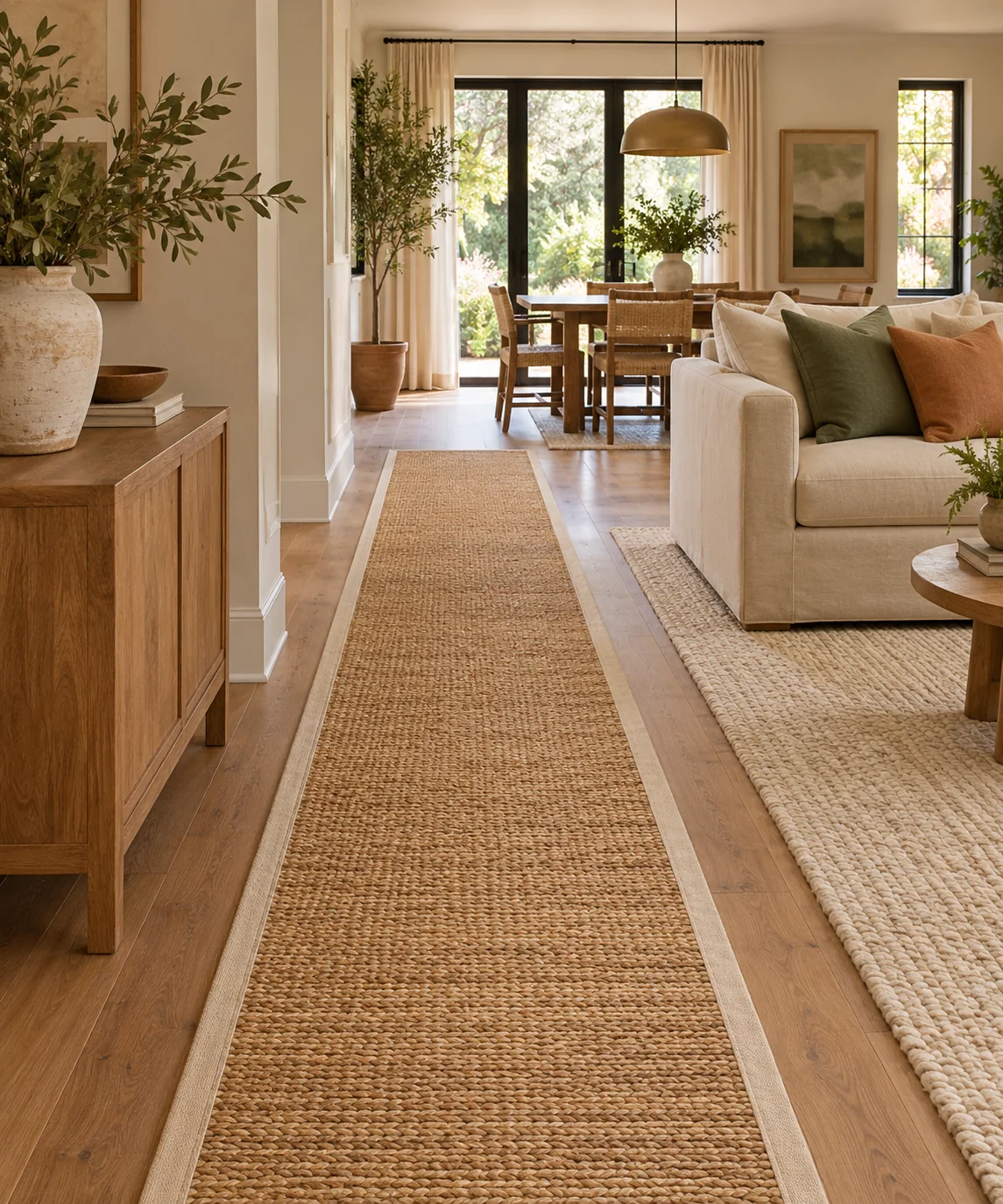
Planning the Circulation Path
Long living areas often combine main walking routes with stationary seating arrangements. Observing the natural path household members take when crossing the room helps identify an unobstructed corridor between doorways and seating zones. The circulation lane should allow comfortable transit without forcing pedestrians to squeeze past table edges or furniture corners. Testing the proposed layout by outlining the runner dimensions with painter's tape confirms clearance around door swings and storage cabinet doors before purchasing.
Balancing Spacing Between Floor Coverings
When using a natural fiber runner alongside an existing living room area rug, keeping a visible margin of bare flooring between the two textiles establishes clean visual boundaries. Overlapping rugs or placing them immediately edge-to-edge can cause edges to curl, catch foot traffic, or bunch up unevenly. A consistent gap of exposed floor provides definition between the active walking lane and the stationary lounge area, supporting orderly room flow.
Selecting Durable Weaves and Bound Borders
Transition pathways experience concentrated foot traffic, making weave selection an important consideration. Dense, low-profile weaves such as bouclé or fine herringbone offer a firm, stable walking surface that resists catching on shoes. Runners finished with heavy cotton twill or canvas edge binding help protect the cut ends of the natural plant fibers from unraveling while providing a clean, tailored border that complements neutral design schemes.
Underlayment Selection and Slip Reduction
Because natural fiber runners have relatively stiff backings and lack built-in adhesion, pairing them with an appropriate non-slip rug pad is essential. Select a low-profile pad designed specifically for your floor type, whether hardwood, tile, or laminate, and trim it slightly smaller than the runner perimeter. A quality underlayment helps reduce shifting under directional foot traffic, cushions step impact, and minimizes abrasive contact between the coarse backing and the floor finish.
Routine Care and Moisture Precautions
Natural plant fibers like sisal are absorbent and sensitive to liquid exposure, which can cause fiber swelling, shrinkage, or localized water marks. Cleaning should focus primarily on dry methods. Vacuum regularly using straight suction rather than a motorized beater bar, which can fray the woven fibers. If a spill occurs, blot immediately with clean, dry, uncolored towels without rubbing, and consult the manufacturer's care instructions for suitable dry-cleaning options.
YOUR STARTING POINT
A little checklist.
Original editorial guidance. Images are AI-generated concepts, not photographs of completed projects. Our sources and approach.
Questions to consider
Can a natural fiber runner be used over wall-to-wall carpeting?
Yes, but it should be paired with a specialized rug-to-carpet underlayment to reduce creeping and wrinkling. Select a thin, low-profile runner to minimize transition height between the carpet surface and the runner edge.
How should liquid spills on untreated sisal be addressed?
Blot the area immediately with clean, dry, white paper towels or cloths, working from the outside inward. Avoid scrubbing or saturating the spot with water-based detergents. For persistent marks, consult manufacturer guidance regarding dry-cleaning powders formulated for plant fibers.
Can natural fiber backings cause wear on wood floor finishes?
Coarse natural fiber backings can cause light surface abrasion on sensitive wood finishes over time under continuous foot traffic. Using a dedicated, compatible rug pad creates a protective barrier that significantly reduces friction against the floor surface.