Small Kitchen Organization · THE GUIDE
Dual-Purpose Butcher Block Topper for Apartment Stoves
Compact rental kitchens often lack continuous counter space between the sink and the range, creating bottlenecks during meal preparation. A fitted wooden noodle board, commonly referred to as a stove topper, converts cold, inactive burners into an expansive staging and prep surface. While this adaptation expands functional square footage, it requires strict operational habits to protect both the cooktop and the timber. By selecting boards with stable footings and dedicated perimeter clearances, cooks can slice, assemble, and rest bowls without crowding narrow counters. Careful workflow discipline ensures the wood never encounters residual heat from active cooking.
Jump to the checklist ↓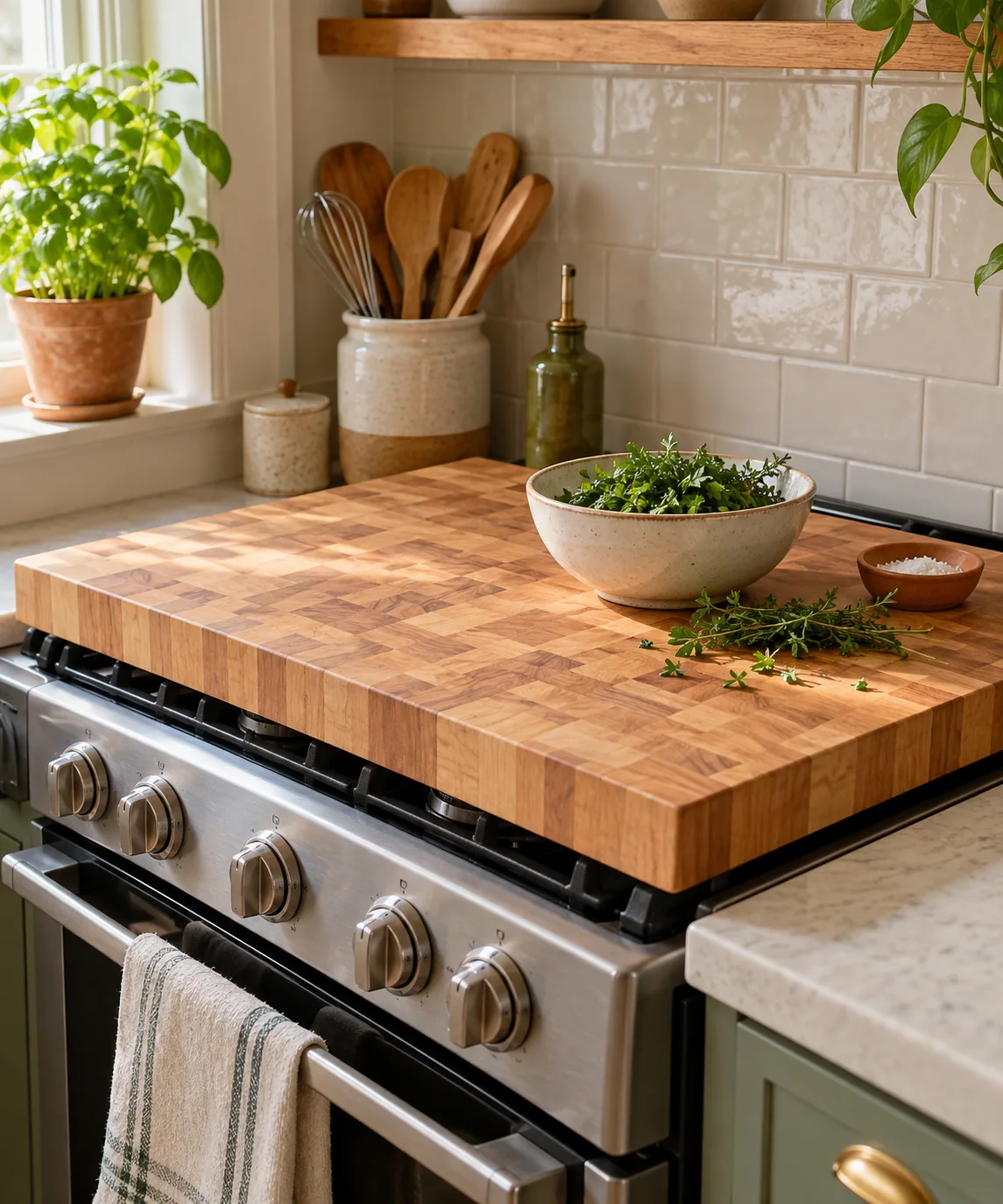
Checking Appliance Guidance and Surface Dimensions
Before considering a stove topper or noodle board, consult the range manufacturer's guidelines. Many appliance makers explicitly advise against placing combustible items across cooktops, and ranges with standing pilot lights must never be covered because heat and trace gas can accumulate beneath the wood. If permitted, measure the exterior perimeter of the cooktop frame rather than solely the grate area. Standard four-burner residential ranges typically span 24 to 30 inches in width, but raised control knobs, rear venting grates, backsplashes, and curved bezels can obstruct a flat board. Ensure the board rests squarely within the frame without teetering or extending so far over the edge that an accidental bump could dislodge it.
Footing Stability and Scratch Protection
A stove topper must never rest directly on exposed heating elements or ceramic glass where friction can abrade finishes. Fit the underside of the board with non-slip, heat-resistant silicone feet or recessed rubber bumpers positioned near the corners. These footings elevate the wood slightly above cold metal grates or smooth glass, providing traction so the board does not shift while slicing vegetables or assembling ingredients. For electric glass cooktops, ensure the feet sit evenly outside the active ring elements on unaffected perimeter glass. Inspect footings periodically to confirm they remain securely adhered and free of embedded grit that could scratch delicate enamel or tempered glass surfaces.
Staging Separation and Cooktop Safety Discipline
Treat a noodle board strictly as an unheated staging station for cold food prep, dry measuring, or resting mixing bowls when the stove is completely out of service. Before placing the board, verify that all burners are switched off and completely cool to the touch. Ranges equipped with front-facing burner knobs benefit from childproof knob locks or removable covers to prevent accidental ignition while the board sits overhead. When turning on any burner or preheating an oven that vents through the cooktop grates, take the board off the range entirely. Store the board well away from active cooking zones to ensure oven exhaust and burner flames remain entirely unobstructed.
Material Characteristics and Wood Density
Dense, tight-grained hardwoods such as rock maple, beech, or walnut provide durable cutting surfaces that resist deep knife gouges and do not readily absorb food juices. Avoid softwoods like pine or fir, which can dent under light pressure, splinter easily, and emit resin when exposed to typical kitchen temperatures. Select boards joined with water-resistant, food-safe glues designed for cutting surfaces. A routed perimeter groove around the outer edge helps contain liquids from washed produce, keeping moisture from running down appliance trim or seeping into the burner assemblies below.
Sanitation, Washing, and Grain Conditioning
Routine care prevents large wooden boards from cupping, warping, or cracking in response to ambient humidity swings in small kitchens. After meal preparation, wipe down the board using a clean cloth dampened with warm water and mild dish soap. Never submerge the board in a sink or run it through a dishwasher, as prolonged saturation causes wood fibers to swell and separate at glue seams. Dry the board promptly with a clean towel. Apply a coat of food-grade mineral oil or beeswax board conditioner roughly once a month, allowing it to soak into the grain before wiping away excess. When not in use, store the board either flat on a dry counter or vertically along its longest edge with adequate space around both faces for balanced air circulation.
YOUR STARTING POINT
A little checklist.
Original editorial guidance. Images are AI-generated concepts, not photographs of completed projects. Our sources and approach.
Questions to consider
Can I keep a stove topper on while using one burner?
No. Never operate any burner while a stove topper is on the range. Radiant heat and open flames can quickly scorch the timber, weaken glue joints, or ignite the wood, creating an immediate fire hazard.
Are noodle boards safe to use on gas ranges with standing pilot lights?
No. Ranges with continuous pilot lights produce constant low-level heat and unburned gas traces that can build up dangerously beneath an enclosed wooden board. Use stove toppers only on fully cold, electronic-ignition ranges or electric cooktops when permitted by the appliance manufacturer.
How can I prevent accidental burner activation while the board is in place?
Install childproof burner knob covers or temporarily remove push-on burner control knobs while the board is deployed. This physical lockout prevents inadvertent ignition if someone bumps the front of the stove while prepping food.