Entryway Organization · THE GUIDE
Fit Canvas Organizer Pockets Beside Sliding Pocket Doors
Pocket doors offer valuable space savings in compact entryways, but their wall cavities present unique storage constraints. Because the sliding door slab travels within the hollow wall framing, driving screws or standard anchors into the wall face can gouge the door finish or jam the sliding mechanism. Hanging a slim canvas pocket organizer creates practical vertical storage for mail, transit passes, and keys while keeping the entry passage clear. By choosing non-penetrating, surface-safe mounting methods and keeping daily loads modest, you can organize daily essentials without risking mechanical damage to the concealed pocket door.
Jump to the checklist ↓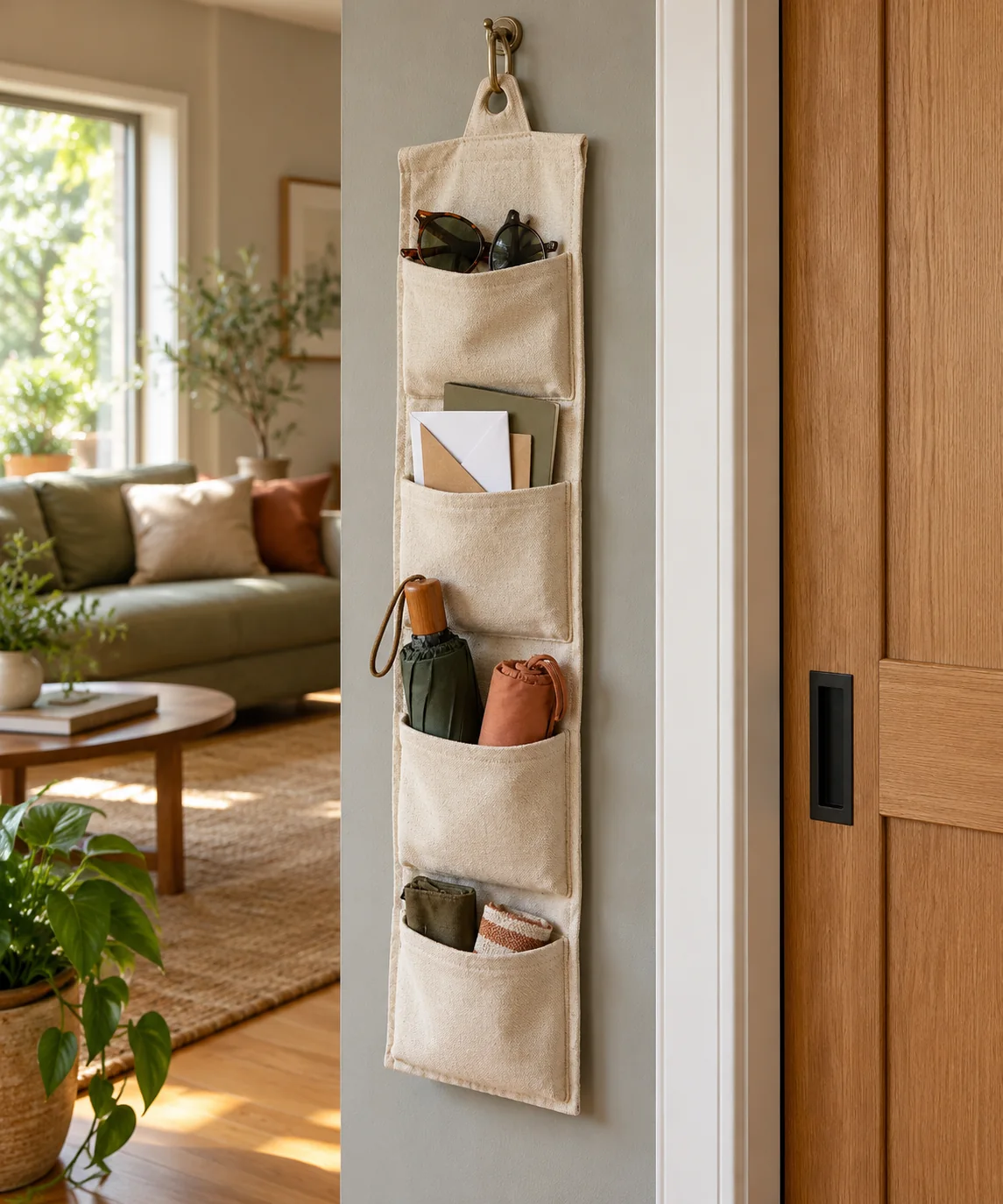
Understanding the Pocket Door Wall Cavity
Pocket door framing relies on narrow split studs to create an interior pocket that accommodates the sliding door slab. This leaves minimal space between the drywall surface and the moving door. Screws, expanding drywall anchors, and nails that extend past the wallboard will scrape the door surface or block its travel entirely. Additionally, electrical wiring or structural framing may run adjacent to the door frame header. Before planning storage on any wall housing a pocket door, slide the door back and forth to confirm the boundary of the pocket cavity and avoid driving mechanical fasteners into that zone.
Selecting Low-Profile Canvas Organizers
Flexible cotton duck or natural canvas organizers provide functional vertical compartments without adding rigid bulk to narrow hallways. Look for organizers with flat, stitched slip pockets rather than bellows-style compartments that protrude outward into the walking corridor. Compact profiles keep mail, key fobs, and folded totes resting close against the wall plane, minimizing the chance that passing coats or bags will snag the fabric. Ensure the top seam features sturdy stitching and a rigid header insert to distribute tension evenly across the hanging surface.
Prioritizing Non-Penetrating Mounting Options
To protect the internal door slab, rely on surface-mounted, non-penetrating solutions rather than drilling into the wall or trim. High-strength removable adhesive strips or picture-hanging strips rated for flat wall surfaces offer a secure, reversible mount when applied according to the manufacturer's surface preparation instructions. Allow the adhesive to cure fully before adding items. If you prefer to avoid the pocket wall altogether, consider placing the organizer on an adjacent conventional partition or hanging it from an over-door bracket on a standard hinged closet door nearby.
Managing Everyday Weight Distribution
Even surface-mounted organizers can pull away from the wall if loaded unevenly or weighed down with bulky items. Maintain a disciplined storage routine by reserving the organizer for lightweight daily items. Dedicate upper pockets to incoming mail, outgoing letters, and transit cards. Use middle and lower compartments for small accessories such as sunglasses cases or light fabric shopping bags. Avoid using the organizer for heavy water bottles, bulky charging bricks, or dense key bundles that place unnecessary tension on adhesive backings or pull the wallboard inward.
Routine Inspection and Surface Care
High-traffic entryway organizers gather household dust and lint over time. Vacuum canvas compartments monthly using a handheld soft brush attachment to remove grit from corner seams without tugging at the mounting points. For spot cleaning, lightly dab the fabric with a damp cloth and mild soap solution, allowing it to dry thoroughly in place. Periodically check the edges of any adhesive mounting strips to confirm they remain firmly seated against the wall, and slide the pocket door open and closed to ensure smooth, unhindered operation.
YOUR STARTING POINT
A little checklist.
Original editorial guidance. Images are AI-generated concepts, not photographs of completed projects. Our sources and approach.
Questions to consider
Why should mechanical wall anchors be avoided on pocket door walls?
Pocket door walls contain hollow cavities where the door slab travels with minimal clearance. Standard drywall anchors and long screws penetrate through the drywall into this cavity, directly scraping the door panel, damaging track hardware, or jamming the door.
How can an entryway organizer be mounted securely without drilling into the pocket frame?
Use heavy-duty removable adhesive strips or hooks rated for the specific weight of your organizer. Clean the wall surface per the adhesive manufacturer's instructions, allow the recommended bonding time, and keep loaded contents light to prevent failure.
What should I do if the canvas organizer billows when the pocket door moves?
Air movement from the sliding door can cause lightweight fabric to shift. Secure the bottom corners of the organizer to the wall using small removable adhesive hook-and-loop pads to keep the fabric stable without driving fasteners into the cavity.