Entryway Organization · THE GUIDE
Free Inward-Swinging Front Door Clearance With Recessed Pegs
In compact entryways where an exterior or interior door swings inward toward an adjacent wall, the space behind the door is frequently underutilized. Standard coat racks or deep decorative hooks project outward, creating collision risks that can dent door panels, damage lever handles, or block the door from opening fully. Assessing the door swing arc and coordinating hook profiles with the existing doorstop allows homeowners to reclaim this narrow perimeter for functional organization. By selecting low-profile or retractable hardware and testing clearances with actual garments, this reversible layout organizes lightweight outerwear, bags, and lanyards without impeding door travel.
Jump to the checklist ↓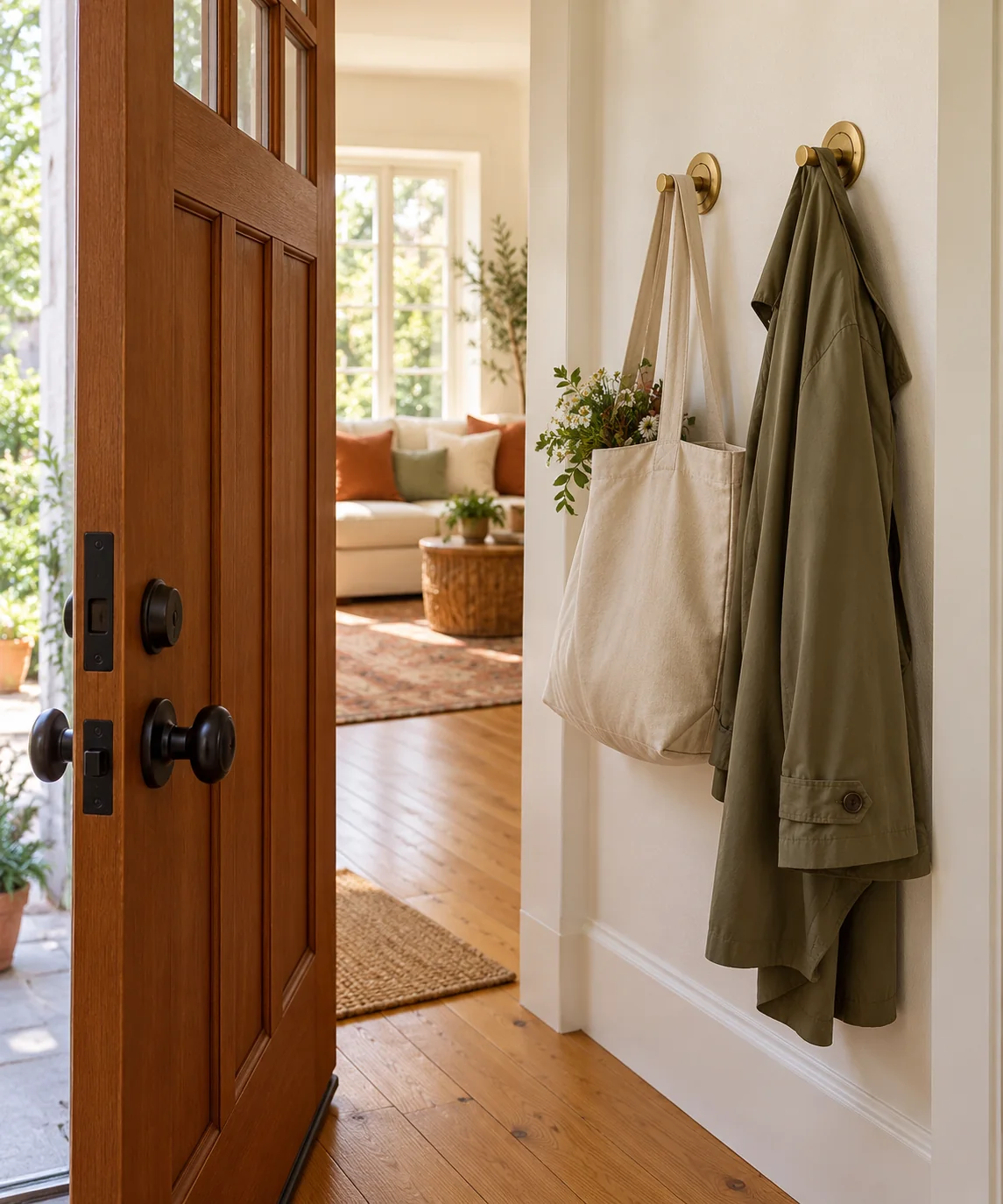
Measuring Door Travel and Doorstop Boundaries
Carefully observing how the door swings is the essential first step when planning behind-the-door storage. Open the door through its complete arc until it makes contact with the floor-mounted or baseboard doorstop, then measure the available space between the door panel and the wall. Take special note of the door handle or deadbolt turn-piece, which projects beyond the face of the door and represents the primary strike risk. Hanging hardware must sit entirely outside the door handle's sweep path to avoid damaging hardware finishes or puncturing hollow-core doors.
Selecting Low-Profile and Folding Hardware
Hardware selection should be dictated directly by the doorstop depth rather than aesthetic preference alone. Choose flat-profile metal hooks, beveled tabs, or folding wooden pegs that remain shallower than the distance established by the doorstop when extended. Retractable pegs that fold flush against their backplate when empty offer an effective solution, maintaining maximum clearance when items are removed. Prioritize smooth, beveled edges over sharp corners to ensure that passing fabrics and door edges do not catch during daily movement.
Verifying Clearances With Test Items
Before finalizing hardware placement, evaluate clearances using the actual items intended for the space. Lightweight, flexible pieces such as unlined cotton totes, thin rain jackets, or knitted scarves compress easily when an opening door gently contacts them. Conversely, rigid backpacks, bulky down parkas, or items containing hard objects will resist compression and cause the door to rebound or strain its hinges. Testing flexible items in position confirms that the door can reach its full open position smoothly.
Staggering Heights to Prevent Bulk Accumulation
Arranging multiple hooks in a single horizontal row often results in overlapping fabrics that project further into the room than individual garments would. Staggering pegs across different vertical heights distributes fabric volume across a broader wall area, keeping the overall storage profile flat. Higher positions work well for longer coats or scarves, while lower pegs accommodate lightweight bags, hats, or pet accessories. Ensure the lowest hooks sit sufficiently high above the baseboard to prevent hanging items from gathering floor dust.
Routine Hardware Checks and Curated Use
Because doors open and close repeatedly throughout the day, the hardware mounted behind them experiences continuous nearby movement and potential accidental contact. Periodically examine mounting screws to ensure wall fittings remain secure and properly aligned. Verify that the floor doorstop has not shifted or loosened, as an insecure stop could allow the door handle to strike hanging items. Keep the area intentionally curated for slim everyday pieces, redirecting heavy seasonal gear to main storage closets.
YOUR STARTING POINT
A little checklist.
Original editorial guidance. Images are AI-generated concepts, not photographs of completed projects. Our sources and approach.
Questions to consider
How much clearance is required behind an inward-swinging door?
The necessary clearance is determined by the existing doorstop depth and the projection of the door handle. All wall hardware and hanging items must sit shallower than the doorstop barrier to prevent impacts.
Can bulky winter parkas be hung behind a swinging door?
Thick winter coats and insulated parkas are generally too voluminous for behind-the-door storage. Their bulk can prevent the door from opening completely and put unwanted pressure on door hinges.
How can door panels be protected from catching on wall hooks?
Verify that the doorstop halts the door before the panel or handle reaches extended pegs. Selecting hardware with rounded, bevelled edges also prevents snags if lightweight fabrics brush the door edge.