Household Reset Routines · THE GUIDE
Hallway Runner Vacuuming and Non-Slip Pad Realignment
Hallway runners absorb continuous linear foot traffic, causing flatweaves to stretch, curl, and migrate out of alignment. Over days of steady walking, non-slip underlayment pads bunch underneath, creating subtle ridges that cause tripping hazards and allow trapped grit to abrade the underlying floor finish. A methodical reset routine restores clean geometric sightlines, centers the textile against surrounding baseboards, and removes settled particles from both sides of the rug. Performing this sequence regularly extends rug life, protects floor surfaces, and maintains crisp order along the primary spine of your living space.
Jump to the checklist ↓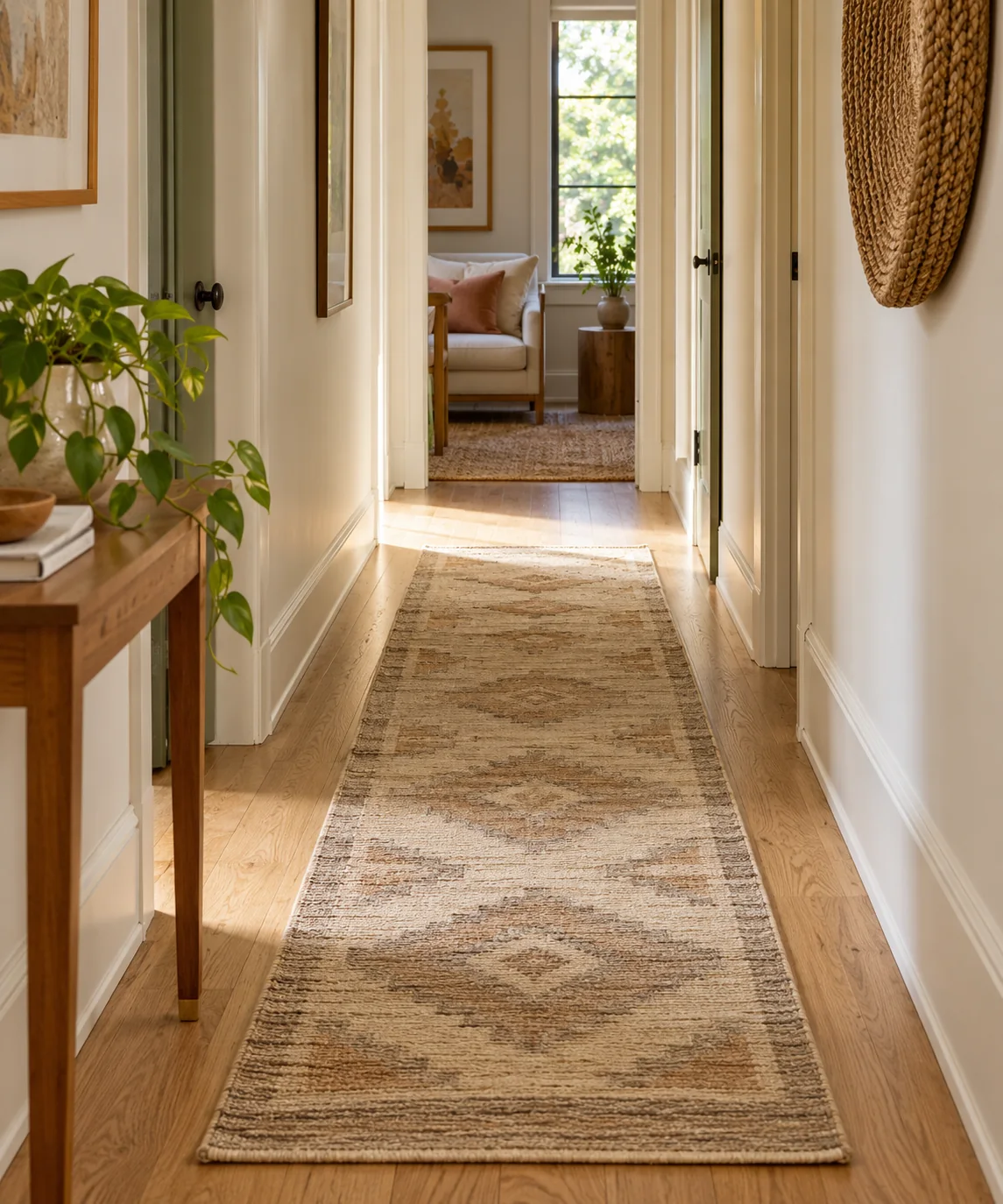
Clearing Foot Traffic and Rolling the Runner
Begin the maintenance routine by removing any obstacles, umbrella stands, or shoes resting along the runner perimeter. Rather than vacuuming in place, roll the runner loosely from one end to the other to expose the underlying pad and floorboards. Rolling, rather than folding or dragging, prevents creasing in wool flatweaves and stops abrasive grit caught beneath the fibers from scratching hard flooring. Set the rolled textile aside temporarily against an adjacent wall out of footpaths.
Surface Cleaning Floorboards and Pad Backing
Sweep or vacuum the exposed floorboards completely, using a soft bare-floor brush attachment to pull sand, fine dirt, and hair away from the baseboard edges. Lift the rubber or felt non-slip pad and wipe the flooring beneath with a dry microfiber cloth to remove microscopic residue. Shake out the pad outdoors or gently vacuum it on low suction. A clean, dust-free contact surface is essential for rubberized pads to achieve maximum friction against smooth wood or tile.
Sizing and Centering the Gripper Pad
Inspect the non-slip pad placement before unrolling the rug. An effective pad should rest roughly one to two inches inside the runner perimeter on all four sides. If the pad extends beyond the runner edges, trim it slightly with utility shears so it remains invisible. Center the pad evenly down the hall corridor, measuring consistent distances from opposite baseboards using a visual floorboard seam or simple ruler to guarantee a straight, parallel axis.
Aligning Runner Edges Against Hallway Baseboards
Position the rolled runner at the starting baseboard, aligning its short edge square to the entry line. Slowly unroll the rug directly over the centered gripper pad, smoothing air pockets outward with your hands as you advance. Keep the runner edges parallel to the floorboard planks or wall molding. Check both long sides to confirm an even reveal of exposed flooring; a symmetrical border creates visual balance and keeps the runner straight under directional walking.
Routine Tension Checks and Walkway Safety
Conclude by vacuuming the top textile surface using a suction-only setting or a raised beater bar to avoid pulling delicate fringe or edge binding. Walk the length of the runner with firm steps to seat the weave into the pad mesh. If either end tends to curl upward from foot friction, press the fibers flat and ensure the pad sits fully beneath the leading edge to eliminate hazardous lip catches.
YOUR STARTING POINT
A little checklist.
Original editorial guidance. Images are AI-generated concepts, not photographs of completed projects. Our sources and approach.
Questions to consider
Why does my hallway runner keep creeping toward one side?
Uneven foot pivot patterns and directional weave bias cause runners to shift. Ensure the floor is clean and dry beneath the pad, and use a dual-sided rubber-and-felt pad to resist lateral movement.
Can I use double-sided carpet tape on hardwood floors?
Carpet tape can leave stubborn adhesive residues or pull off floor sealants when lifted. High-quality non-adhesive natural rubber or felt gripper pads provide stable grip without damaging hardwood finishes.
How often should I realign the hallway runner and pad?
Perform a full realignment every two to four weeks, or immediately whenever you notice ripples, exposed pad edges, or uneven borders relative to your hallway baseboards.