Garden Tool Organization · THE GUIDE
Hang Garden Sieve Screens and Soil Riddles from Wall Pegs
Garden soil riddles and wire compost sieves are practical tools for sifting amendments and potting media, but their broad circular frames can quickly crowd benches and floor space. Laying sieves flat on work surfaces exposes delicate wire cloth to accidental impacts, settled debris, and moisture from nearby potting tasks. Utilizing existing vertical wall pegs or dedicated storage rails keeps frames organized within an accessible profile while freeing valuable counter space. Vertical hanging allows gardeners to inspect aperture sizes at a glance, reduces direct contact between stored items, and keeps sifted screens elevated away from damp floor conditions, provided the supporting wall fixtures and fasteners suit the weight of the collection.
Jump to the checklist ↓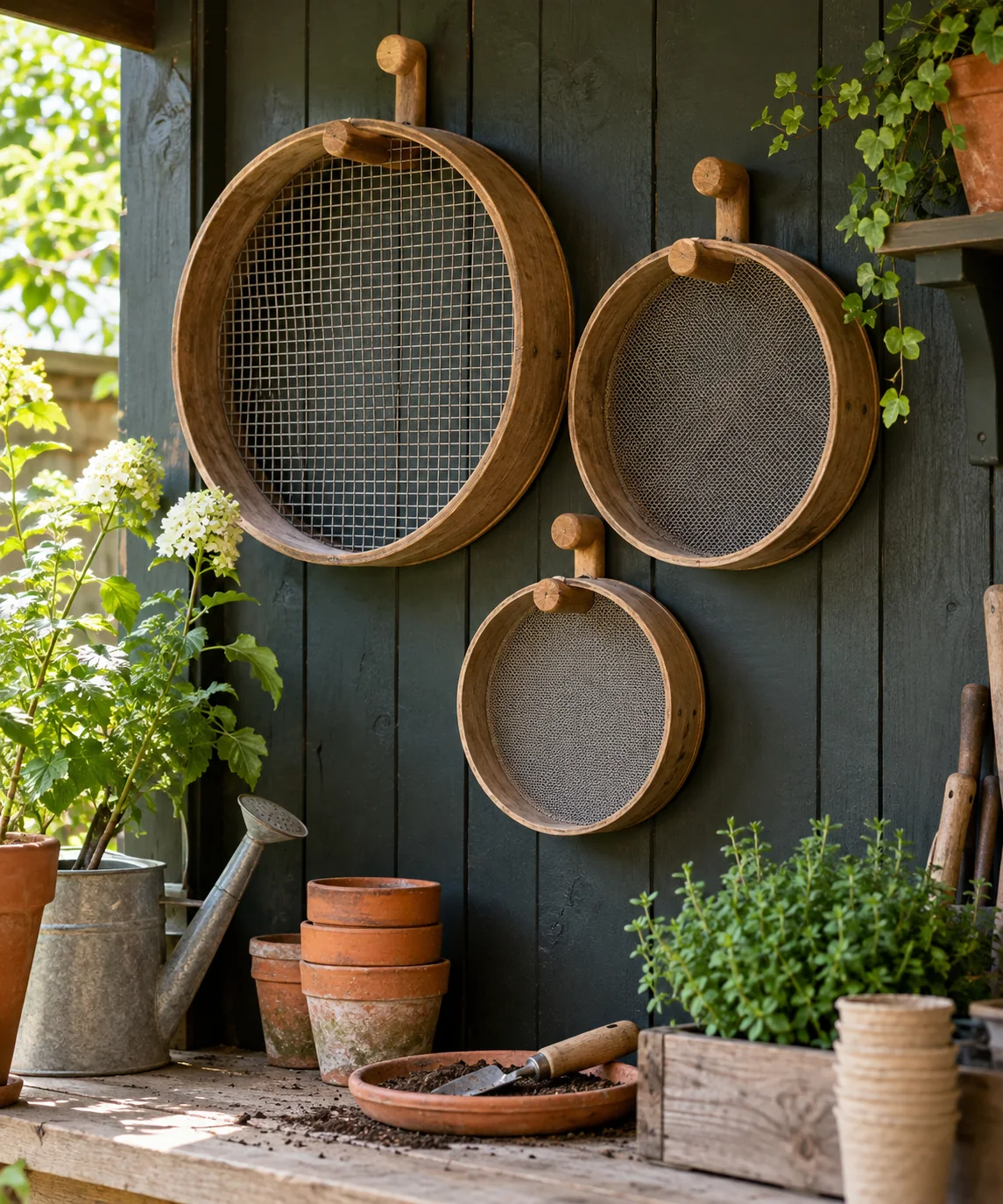
Assessing Frame Profiles and Outer Dimensions
Soil riddles typically feature circular rims formed from spun steel, galvanized sheet metal, or bent hardwood hoops ranging widely in diameter and depth. Before planning hanging locations, measure the outer diameter and rim depth of each sieve in your collection. Deeper wooden rims occupy significant outward space, while shallow metal screens sit flatter against vertical surfaces. Grouping sieves by depth helps you determine whether individual wall supports or multi-tiered hanging rails are most appropriate for your workspace. Reviewing the overall weight of all frames prevents overloading individual wall fixtures or mounting hardware.
Planning Wall Layout and Spacing
When positioning sieves along an existing wall rack or peg board, verify that each hoop clears adjacent tools, shelving uprights, and access paths. Rather than applying arbitrary clearance formulas, hold your largest sieve against the wall surface to observe the natural perimeter it requires. Allow adequate visual and physical margins so neighboring handles or hanging implements do not rub against the woven wire mesh during retrieval. Arranging frames in an accessible sequence—such as descending mesh apertures or uniform frame materials—simplifies selection during soil preparation while keeping handling to a minimum.
Evaluating Wall Supports and Hardware Ratings
Select smooth, blunt-ended wooden pegs, shaker pegs, or vinyl-coated brackets capable of supporting the combined weight of your tools. Sharp, narrow metallic screw hooks can gouge soft wooden hoops or scratch protective coatings on metal rims, creating entry points for moisture. Confirm that any wall-mounted rack or peg assembly is firmly anchored into appropriate wall studs or solid backing according to manufacturer instructions, rather than relying on unanchored drywall fasteners. Fixtures should hold rims securely so that vibration from closing shed doors does not cause frames to shift or fall.
Practical Storage and Nesting Considerations
If space constraints make individual peg locations impractical, some gardeners hang multiple hoops from a single deep peg or utility hook. When grouping frames, place the widest and heaviest frame closest to the wall backing, allowing smaller, lighter sieves to rest forward. Avoid forcing rims together or wedging interchangeable wire inserts between frames, as sustained lateral pressure against wire mesh can distort delicate weaves. If hoops do not nest freely without pressing against the center wire cloth, store them on separate supports to protect the integrity of the sifting surfaces.
Cleaning and Moisture Management Before Storage
Before returning riddles to wall pegs, brush away loose compost, soil clumps, and plant debris that might trap moisture against frames or wall cladding. Residual damp matter accelerates surface corrosion on ungalvanized metal mesh and promotes mildew along natural wood rims. A handheld, stiff-bristled utility brush kept nearby makes it easy to remove dry particles after each potting session. Store sieves in a sheltered, well-ventilated outbuilding away from roof leaks, irrigation spray, and unvented propagation benches to help preserve both the wood hoops and metal fasteners.
YOUR STARTING POINT
A little checklist.
Original editorial guidance. Images are AI-generated concepts, not photographs of completed projects. Our sources and approach.
Questions to consider
How should interchangeable wire sieve discs be stored?
Flat interchangeable sieve inserts lack rigid supporting hoops and can warp if hung by their fine mesh. Store flat screens together inside a primary fitted rim, vertically in a partitioned wooden slotted caddy, or lying flat on a dry shelf where they are protected from heavy tools.
Does hanging sieves vertically affect screen tension over time?
When a riddle hangs from a peg, the load rests across its rigid outer wooden or metal rim rather than the interior mesh. However, storing sieves in damp, unheated sheds can cause wood expansion or frame corrosion, which alters rim tension. Keeping storage areas dry is more critical to preserving tension than the hanging orientation itself.
How can I prevent wooden hoop sieves from deteriorating in a shed?
Position hanging pegs away from areas with high humidity, such as indoor sinks, water barrels, or closed propagation enclosures. Allow damp wood hoops to dry thoroughly in shaded, circulating air before returning them to the wall, and inspect frame joints periodically for loosening or fungal growth.