Small Bedroom Layouts · THE GUIDE
Hanging Full-Length Mirrors to Amplify Narrow Bedroom Passages
Narrow circulation paths around a bed or entry passage can make a compact bedroom feel visually confined and dim. Bulky decorative frames or floor-standing mirror easels often project into primary walkways, reducing usable clearance and creating potential pinch points. Positioning a slender, low-profile full-length mirror along a circulation wall can help reflect available daylight and extend visual sightlines across the room. Achieving a practical, unobtrusive result depends on evaluating sightlines, choosing hardware rated for your specific wall substrate, following manufacturer mounting instructions, and selecting dimensions that suit your household's clearance needs without protruding into routine movement paths.
Jump to the checklist ↓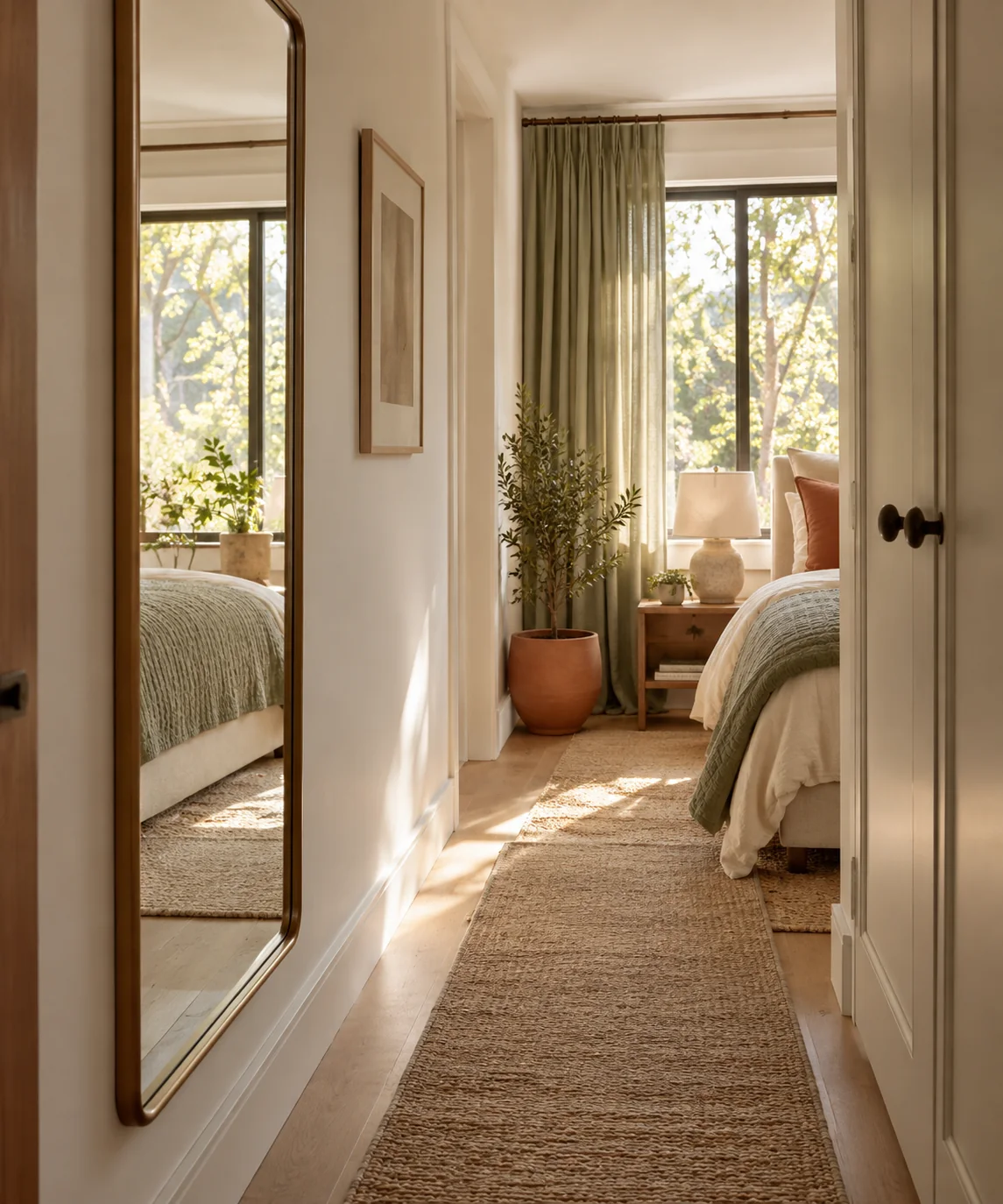
Selecting and Evaluating Circulation Walls
Examine the primary pathways in your bedroom, such as the passage between the mattress edge and an opposing partition or a narrow entrance corridor. Observe what falls within direct view from that position before deciding on placement. Positioning a mirror where it catches light from a nearby window, an open doorway, or a light-colored wall helps disperse ambient illumination and creates a greater sense of visual openness. Conversely, facing the mirror toward open wardrobes, utility storage, or crowded shelving tends to duplicate visual clutter rather than foster a calm atmosphere. Assess how movement through the corridor feels at different times of day to ensure the chosen location does not catch harsh direct glare while resting.
Choosing Low-Profile Profiles and Edge Treatments
In compact passages where shoulder and hip clearance is limited, keeping wall projection to a minimum helps preserve comfortable passage width. Frameless mirrors with ground or beveled edges, as well as models with ultra-slim metal borders, sit closer to the wall surface than ornate or deeply carved wooden frames. Thick decorative molding adds unnecessary depth that can catch loose clothing or bedding during daily routines. Review manufacturer specifications for overall profile depth and edge finishing, confirming that smooth, polished edges are selected to minimize snagging risks in high-traffic residential corridors.
Determining Proportional Hanging Heights
Mirror placement should accommodate the viewing height of room occupants while maintaining comfortable visual balance along the wall. Rather than relying on a rigid numerical formula, test placement by considering the distance available to step back within the narrow passage. Holding a lightweight template, such as craft paper cut to the mirror's dimensions, against the wall allows you to preview sightlines. The goal is to view your reflection from head to toe within your normal standing distance while keeping the bottom edge high enough to avoid incidental kicks, vacuum bumper impacts, or interference with existing baseboards.
Hardware Selection and Structural Substrate Checks
Full-length glass mirrors carry considerable weight and require mounting hardware specifically rated for both the mirror's load and the specific wall substrate. Never rely solely on generic plastic wall anchors or adhesive strips in high-traffic corridors. Locate wall studs whenever possible, or select hollow-wall anchors, mounting brackets, or cleat systems specified by the mirror manufacturer and rated for the mirror's total weight. Ensure brackets are installed level according to the hardware manufacturer's guidelines, and verify that the glass rests securely without wobbling or shifting when nearby doors close or vibrations occur.
Corridor Upkeep and Surface Maintenance
Mirrors positioned along active bedroom pathways tend to gather airborne dust, fabric fibers from bedding, and stray fingerprints more rapidly than mirrors in low-traffic locations. Clean glass surfaces regularly with a clean, lint-free microfiber cloth lightly misted with water or a standard glass cleaner, applying liquid to the cloth rather than spraying the glass directly to prevent moisture from seeping behind the backing. Keep the immediate floor path along the base of the mirror unobstructed by hampers, shoes, or storage bins to preserve clear walking clearance throughout the room.
YOUR STARTING POINT
A little checklist.
Original editorial guidance. Images are AI-generated concepts, not photographs of completed projects. Our sources and approach.
Questions to consider
How far do low-profile wall mirrors typically project from the wall?
Frameless mirrors mounted with low-profile brackets or clips generally project between 10 and 20 millimeters, depending on the glass thickness and mounting hardware design. Always verify the manufacturer's specified bracket depth to ensure it suits your available corridor clearance.
What mirror dimensions work best for narrow bedroom passages?
Mirrors approximately 35 to 50 centimeters wide and 120 to 150 centimeters tall typically provide full-body viewing without dominating narrow wall spans. The ideal size depends on the viewing distance available in your passage and occupant height.
Why is wall-mounting preferred over leaning a mirror in tight corridors?
Leaning mirrors require floor space for their base and angle upward into the walking zone, reducing usable clearance and presenting potential tipping hazards if bumped. Wall-mounting with substrate-appropriate hardware secures the mirror flat and preserves the entire floor corridor.