Patio Seating Ideas · THE GUIDE
Hinged Wall-Fold Settle Bench for Tight Walkways
Narrow side passages and small patio corridors often present a spatial planning challenge: they provide quiet areas for taking a break, yet must remain functional corridors for garden maintenance and household transit. A wall-mounted folding bench offers adaptable seating that rests flat against a structure when foot traffic takes priority. Planning for folding furniture along a path requires careful assessment of movement patterns, clear pathway space, and secure latching. By evaluating how the space is used daily and engaging qualified professionals for wall evaluation, homeowners can introduce flexible resting spots without compromising access.
Jump to the checklist ↓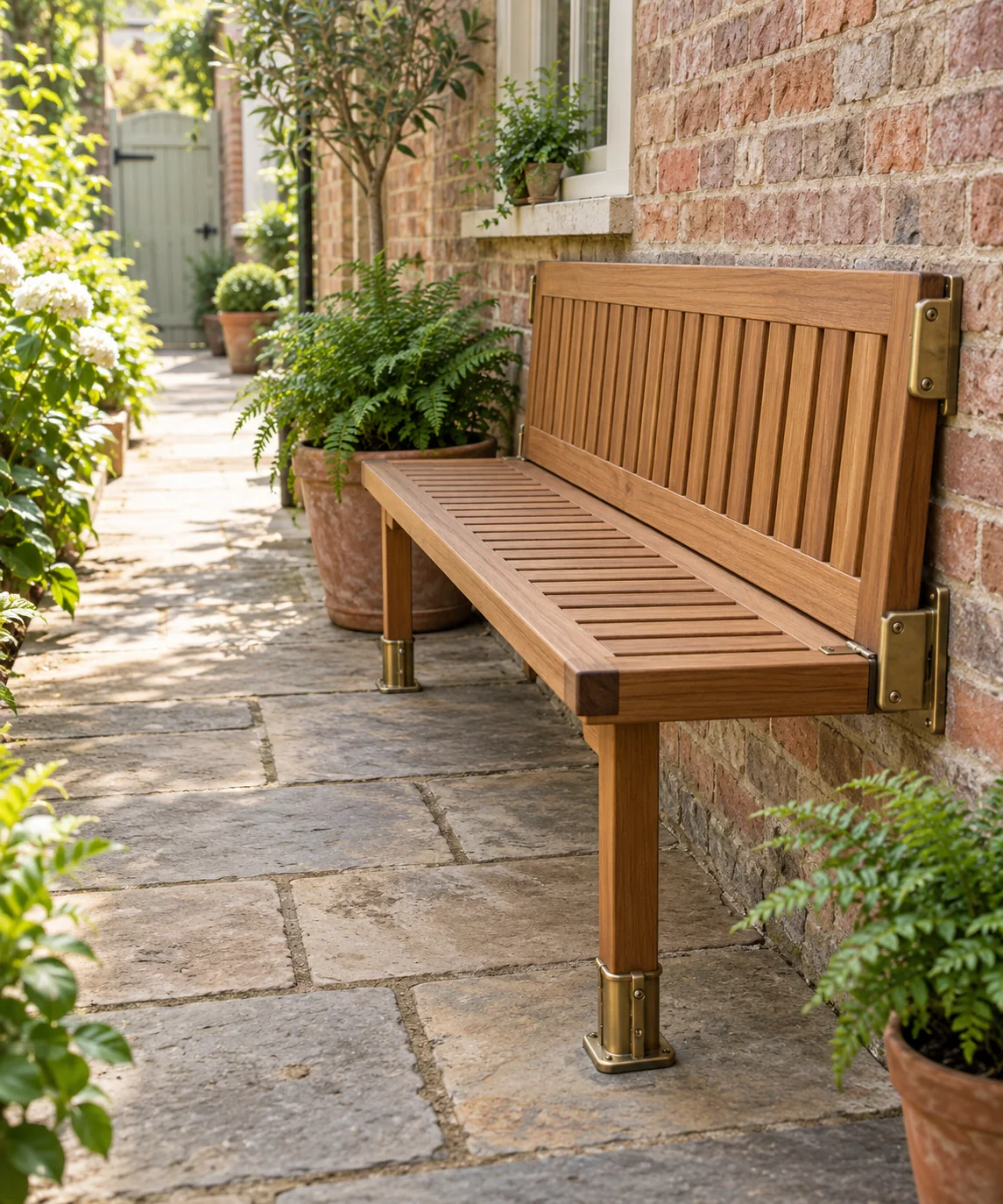
Assessing Corridor Clearance and Egress Requirements
Before considering a wall-mounted fold-down bench, evaluate the corridor's daily functional demands and primary egress functions. Walkways must maintain sufficient unobstructed width to comply with local building and safety codes, particularly along primary residential escape paths. Measure the corridor with the bench folded flat against the wall, taking into account any projecting handles, hinges, or brackets. The remaining path must comfortably accommodate everyday movement, garden equipment, and waste bins without forcing users to turn sideways or brush against rough exterior surfaces.
Bench Proportions and Spatial Planning
Choosing appropriate dimensions for a folding bench balances comfortable seating with minimal pathway projection. Bench lengths are typically planned around the anticipated number of seated occupants, while seat depth must provide adequate support without extending too far into the corridor when lowered. Plan for adequate knee and foot room in front of the lowered seat so that seated individuals do not step into adjacent planting borders or landscape edging. Reviewing manufacturer dimensional drawings helps ensure the lowered seat leaves functional passage space for companions.
Cardboard Mockups and Movement Trials
A full-scale cardboard template is an effective planning tool for testing clearance before committing to hardware installation. Cut cardboard to match the proposed seat dimensions and temporarily position it against the chosen wall surface. Lower the mockup to test clearance when rolling wheelbarrows, garden carts, or trash bins past the seat. This mock trial reveals potential conflicts with existing utility fixtures, such as exterior hose spigots, electrical outlets, light fixtures, or low-hanging downspouts, allowing adjustments before final placement.
Material Selection and Hardware Considerations
Exterior folding furniture requires durable, weather-resistant materials that withstand exposure to rain, sun, and seasonal temperature swings. Naturally dense hardwoods or powder-coated metals perform reliably outdoors when paired with corrosion-resistant fasteners like stainless steel. Moving components, such as pivot joints, barrel bolts, and support hinges, require periodic inspection to ensure hardware remains tight and free of grit. Regularly clearing leaves, soil, and organic debris from the pivot mechanism prevents binding and preserves smooth operation over time.
Structural Substrate and Safety Verification
Mounting a folding bench to an exterior wall exerts substantial dynamic force on the wall framing or masonry. Exterior cladding, siding, and veneer materials are not designed to support cantilevered or dynamic seating loads independently. Fastening must penetrate directly into verified structural studs or solid masonry, which requires evaluation by a qualified contractor or structural professional. Additionally, ensure the bench includes a positive mechanical latch or safety bolt that secures the seat upright against the wall when folded, preventing accidental release from wind or accidental bumps.
YOUR STARTING POINT
A little checklist.
Original editorial guidance. Images are AI-generated concepts, not photographs of completed projects. Our sources and approach.
Questions to consider
Can a folding bench be mounted directly into exterior siding?
No. Siding and thin exterior facings cannot bear dynamic seating loads. Fasteners must secure into structural wall framing or solid masonry, requiring evaluation by a qualified contractor.
How can I test whether a side path is wide enough for a folding bench?
Tape a cardboard mockup of the bench in both folded and down positions against the wall, then test navigating your widest equipment, such as wheelbarrows or rolling bins, through the space.
What prevents a wall-mounted folding bench from falling open in high winds?
A positive mechanical latch, such as a manual sliding barrel bolt or heavy-duty gravity catch, firmly retains the seat upright and prevents accidental deployment from wind or physical contact.