Dining Nooks · THE GUIDE
Introduce an Oval Tulip Table to Eliminate Sharp Corner Bumps
Navigating tight dining nooks in busy family kitchens often leads to painful hip and thigh collisions against sharp rectangular furniture edges. An oval tulip table resolves this issue by combining gently rounded contours with an uncluttered central pedestal base. Without intrusive corner legs or abrupt right angles, family members can circulate around tight banquette perimeters smoothly. The elongated oval shape preserves ample tabletop surface area for family meals and tasks while softening the architectural transit zones. Choosing an oval pedestal format improves circulation routes, expands accessible seating positions, and eases overall movement through compact kitchen dining alcoves.
Jump to the checklist ↓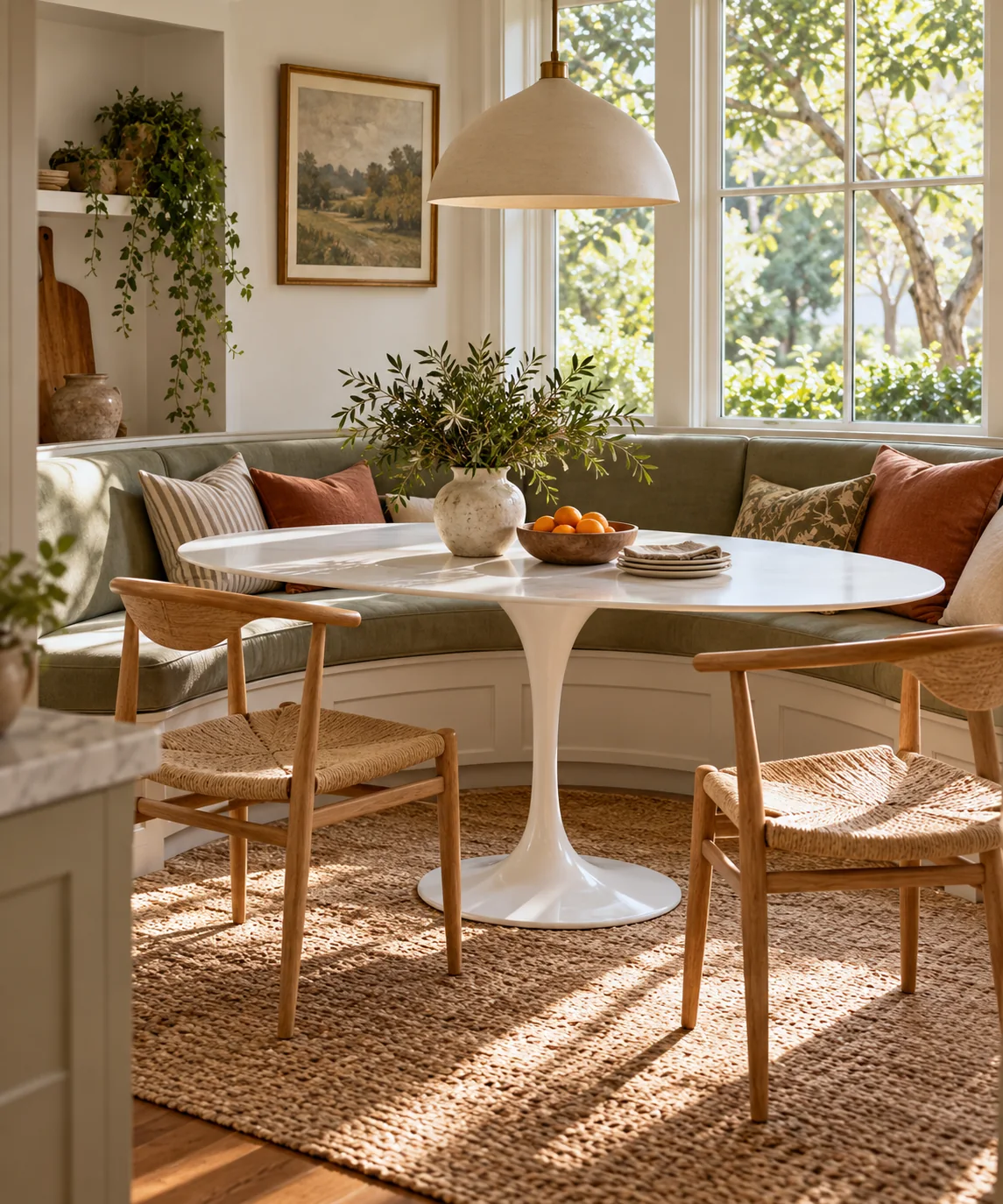
Continuous Curvature and Collision Prevention
Sharp corners on rectangular dining tables become daily physical hazards in narrow eat-in kitchens, particularly along frequent pathways between counters and banquettes. An oval tulip table replaces rigid 90-degree points with a continuous curved perimeter that redirects brushing contact safely. When individuals maneuver past the table during meal preparation, their bodies glide along the rounded edge rather than striking an unyielding corner. This curvature proves especially advantageous in tight corners where doors, drawers, or nearby pantry cabinets open close to the seating area.
Pedestal Bases and Banquette Ingress
Traditional four-legged dining tables severely restrict entry into banquette seating, forcing diners to twist sideways and awkwardly step over protruding outer legs. The tulip base eliminates these perimeter obstacles by supporting the tabletop from a single cast-aluminum or weighted steel central stem. Banquette occupants can slide directly onto the bench cushions from either side without catching knees, shins, or clothing. Furthermore, this centered footprint allows chairs pulled up to the outer curve to tuck inward completely when not in use.
Surface Area Efficiency Versus Round Tops
While circular tables also soften sharp corners, they often fail to fit long, narrow breakfast alcoves or galley kitchen borders. An oval tabletop balances rounded safety with the linear proportionality of a rectangular surface. It delivers generous serving space for shared platters, dinner plates, and homework supplies along its flat center length, tapering softly at both ends. This geometry allows four to six people to dine comfortably without sprawling into the primary walkways of the adjacent kitchen prep zone.
Clearance Planning and Mockup Testing
Before purchasing an oval tulip table, map out the floor clearances using brown butcher paper cut to the table’s exact dimensions. Position the paper template on the floor between your banquette and kitchen cabinets. Ensure you maintain at least 30 to 36 inches of clear walking space between the curved table perimeter and adjacent walls or counters. Walk through the space carrying serving bowls or lunch boxes to verify that the curved ends allow fluid movement during busy morning routines.
Material Durability and Base Stability
Tulip table tops come in varied materials such as laminate, sealed fiberglass, solid wood, or composite stone. In high-traffic family settings, high-pressure laminates or sealed finishes resist spills, acid marks, and crayon lines far better than porous natural marbles. Be mindful of tabletop leverage: pressing heavily on the extreme end of an elongated oval can cause tipping if the base lacks sufficient ballast. Choose models with a heavy, wide circular cast base engineered specifically to counterbalance the tabletop’s reach.
YOUR STARTING POINT
A little checklist.
Original editorial guidance. Images are AI-generated concepts, not photographs of completed projects. Our sources and approach.
Questions to consider
Why choose an oval tulip table over a round one?
Oval tables accommodate narrow rectangular floorplans better than round tables. They provide linear eating surface for multiple diners while eliminating corner points that impede traffic flow in tight breakfast nooks.
Can an oval pedestal table tip over easily?
High-quality oval pedestal tables feature heavy cast-iron or weighted steel bases designed to counterbalance normal dining weight. Always inspect the manufacturer’s base-to-top proportion to ensure stability under household use.
How much walkway space is needed around an oval table?
Aim for 36 inches of walkway clearance between the table edge and adjacent kitchen counters or walls. In tight nooks, a minimum of 30 inches maintains functional pass-through space without snagging clothing.