Bookshelf Styling · THE GUIDE
Make an Asymmetrical Cubby Bookshelf Look Balanced and Restful
Staggered cubby shelving units offer dynamic architectural lines, but their irregular compartments can quickly look chaotic if filled haphazardly. Achieving visual balance requires an intentional distribution of density, orientation, and open space. By intentionally varying between upright book groupings, horizontal stacks, and completely clear breathing zones, you establish an organic rhythm across the bookcase. The goal is not rigid symmetry, but rather an evenly distributed optical weight that lets the eye travel smoothly across the piece. Planning your cubby contents using modular placement strategies turns an asymmetrical frame into a restful, structured focal point.
Jump to the checklist ↓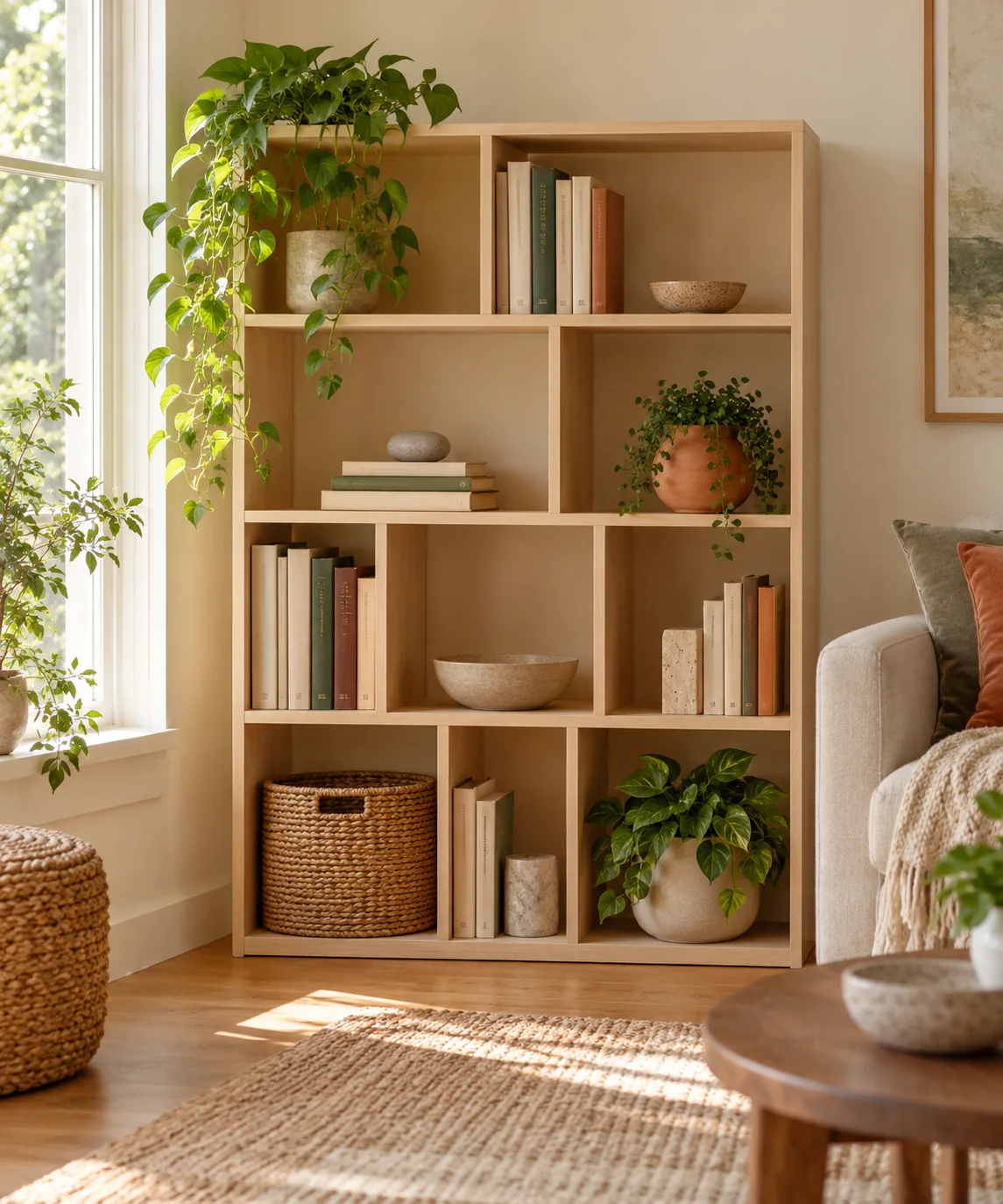
Mapping Optical Weight Across Uneven Compartments
Step back and view the empty bookcase as a single composition divided into quadrants. Heavy, densely packed book rows naturally belong in larger lower cubbies to establish visual stability. Distribute darker bindings and bulkier hardcovers across opposite sides of the unit—such as bottom left and middle right—to balance visual mass without creating mirror symmetry. Leaving smaller or upper cubbies for lighter groupings prevents the top of the shelf from feeling top-heavy, anchoring the overall frame securely within your room layout.
Alternating Vertical Rows and Horizontal Stacks
Avoid filling every cubby with identical vertical book rows. Instead, alternate orientations across neighboring cubes to create visual relief. Fill one cubby two-thirds full with upright books, then arrange three to four flat volumes in the adjacent compartment. Horizontal stacks should feature the largest, widest book at the bottom, tapering upward naturally. This structural variation creates horizontal ledges that rest the eyes, breaking up the harsh vertical repetition that often overpowers asymmetrical cube designs.
Preserving Strategic Breathing Space
The secret to restful cubby styling is leaving select compartments partially or entirely empty. Aim to dedicate roughly one-third of your total cubby volume to negative space. In partially filled cubes, allow books to stop short of the sidewall, leaving a three- to four-inch pocket of open air. In completely open cubbies, place only a single low-profile item, like a smooth stone paperweight, or nothing at all. This void allows natural light to filter through, softening the shelf structure.
Maintaining Consistent Spine Alignment and Margins
Physical alignment creates an underlying sense of order within an irregular shelving footprint. Pull book spines forward so they sit flush with the front shelf lip or align them exactly one inch behind the edge throughout every cubby. Recessed books pushed deep against back panels create uneven shadows that make cubbies appear cluttered. Standardizing spine margins establishes a crisp, continuous plane across varying compartment depths, bringing unity to what would otherwise look like disconnected pockets of storage.
Editing and Refining from a Distance
Finalizing an asymmetrical bookcase requires evaluating the entire unit from six to eight feet away. Check whether your eye snags on a dark cluster of spines or feels drawn downward by excessive density on one side. If one area appears overcrowded, move two volumes to an adjacent horizontal stack or shift a dense book bundle toward the bottom tier. Regular editing ensures that everyday book additions do not overwhelm the open pockets, keeping your asymmetrical arrangement calm, intentional, and balanced.
YOUR STARTING POINT
A little checklist.
Original editorial guidance. Images are AI-generated concepts, not photographs of completed projects. Our sources and approach.
Questions to consider
How many books should I put in a horizontal stack?
Limit horizontal stacks to three or four books of similar dimension. Taller stacks look unstable, compress lower paper bindings, and make it awkward to retrieve the bottom volume without disturbing the rest of the cubby display.
Can I use cubby inserts like fabric drawers in an asymmetrical shelf?
Yes, but use them sparingly. Place one or two matching bins in the lowest, widest openings to conceal clutter. Avoid scattering multiple different bins throughout, which visually fractures the staggered structure and overwhelms negative space.
What should I place on top of horizontal book stacks?
Keep topper accents minimal and functional, such as a plain ceramic dish or a smooth stone paperweight. Avoid tall, top-heavy decor items that draw attention away from the books and risk toppling during book retrieval.