Compact Home Offices · THE GUIDE
Mount a Floating Birch Plywood Desk Over a Low Baseboard Radiator
Placing a workstation above a low hydronic baseboard radiator recovers perimeter floor area often dismissed as unusable. The design requires balancing human comfort with the natural upward draft of convective heat. Birch plywood serves as an ideal material for this application due to its cross-laminated structure, which resists drying and warping far better than solid timber boards. By incorporating an open convective vent along the rear edge and maintaining generous vertical clearance above the heating element, you preserve ambient room warming while creating a stable, heat-safe surface for daily computer tasks.
Jump to the checklist ↓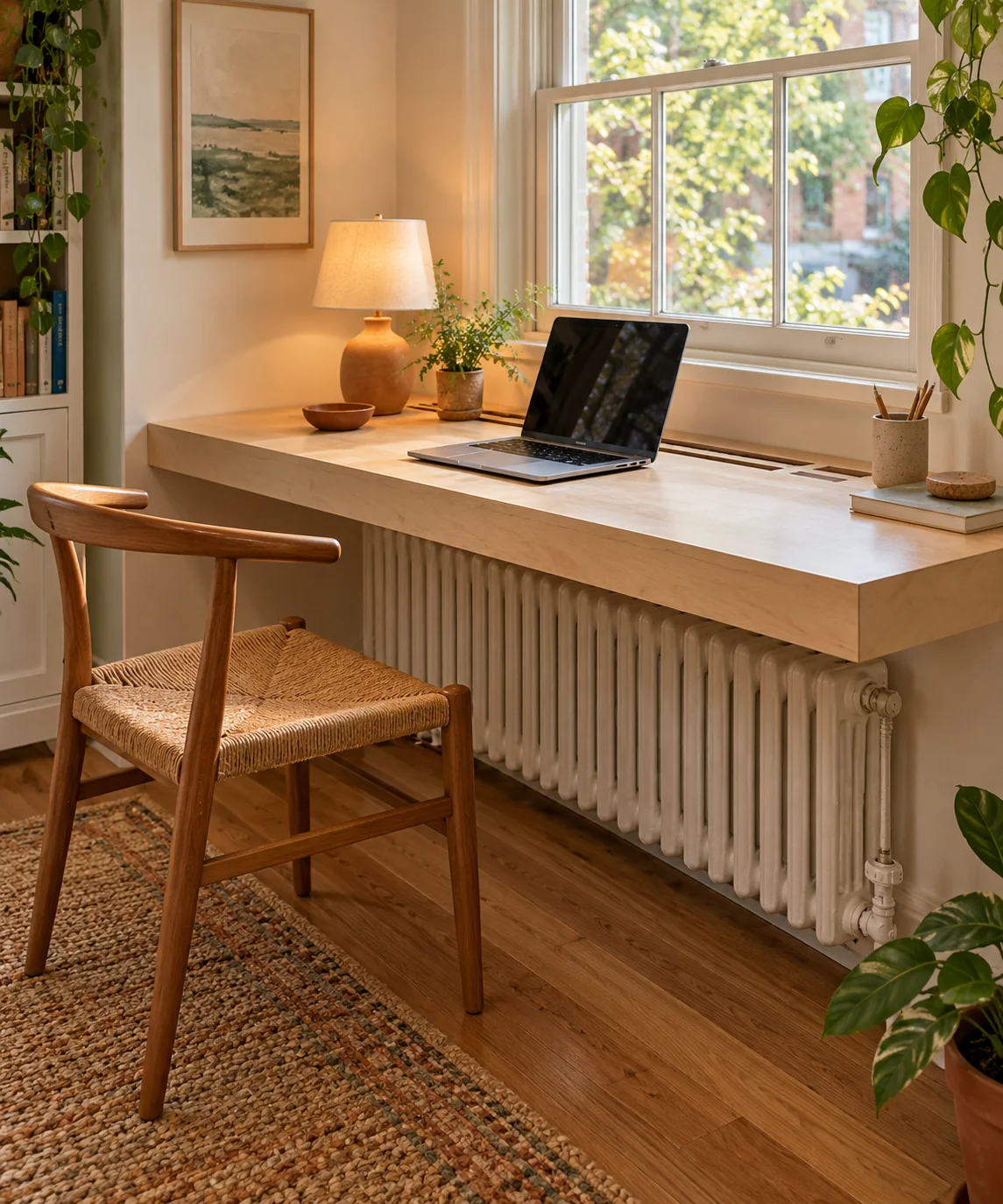
Convective Heat Dynamics and Manufacturer Clearances
Hydronic baseboard radiators function by drawing cool room air across heated fins and releasing warmed air out of top louvers. Placing any horizontal surface above an active heating unit alters this convective plume. Before planning a surface over a radiator, check the specific heater manufacturer’s required clearances and local residential mechanical guidelines. Spacing requirements vary widely by unit output, and an unverified surface can trap heat, impairing room comfort and elevating temperatures on the underside of the panel.
Material Behavior of Multi-Ply Birch Under Heat
Solid timber boards tend to cup, twist, or check when exposed to uneven, localized heat from underneath. Cross-laminated hardwood plywood, such as multi-ply birch, offers improved dimensional stability because alternating grain directions restrain movement across temperature and humidity cycles. Nonetheless, sustained heat exposure can degrade standard wood adhesives and finishes over time. Selecting high-grade panels with exterior-rated or heat-resistant bonding adhesives helps mitigate the risk of internal layer delamination.
Ventilation Channel Planning and Equipment Placement
To facilitate natural upward air movement, any stationary panel positioned over a convective heat source requires deliberate venting. Incorporating an open perimeter gap or routed vent channels along the back edge allows the warm plume to rise freely into the living space rather than pooling beneath the work surface. Keep all computer hardware, peripheral batteries, and documents forward of these ventilation openings to protect delicate electronics from direct convective heat exposure.
Ergonomics and Clearances Near Heating Enclosures
Baseboard radiator casings project several inches into the room, directly encroaching on lower leg and foot space. When setting up a work area above a radiator, verify that your seated posture does not force your knees or shins into contact with the radiator housing. The usable desktop must provide sufficient forward depth so your chair can tuck in comfortably while maintaining safe separation from warm metal elements.
Protective Finishes, Inspection, and Maintenance
Localized dry heat rapidly draws moisture from finished wood surfaces, which can lead to uneven shrinkage and fine surface cracks. Sealing all panel surfaces equally—including the core edges, underside, and interior ventilation cuts—with a heat-tolerant finish helps regulate moisture absorption and release. Keep the upper convective vents completely free of paper stacks, cables, and accumulated dust to maintain clear air movement throughout the heating season.
YOUR STARTING POINT
A little checklist.
Original editorial guidance. Images are AI-generated concepts, not photographs of completed projects. Our sources and approach.
Questions to consider
Can a desktop be installed over an electric baseboard heater?
Electric baseboard heaters generate higher, more concentrated surface temperatures than hydronic systems. Placing combustible materials over electric baseboards is restricted by strict manufacturer clearances and local fire codes; consult a qualified professional before planning any surface near electric heat.
How can I prevent electronics from overheating near a baseboard heater?
Keep laptops, external drives, and chargers positioned on the forward solid area of the desktop, completely away from rear convective airflow slots, and ensure the room maintains adequate general air circulation.
What thickness of birch plywood is appropriate for a compact desk span?
A panel thickness of three-quarters of an inch to one inch is typical for modest spans. Longer spans require intermediate framing, brackets, or stiffeners to prevent mechanical sagging under working loads.