Dining Nooks · THE GUIDE
Mount a Floating Drop-Leaf Shelf as a Space-Saving Prep and Eat Counter
In compact studio apartments, floor area must be allocated thoughtfully to prevent congestion between cooking, working, and dining activities. A wall-mounted drop-leaf surface provides an adaptable setup that serves as a supplemental preparation counter or compact dining ledge when elevated, and folds down flat when open space is needed. Because wall construction, lease rules, and framing conditions vary widely across multifamily buildings, planning such an installation requires evaluating structural support, hardware specifications, and clear walking paths rather than assuming standard anchor performance.
Jump to the checklist ↓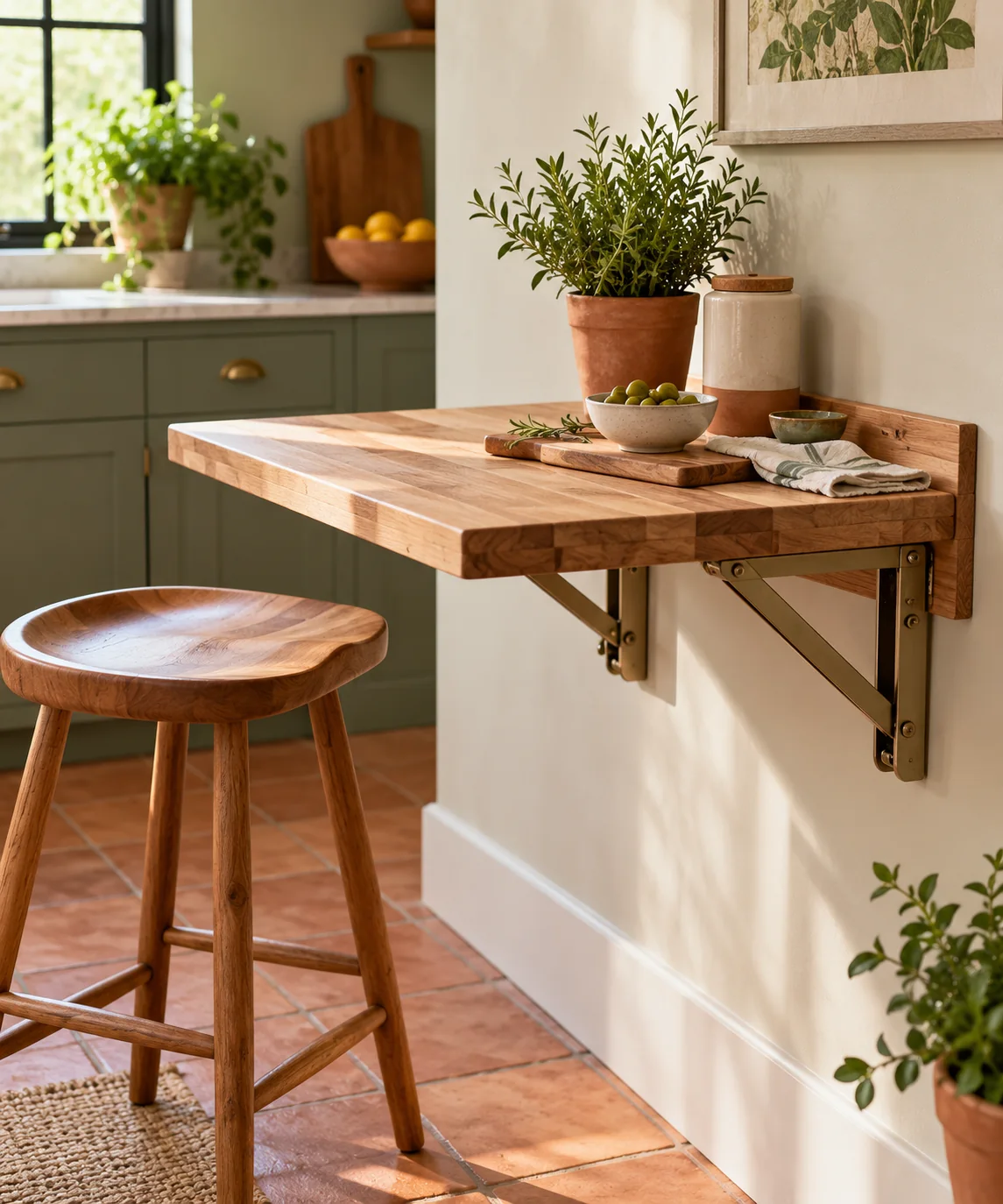
Evaluating Ergonomic Height and Use Cases
Determining the height of a drop-leaf surface involves balancing standing food prep comfort with seated dining practicalities. A standard counter height around thirty-six inches often serves as a functional middle ground, functioning as an auxiliary standing workspace for chopping or assembling meals while pairing with standard twenty-four-inch counter stools. However, if primary usage favors low dining or laptop tasks, standard table height near thirty inches paired with conventional dining chairs may prove more comfortable. Reviewing daily routines before selecting hardware ensures the elevated plane meets personal physical needs.
Planning Circulation and Usable Clearances
Before settling on leaf dimensions, map the surrounding circulation zones using removable painter's tape on the floor. Verify that comfortable walking clearance remains behind the extended surface when fully raised so meal preparation does not completely block transit through the kitchen. When folded downward, the leaf should rest close to the wall plane to minimize physical obstruction in active pathways. Always check landlord regulations or local tenant lease terms regarding wall additions in shared corridors or compact studio footprints before proceeding.
Selecting Food-Safe Surface Materials
A dual-purpose prep and dining surface benefits from durable, food-safe materials that can withstand meal preparation and light surface wipe-downs. Solid wood or edge-grain butcher block offers structural integrity across bracket spans, but requires appropriate finishing to prevent moisture absorption. Applying food-grade mineral oil or dedicated butcher block conditioner protects the timber while allowing straightforward surface cleaning. For non-food-contact applications, sealed timber or durable laminates provide stain resistance against daily spills, though hot cookware and direct knife cutting should always be isolated using trivets and cutting boards.
Reviewing Hardware Ratings and Wall Integrity
Drop-leaf surfaces rely on specialized folding brackets that lock securely into position when extended. Rather than estimating load capacities, consult the bracket manufacturer's published specifications for working weight limits and appropriate fastening requirements. Wall construction varies significantly between modern metal-stud partitions, traditional timber framing, and solid masonry. Because downward leverage increases substantially toward the front edge of a deep counter, review installation plans with a qualified carpenter or building maintenance supervisor to confirm the underlying wall assembly can safely accommodate intended operational stresses.
Coordinating Seating and Storage Solutions
To maintain clear floor area when the drop-leaf is folded against the wall, plan where seating will reside during non-dining hours. Backless or low-profile counter stools can often slide beneath an adjacent console, tuck into an entryway alcove, or stack neatly inside a storage closet. Selecting lightweight seating with scratch-resistant floor glides ensures smooth repositioning across apartment flooring. Planning where stools live when the counter is lowered preserves the open circulation benefits that make folding furniture advantageous in small layouts.
YOUR STARTING POINT
A little checklist.
Original editorial guidance. Images are AI-generated concepts, not photographs of completed projects. Our sources and approach.
Questions to consider
Can food be prepared directly on a drop-leaf wooden surface?
Using a separate cutting board is always recommended. Direct knife contact cuts into protective oil finishes, scores the wood grain, and transfers repetitive downward impact forces onto the folding hinges and wall brackets.
What dimensions are typical for a compact dining leaf?
Depths between fourteen and eighteen inches generally accommodate standard dinner plates and glassware while minimizing front-edge leverage against the supporting brackets and maintaining reasonable room clearance.
How should bracket performance and stability be maintained over time?
Regularly inspect the hinge mechanisms, locking release levers, and wall connection points for signs of mechanical play or looseness. Follow manufacturer guidelines for tightening hardware and adhere strictly to rated operational weight limits.