Compact Home Offices · THE GUIDE
Mount a Fold-Down Secretary Desk in a Narrow Hallway
Corridors often serve solely as transit paths, yet a quiet section of hallway wall can double as an effective touch-down workspace. A wall-mounted drop-leaf secretary desk that folds flat to under six inches deep reclaims this vertical boundary without obstructing essential household passage. When closed, the cabinet sits flush like an understated architectural feature; when opened, the fold-down door provides an instant horizontal writing surface for sorting mail, handling finances, or answering quick correspondence. Careful evaluation of hallway widths, working height, and compact seating ensures this setup remains safe, functional, and visually unobtrusive.
Jump to the checklist ↓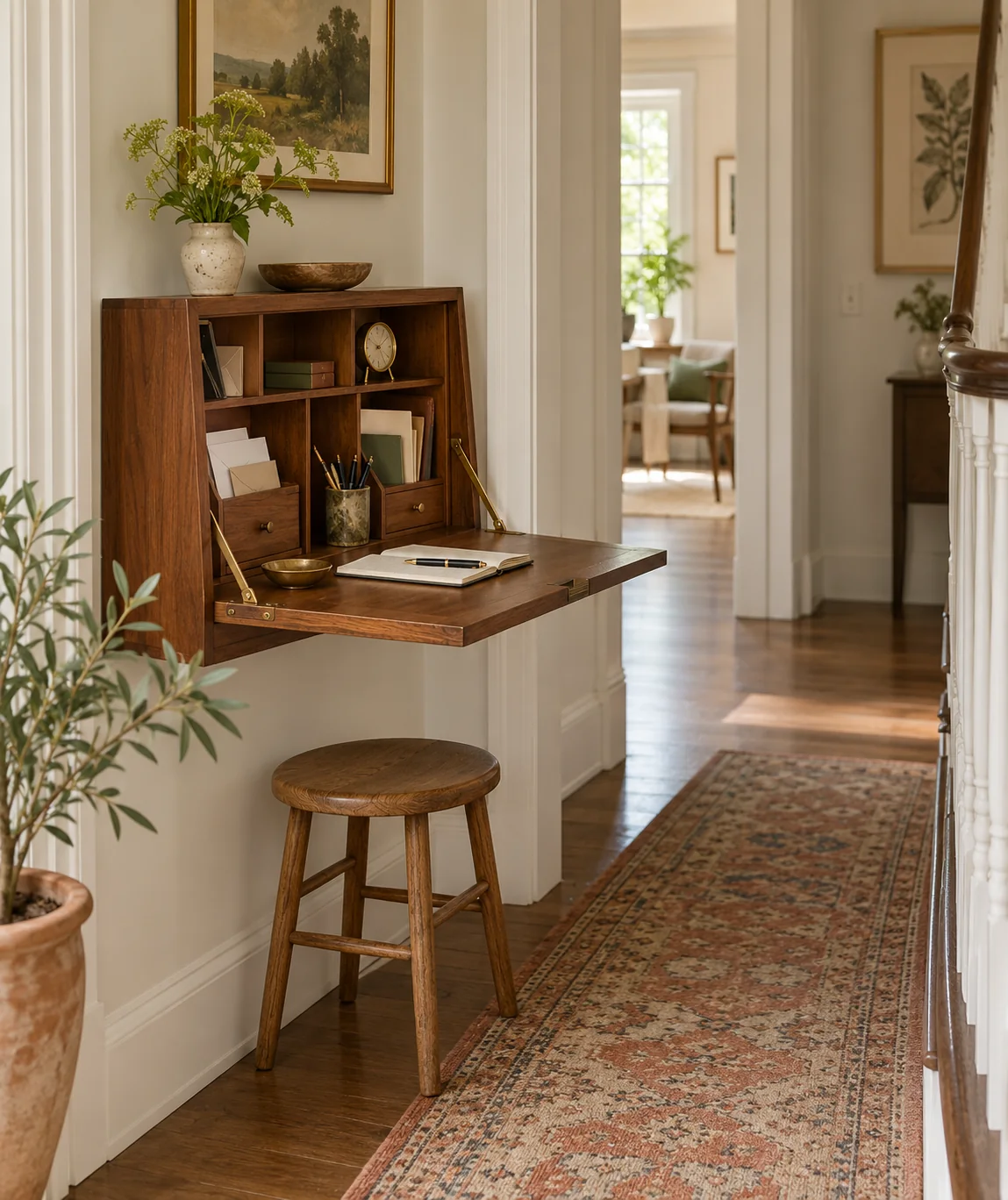
Hallway Clearances and Egress Planning
Before planning a wall-mounted fold-down desk in a corridor, check local building and fire egress codes regarding minimum required passage widths. Corridors often serve as designated primary exit routes, where any fixed protrusion must not compromise emergency evacuation. While standard interior residential hallways often measure around three feet across, opening a desk leaf temporarily narrows this pathway significantly. Site the cabinet well away from high-frequency door swings, stair landings, and tight blind intersections. Selecting a unit with a minimal closed profile helps prevent shoulder snags during normal transit, but the opened flap must still leave sufficient navigable space for all household members.
Ergonomic Height and Seating Considerations
Decide whether the desk will serve as a seated writing station or a quick-access standing ledger. For seated setups, comfortable desk height generally aligns with the user's natural forearm angle, often between 28 and 30 inches from the floor. However, seated use in a narrow hall requires careful planning for seating; a lightweight, backless stool or foldable perch can be tucked completely beneath the unit or stored elsewhere when not in use. A standing-height placement eliminates floor seating entirely, keeping the walking plane completely clear and discouraging prolonged lingering in a shared transitional corridor.
Shallow Interior Cabinet Organization
Because drop-down secretary cabinets intended for tight corridors typically measure only a few inches in depth, internal organization requires thoughtful arrangement. Utilize shallow vertical letter racks, low-profile elastic bands, and built-in ledges to retain paper goods, notebooks, and writing instruments against the back panel. Loose accessories placed haphazardly on internal shelves can easily shift and spill out when the drop-leaf door lowers. Keeping heavy objects out of upper compartments also prevents forward-tipping leverage and maintains balanced weight distribution across the unit's cabinet frame.
Managing Shared Traffic and Daily Habits
A corridor workspace functions best as a short-duration transition hub rather than a permanent all-day computer station. Active foot traffic from other household occupants will inevitably overlap with work activities in a narrow hall. Establishing a consistent household habit of closing and latching the work leaf immediately after completing a task prevents hallway bottlenecks and protects the extended hinges from accidental collisions. Storing laptops, tablets, and loose documents inside before shutting the face keeps the corridor visually tidy and physically clear.
Weight Capacities and Hardware Maintenance
Wall-mounted fold-down surfaces rely on specialised hardware such as drop-leaf stays, piano hinges, or tension cables. Never guess a unit's holding strength or lean body weight on the extended edge. Always consult the manufacturer's specified weight threshold, which typically accounts only for light desktop items like stationary and compact electronics. Mounting should strictly follow the manufacturer's structural recommendations, ensuring anchors engage appropriate wall framing studs rather than unsupported hollow wallboard. Periodically inspect hinges, latches, and stay mechanisms for signs of looseness or wear, having qualified personnel service structural fasteners if any movement develops.
YOUR STARTING POINT
A little checklist.
Original editorial guidance. Images are AI-generated concepts, not photographs of completed projects. Our sources and approach.
Questions to consider
Does a drop-down desk in a hallway violate local fire or building codes?
It can if the extended flap encroaches upon minimum required exit corridor dimensions defined by local residential building or fire codes. Always check municipal regulations and ensure the pathway remains safely navigable even when the desk leaf is open.
Can electronic devices be safely stored inside a closed drop-down cabinet?
Yes, provided the interior dimensions accommodate the device without forcing the latch shut. Always power down or put electronic devices into sleep mode before closing the cabinet to prevent excessive heat accumulation within a confined space.
What should I look for in the mounting hardware for a fold-down secretary desk?
Follow the manufacturer's exact hardware specifications and ensure structural wall fasteners attach directly to solid wall studs. Avoid generic hollow-wall anchors, as dynamic downward leverage on an open desktop requires firm structural backing.