Sage and Cream Interiors · THE GUIDE
Mount a Kitchen Pot Rail Below Shelving to Clear Deep Drawers
Deep kitchen drawers frequently turn into crowded stacks where retrieving a small saucepan requires shifting multiple heavy lids and skillets. Adding horizontal hanging rail storage below open shelving can free up lower drawer capacity by taking advantage of vertical wall and backsplash space. Pairing warm brass finishes with soft cream cabinetry and sage enameled cookware establishes a timeless, functional visual anchor. Planning this setup requires verifying that your existing shelving and wall fixings can handle the combined downward pull, while preserving adequate clearance above countertops so everyday prep zones remain fully accessible.
Jump to the checklist ↓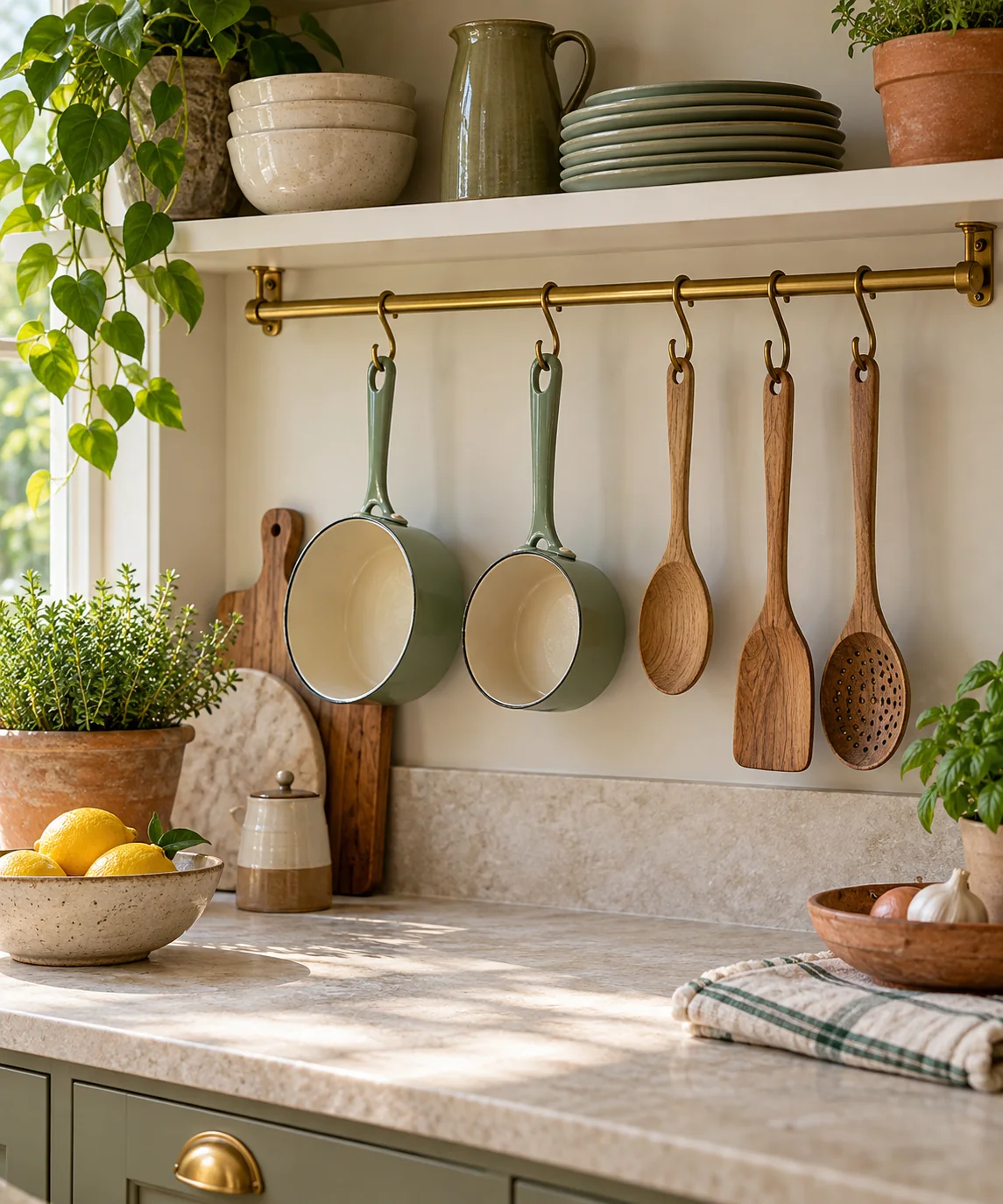
Assessing Shelf Load Limits and Counter Clearance
Before selecting hanging hardware, review the load specifications and wall anchors supporting your open shelving. Suspended cookware introduces downward leverage that transfers directly to shelf brackets and wall fasteners, so the assembly must have adequate rated capacity beyond the items stored on top. Examine the vertical span between the shelf underside and countertop to confirm that suspended pans will hang clear of work surfaces and small appliances. If your shelving uses concealed floating brackets or lightweight drywall anchors, property guidelines and manufacturer weight ratings should be consulted before introducing suspended loads.
Balancing Rail Distribution and Hook Placement
Cookware weight should be distributed intentionally along the rail to minimize concentrated stress on any single point. Grouping items across the rail rather than crowding them in one zone helps balance the mechanical pull on supporting brackets. Placing slightly heavier saucepans closer to the bracket ends transfers weight more directly into the shelf supports, leaving intermediate spaces for lightweight tools such as whisks or wooden spatulas. Selecting hooks with contoured profiles helps cookware hang steadily, reducing excessive swinging when items are lifted during daily meal preparation.
Selecting Cookware Suited for Suspended Storage
Hanging arrangements work best when reserved for lightweight, frequently used pieces rather than heavy cast iron Dutch ovens or large stockpots. Compact enameled steel saucepans, butter warmers, or measuring cups in soft sage tones bring gentle color to cream backings without adding excessive strain. Examine handle designs carefully before committing pans to hanging storage, verifying that hanging loops or apertures fit over hook curves smoothly. Handles with narrow or sharp-edged openings can scrape hardware finishes or resist quick release during active cooking.
Managing Kitchen Vapors and Regular Cleaning
Cookware and hardware suspended along a backsplash naturally encounter airborne grease, heat, and moisture from nearby cooking zones. Solid brass rails and enameled surfaces benefit from routine wipe-downs with a soft microfiber cloth dampened in warm, soapy water to stop sticky residues from settling. Rotating through hanging utensils and pans ensures vessels do not gather ambient dust while sitting idle. For kitchens where the rail sits adjacent to a cooktop, keep hanging tools far enough from active burners to prevent direct heat exposure and handle scorching.
Reorganizing Base Drawers for Improved Access
Moving awkward, long-handled saucepans out of base drawers allows you to reconfigure the vacated space for more efficient storage. Use adjustable drawer dividers or shallow bins to organize wide mixing bowls, ceramic bakeware, or dry pantry staples in neat, single-layer arrangements. Without protruding pan handles catching on drawer frames or jamming slides, lower cabinetry opens smoothly and protects cookware surfaces from chipping. This reassignment turns deep, chaotic drawers into structured zones where heavy items remain easily accessible without tedious unstacking.
YOUR STARTING POINT
A little checklist.
Original editorial guidance. Images are AI-generated concepts, not photographs of completed projects. Our sources and approach.
Questions to consider
Can I hang heavy cast iron skillets beneath an open shelf?
Heavy cast iron skillets are generally unsuitable for under-shelf rails because their weight can easily exceed the load ratings of shelf brackets and wall anchors. Keep heavy skillets, griddles, and Dutch ovens stored in dedicated base drawers or reinforced cabinets, reserving hanging rails for lightweight saucepans, butter warmers, and utensils.
How can I prevent hanging hooks from shifting when removing a pan?
Hooks with a closed upper loop or a snug fit around the rail diameter stay anchored to the bar during one-handed lifting. Flat-profile S-hooks also reduce lateral swinging compared to rounded wire hooks, helping pans lift off cleanly without dislodging the hardware.
What metal finishes pair well with sage cookware and cream shelves?
Warm unlacquered brass, brushed bronze, and satin nickel complement sage green enamel and cream surfaces effectively. Choosing a finish that aligns with your existing cabinet pulls or faucet creates visual cohesion across the kitchen without overwhelming the soft color palette.