Warm Neutral Living Rooms · THE GUIDE
Mount Floating Birch Ledges for Flexible Family Print Displays
Gallery walls often produce visual chaos when multiple individual frames require permanent individual fasteners and rigid spacing. Shallow birch picture ledges offer a calm, architectural alternative that aligns naturally with warm neutral living spaces. The pale tone and subtle grain of birch soften stark drywall while establishing a dedicated linear plane for displaying family prints. By relying on ledges rather than fixed hooks, you can freely adjust frame sizes, overlap mats, and swap portraits without puncturing the wall repeatedly. This approach streamlines seasonal updates while preserving a cohesive, uncluttered aesthetic.
Jump to the checklist ↓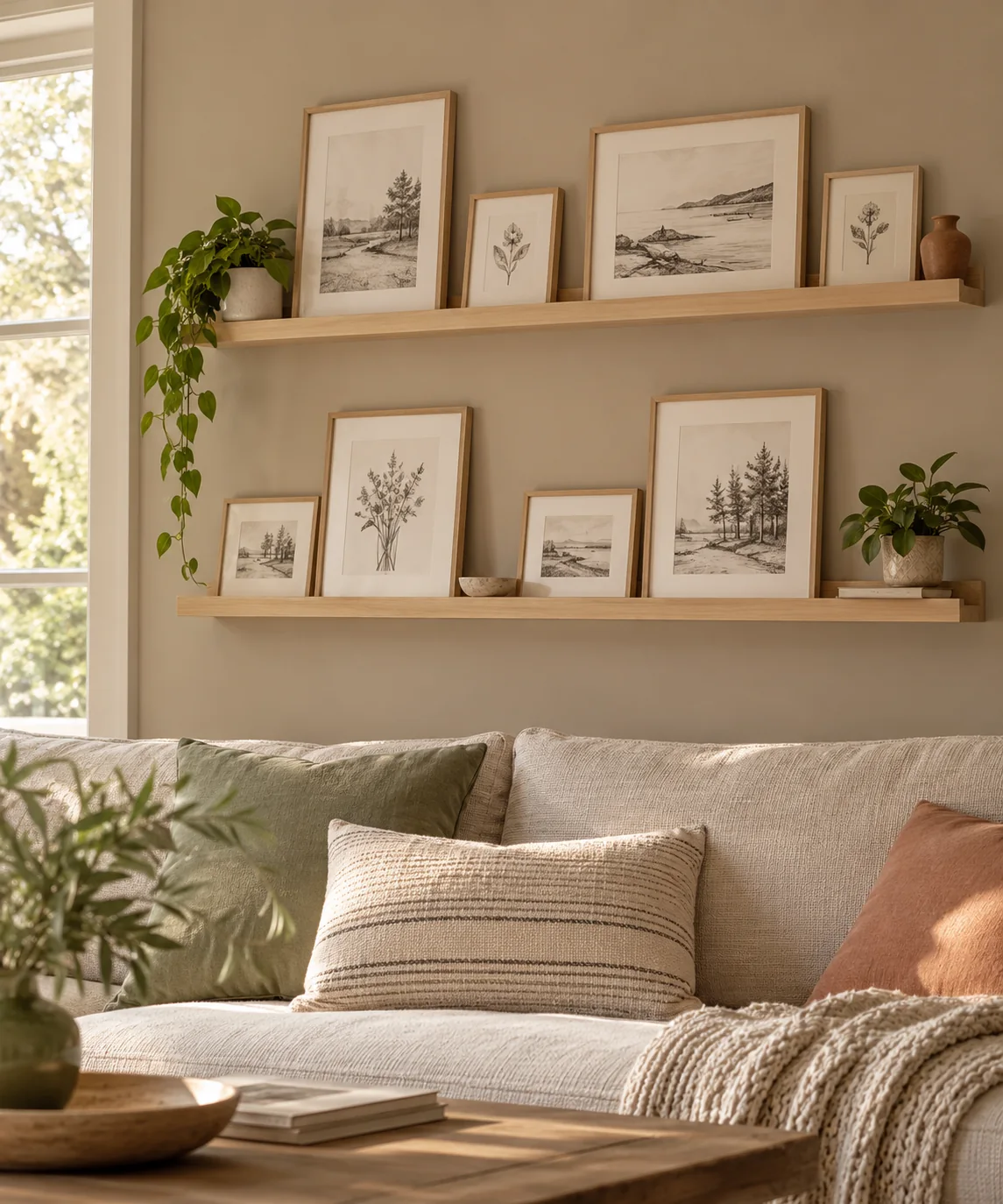
Evaluating Sightlines and Vertical Spacing
Positioning picture ledges requires balancing room sightlines from both seated and standing perspectives. Install the primary ledge roughly four to four and a half feet from the floor so that resting artwork sits comfortably near eye level. If stacking two ledges vertically, leave at least sixteen to twenty inches of clearance between them to accommodate taller frames. Test potential heights by taping craft paper mockups to the wall first. This preliminary step prevents visual crowding above low sofas while confirming unobstructed paths along living room walkways.
Selecting Harmonious Frames and Mats
A cohesive display relies on intentional framing choices that echo neutral decor. Pair natural birch ledges with light ash, white oak, or thin matte black frames to maintain restrained contrast. Generous off-white or cream mat boards create negative space around black-and-white family photographs or line drawings, keeping the arrangement light. Limit the display to two or three standard frame dimensions, such as eight-by-ten and eleven-by-fourteen inches. Consistent framing prevents visual fatigue across the horizontal length and lets print subjects remain the primary focus.
Layering Art for Controlled Visual Depth
Picture ledges naturally accommodate gentle overlapping, which creates dimension without unnecessary bulk. Place your largest framed pieces against the wall first to anchor the arrangement on both sides. Next, tuck smaller frames slightly in front of the wider mats, ensuring that faces and key details remain fully visible. Keep the total depth contained within the standard three-to-four-inch rail capacity so frames cannot pitch forward. Stagger vertical and horizontal orientations across the display to break up rigid symmetry in a relaxed, organic manner.
Planning Seamless Print Rotations
The greatest operational advantage of picture rails is effortless rotation as children grow or seasons change. Designate an archival storage box in a nearby closet for spare prints, seasonal sketches, or school artwork. When refreshing the ledge, swap out two or three images while leaving foundational anchors in place to preserve visual stability. Because the frames rest freely on the lip, adjustments take only moments and require no tools, eliminating the hesitation that typically leaves standard gallery walls static for years.
Display Maintenance and Stability Checks
Ledges accumulate airborne dust over time, particularly along the front lip where frames settle. Incorporate a quick dry microfiber wipe-down into your standard cleaning routine every few weeks. Verify that frame backing stands are either removed or pressed flat against the glass to prevent frames from sliding forward. Applying small silicone dots or felt pads to the lower frame edges adds subtle grip against smooth birch timber. This minor precaution keeps displays securely aligned even in active households with frequent vibration.
YOUR STARTING POINT
A little checklist.
Original editorial guidance. Images are AI-generated concepts, not photographs of completed projects. Our sources and approach.
Questions to consider
How deep should a living room picture ledge be?
A depth of three to four inches is ideal. This width comfortably accommodates standard frame moldings and gentle overlapping without projecting so far into walkways that passing shoulders risk knocking the displays.
Can I mix canvas boards with framed prints on the rail?
Yes, slim unframed canvas boards or mounted linen panels mix well with framed works. Keep canvas depths under one inch so they rest flat against the wall without tipping forward off the shallow ledge lip.
How many frames fit on a four-foot picture ledge?
A four-foot rail typically holds three to five mixed-size frames comfortably. Avoid cramming edges together; leaving breathing room between the outer frames and the ledge ends maintains an uncluttered, calm neutral look.