Bookshelf Styling · THE GUIDE
Organize a Compact Travel Guide Collection by Continent Using Spines
Compact travel guides, foldout city itineraries, and regional manuals present a unique organizational challenge due to mismatched heights and vibrant, high-contrast spine colors. Organizing these slim volumes geographically by continent turns an unruly shelf into an intuitive travel library that simplifies trip research. By leveraging natural publisher color codes, establishing physical subdivisions, and integrating dedicated pouches for loose maps, you create a disciplined display. The result keeps thin, easily damaged travel guides upright, fully legible, and accessible whenever planning your next departure.
Jump to the checklist ↓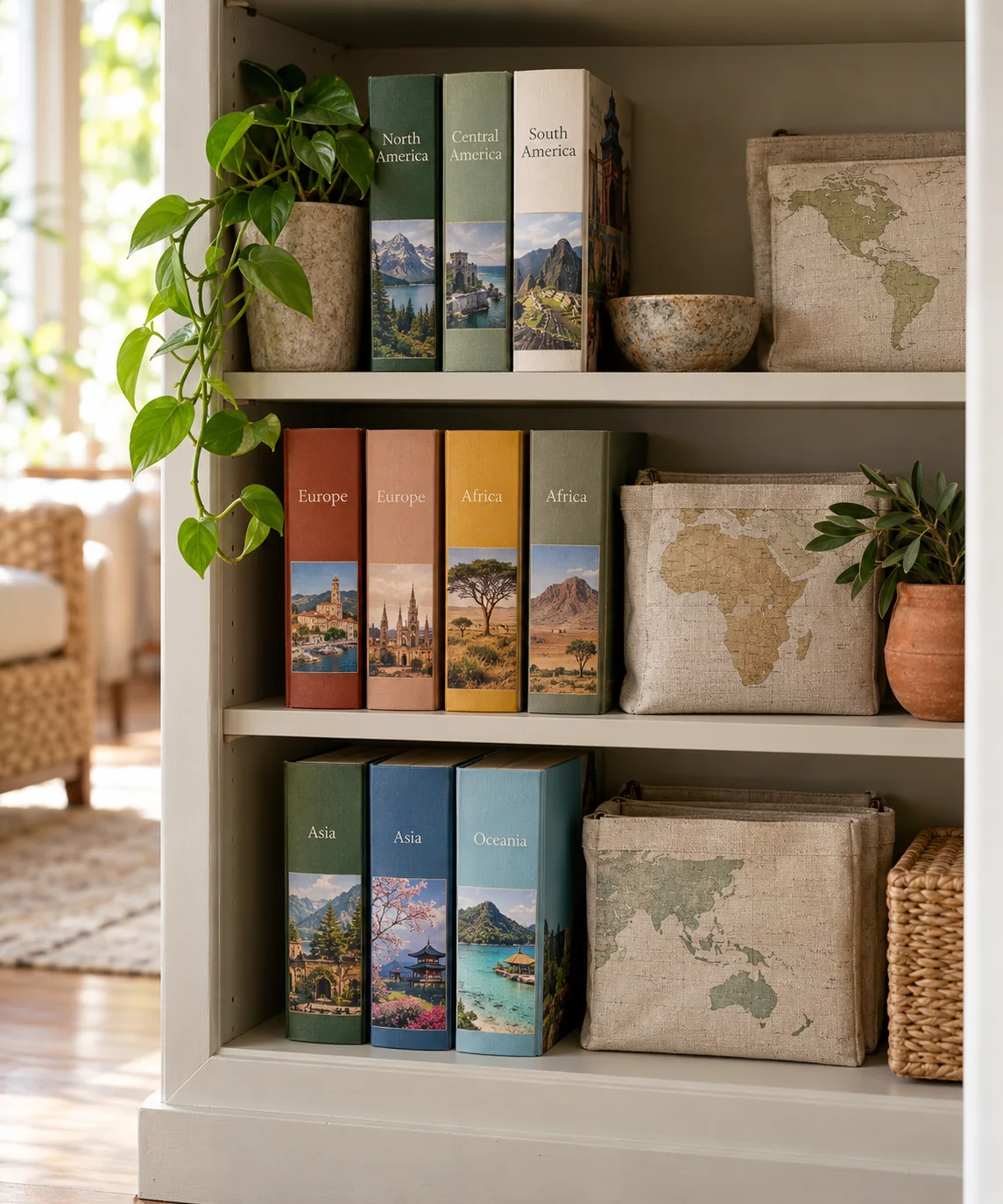
Categorizing Literature by Continental Geography
Begin by sorting your entire travel collection into primary continental groups: Europe, Asia, North America, South America, Africa, and Oceania. Place your most frequently visited or collected continents on the most reachable shelf tiers at chest height. Within each continental group, organize titles alphabetically by country, followed by regional or city guides. This logical heirarchy makes locating a specific destination instantaneous, eliminating the frustrating search through haphazardly clustered books of disparate publishers, scales, and publication years.
Standardizing Varied Heights on Narrow Shelves
Travel publications range from pocket-sized transit booklets to tall regional guidebooks. To preserve visual balance across a narrow shelf, arrange books so heights step down gently rather than alternating erratically. Place larger guides on the left side of each continental section, transitioning into pocket formats toward the right. If a guide is exceptionally slender and slips beneath neighboring covers, place it between two standard-format manuals to keep its spine title visible and prevent forward curling.
Housing Foldout Maps and Paper Ephemera
Loose foldout street maps, subway brochures, and transit passes quickly clutter open shelves if slipped loosely between books. Store these unspined items in structured, breathable linen pouches or slim cardboard document sleeves inserted at the end of each continental group. Label the exterior edge of the pouch with the corresponding region. This method contains paper ephemera cleanly, prevents creased edges, and stops thin paper leaflets from sliding behind the backboard of the bookcase.
Harmonizing High-Contrast Publisher Spines
Major travel publishers rely on distinct, vibrant spine hues such as bright yellow, deep blue, or saturated orange. Grouping by geography often mingles these contrasting tones. You can visually calm the arrangement by aligning all book spines precisely flush with the front edge of the shelf. This alignment creates a unified frontal plane that catches light consistently, turning disparate commercial designs into an intentional, rhythmic pattern rather than a disorganized cluster.
Maintaining Reversible Labels and Annual Audits
Travel guides age quickly as transport routes and logistics evolve over time. Maintain an ongoing system by inserting thin cardstock index dividers between continental sections rather than applying permanent adhesive stickers directly to publisher spines. Once a year, review your collection to separate outdated editions from classic destination literature. Keeping only relevant, historically interesting, or upcoming destination volumes ensures your compact shelving compartment remains functional and free of unnecessary clutter.
YOUR STARTING POINT
A little checklist.
Original editorial guidance. Images are AI-generated concepts, not photographs of completed projects. Our sources and approach.
Questions to consider
How do I handle guidebooks that cover multiple continents?
Place transcontinental guides or global overland reference manuals in a dedicated general section at the beginning of the shelf. Group them separately so they do not interrupt specific continental and regional sequences.
What keeps extremely slim city pamphlets from falling over?
Store ultra-thin pamphlets inside an upright open-top document box or a structured linen sleeve. Clustering several thin guides within one container prevents them from sagging or slipping under neighboring books.
Should I organize guides by publisher color instead of geography?
While color-blocking creates a striking graphic look, it scatters guides for the same country across multiple areas. Organizing geographically retains practical utility while forward-edge spine alignment provides necessary visual order.