Garden Tool Organization · THE GUIDE
Organize Garden Twine and Raffia on a Wall-Mounted Dowel Dispenser
Tying climbing vines, securing heavy stems, and training young plants requires reliable access to binding material at the potting bench. Spools of jute, hemp cord, and bundles of natural raffia easily unravel, collect moisture, or tangle when tossed loosely into deep utility drawers or crowded bins. A dedicated wall-mounted dowel dispenser keeps multiple binding mediums visible, separated, and instantly accessible. By setting up a smooth spindle system with integrated cord guides, you can effortlessly measure and cut precise lengths using one hand, streamlining repetitive garden tying chores while protecting natural fibers from damp work surfaces.
Jump to the checklist ↓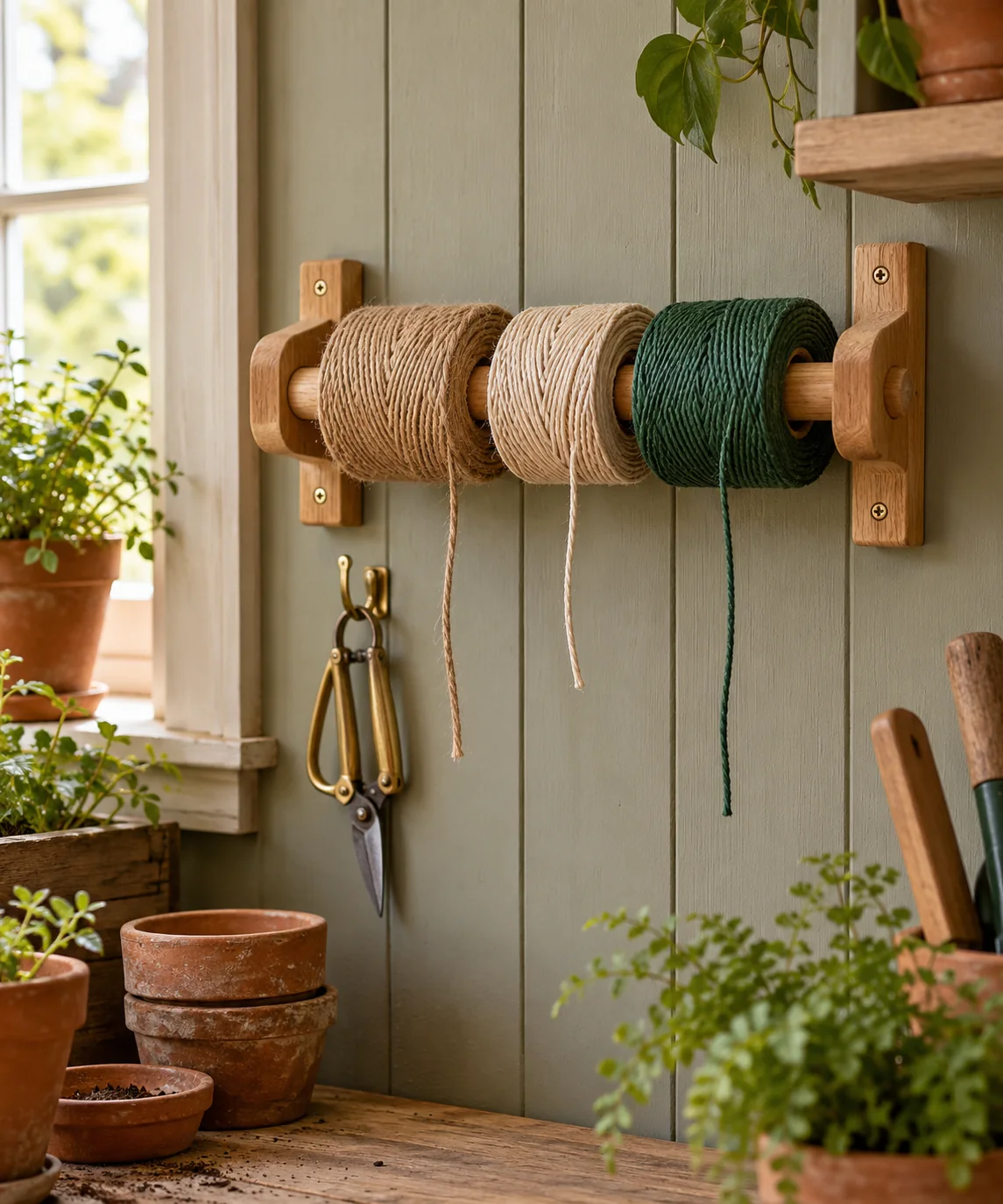
Positioning the Dispenser for Efficient Workflow
Mount the dowel assembly directly above or beside your primary potting station, roughly at chest height. Positioning the dispenser within arm's reach allows you to grasp a cord end with your non-dominant hand while holding snips in the other. Ensure the chosen wall zone is completely dry, well away from water basins, hose nozzles, and splash zones. Check that unspooling lines do not cross over seedling trays or delicate potted plants where snagged cords might cause accidental tipping.
Sizing Dowels and Spool Clearances
Select a sturdy, straight hardwood dowel, such as oak or ash, with a diameter of approximately twelve to sixteen millimeters. This gauge comfortably accommodates the cardboard or plastic core openings found in standard garden twine spools without bowing under tension. Leave at least three centimeters of lateral clearance between adjacent spools to prevent friction from turning neighboring reels simultaneously. Secure the dowel ends with removable wooden pins, split rings, or notched brackets to make spool swaps quick and painless.
Directing Lines with Clean Eyelet Guides
Prevent spools from free-spinning and tangling by running each cord end through a dedicated guide. Small brass eyelet screws or smooth ceramic rings secured directly beneath each spool create optimal downward tension. Thread the loose end through the corresponding guide ring, leaving a five-centimeter tail exposed for immediate grasping. For wide, loose materials like unspooled natural raffia bundles, suspend them using loose wooden curtain rings along the rod rather than threading the core onto the dowel.
Tethering Cutting Implements Safely
A dispenser functions most efficiently when cutting implements remain permanently paired with the workstation. Install a small brass hook or a smooth magnetic bar directly alongside the spindle assembly to hold dedicated thread snips or floral scissors. If hanging snips, use an open loop or slip sheath to shield sharp tips from accidental contact. Never let cutting blades dangle on long cords that could snag wrists or sway unpredictably during hurried potting sessions.
Preserving Natural Fiber Longevity
Natural fibers like jute, sisal, and raffia absorb ambient moisture readily and will weaken or mildew if kept in humid environments. Ensure your potting shed or workspace maintains good air circulation and low dampness. If a spool exhibits surface mold or musty odor after extended damp weather, discard the compromised outer layers immediately. Dust the dispenser assembly periodically with a dry microfibre duster to prevent soil particles from accumulating between the dowel and spool cores.
YOUR STARTING POINT
A little checklist.
Original editorial guidance. Images are AI-generated concepts, not photographs of completed projects. Our sources and approach.
Questions to consider
What diameter dowel works best for standard garden twine?
A twelve to sixteen millimeter hardwood dowel fits most standard twine spool cores comfortably, offering sufficient rigidity to hold three or four full rolls without sagging across typical mounting widths.
How do I stop loose twine from unraveling off the spools?
Route each cord through a dedicated eyelet screw mounted directly below its spool. The mild directional friction keeps the line taut, preventing excess free-spinning while leaving a tail ready to pull.
Can natural raffia bundles be mounted on a spindle?
Yes, but instead of forcing the dowel through loose hanks, loop the raffia bundle loosely over smooth wooden curtain rings slid onto the rod, allowing clean, single-strand pulls without snarling.