Entryway Organization · THE GUIDE
Organize Winter Puffer Coats With Heavy-Duty S-Hooks
Bulky down and synthetic puffer coats pose unique challenges in winter foyers. Their slick exterior fabrics slide off standard tapered wooden pegs, while their lofty volume causes standard wall hooks to bend or release them onto the floor. When piled together, puffers take over hallway paths and trap moisture between dense fabric layers. Utilizing heavy-duty S-hooks suspended from a horizontal rail provides an effective mechanical solution. The deep curve captures coat hanging loops securely, allowing thick insulation to expand naturally while keeping walking corridors entirely unobstructed.
Jump to the checklist ↓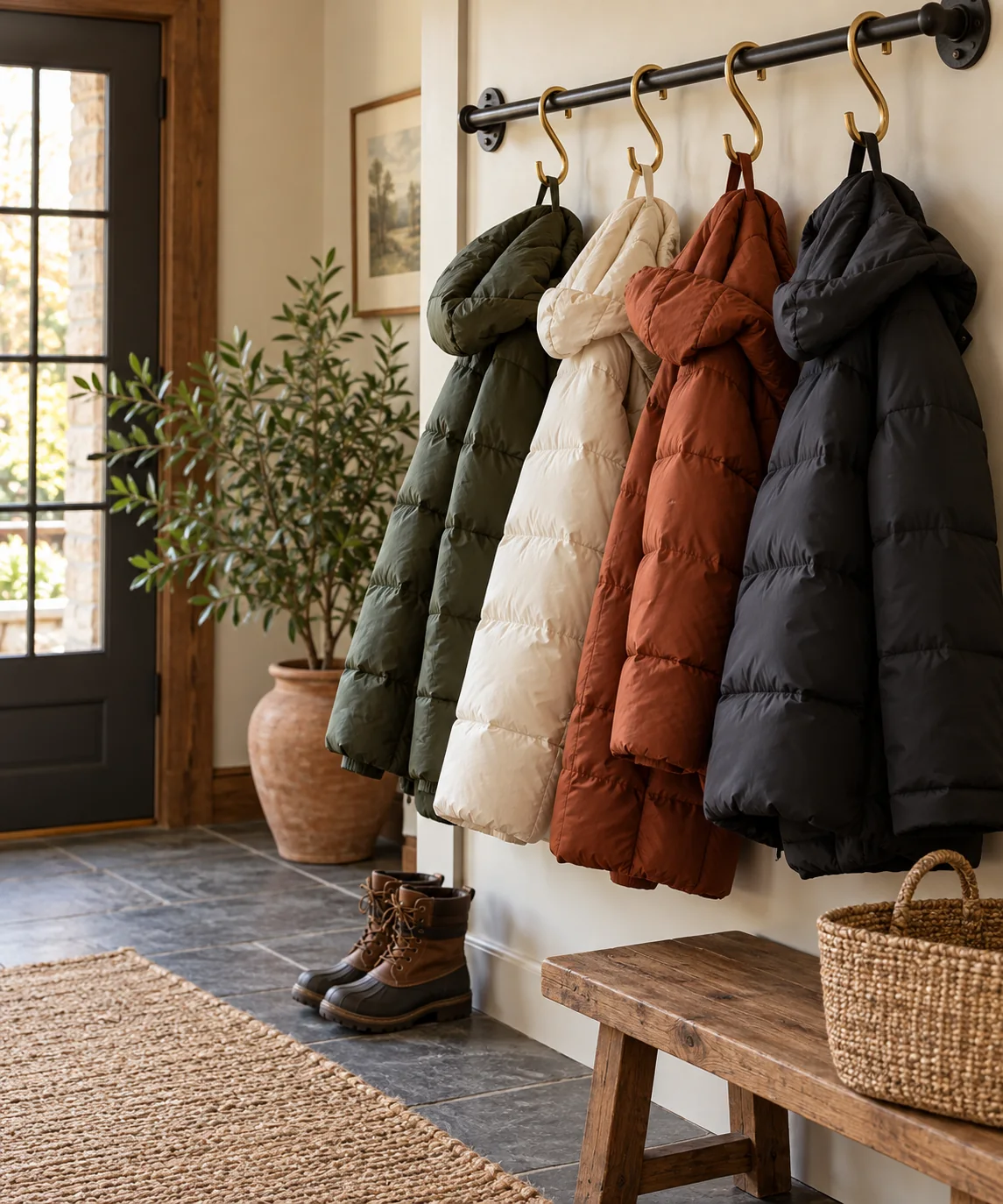
Selecting Hook Geometry and Throat Width
Standard utility hooks are often too narrow to capture the reinforced, heavy-duty locker loops found inside technical winter parkas. Choose rigid metal S-hooks with a wide throat opening of at least one and a half inches. The ends should feature smooth, rounded ball tips or blunt deburred edges to prevent snagging delicate nylon shells. A wide lower curve allows the garment loop to settle into the lowest point without bunching, ensuring the coat hangs plumb against the wall.
Spacing to Accommodate Down Loft
Puffer jackets require significant lateral room to maintain loft and dry between outings. When coats are squeezed together, trapped moisture cannot evaporate and synthetic baffles remain compressed. Position S-hooks at least ten to twelve inches apart along the support rail. This dedicated spacing accommodates the natural eight- to ten-inch outward expansion of insulated parkas. It also provides sufficient air circulation around the shell, which speeds up drying after exposure to falling snow or sleet.
Controlling Hook Drift and Stability
Free-hanging S-hooks can shift or twist along a smooth horizontal rail when coats are grabbed quickly during morning departures. To maintain consistent spacing, slide durable rubber O-rings or silicone bumper rings onto the rail on either side of each hook. These friction stops keep the hooks fixed at set intervals without marring the metal finish. Alternatively, use closed-loop S-hooks where the top loop is pinched tightly around the rail to prevent accidental lift-off.
Protecting Fabric and Internal Loops
Heavy down parkas with saturated outer shells exert considerable downward pull on their internal hanging loops. Inspect the loop stitching periodically for signs of stress or fraying. If a coat lacks an internal loop, avoid hooking the metal directly through the hood fabric or collar material, which can puncture water-resistant membranes. Instead, hang the coat on a broad-shouldered wooden hanger and suspend the hanger itself directly from the S-hook.
Seasonal Rotation and Warm-Weather Planning
Heavy-duty hooks dedicated to puffy gear serve an essential role during cold months, but can become visual clutter during warm seasons. When winter concludes, clear the parkas for off-season storage in breathable garment bags. The S-hooks can be gathered toward one end of the rail, leaving the remaining open run clear, or removed entirely until the next freeze. This seasonal transition keeps the entryway light, spacious, and appropriate for current weather needs.
YOUR STARTING POINT
A little checklist.
Original editorial guidance. Images are AI-generated concepts, not photographs of completed projects. Our sources and approach.
Questions to consider
Can coats without sewn hanging loops use S-hooks?
Do not hook slick fabric directly over metal ends, as this punctures materials. Place unlooped parkas on thick, contoured wood or plastic hangers, then hang the hanger neck securely inside the S-hook.
How much clearance is needed below the coats?
Provide at least eight to twelve inches of clear space below the longest hem. This clearance ensures wet coat tails avoid dirt on entryway mats and allows boots to sit underneath.
Do metal S-hooks scratch wooden rails?
Bare metal sliding on wood can wear down finishes over time. Use vinyl-coated S-hooks or apply thin heat-shrink tubing to the upper curve of the hook to cushion contact with wooden rails.