Kitchen Herb Gardens · THE GUIDE
Prep Counter Corner Lazy Susan Herb Turntable
Deep countertop corners often become dead zones where clutter accumulates and potted plants struggle from uneven light. A rotating wooden lazy Susan transforms an awkward kitchen corner into a practical, dynamic herb station. Rather than leaving culinary plants stationary where one side stretches toward distant windows, a sturdy turntable lets you rotate pots effortlessly to balance sunlight exposure. The raised carousel groups culinary herbs neatly in one footprint, safeguarding adjacent food preparation surfaces. With thoughtful placement, moisture protection, and balanced weight distribution, this reversible setup turns underutilized counter space into an accessible, organized culinary asset.
Jump to the checklist ↓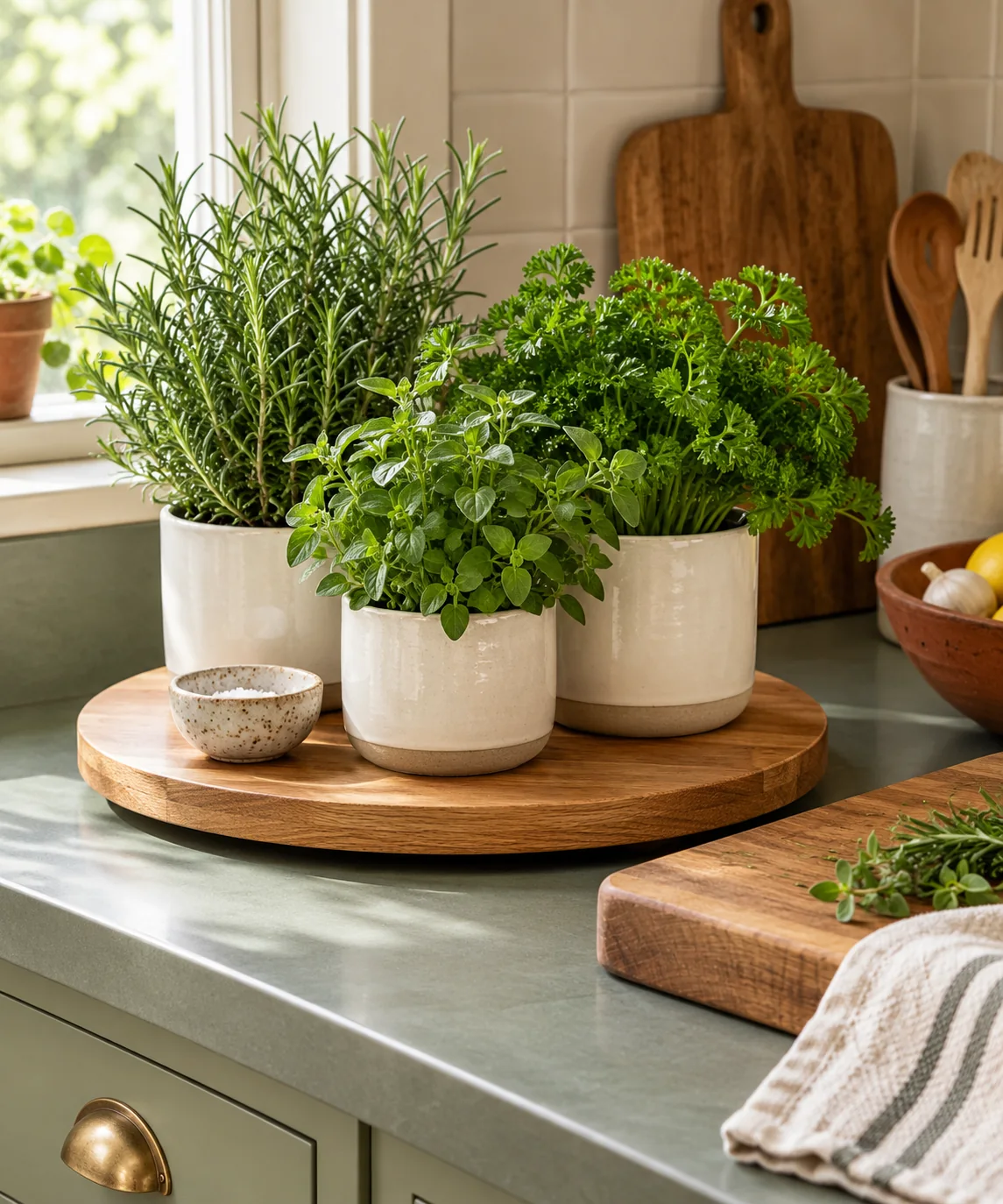
Evaluating Light Levels in Corner Locations
Kitchen corners frequently sit shaded beneath upper cabinetry and away from direct window lines, creating challenging microclimates for culinary herbs like basil, rosemary, and thyme. Before dedicating corner space to a countertop turntable, observe the area across varying times of day to evaluate natural light reach. Countertops flanked by tall cabinets often experience deep shade even when the adjoining room feels bright. If natural daylight falls short of the moderate-to-bright levels required by culinary species, locate the turntable closer to an open window line or incorporate a dedicated, counter-mounted supplemental grow light. Rotating plants within a completely dark corner will only distribute shade equally, failing to supply the energy needed for active foliage development.
Turntable Selection and Moisture Protection
Select a turntable engineered to support localized weight with smooth, stable movement, prioritizing moisture-tolerant hardwoods like acacia or oak, or sealed food-grade composite materials. Avoid unfinished porous lumber or lightweight plastic carousels with flimsy central pivots that bind under load. Because potting mix and routine irrigation generate moisture, treat natural wood platforms with food-safe mineral oil or water-resistant board wax prior to setting containers in place. Verify that the turntable base features durable, non-slip rubber or silicone footing that elevates the platform slightly above the counter surface, which prevents trapped moisture rings and protects stone, laminate, or solid-surface countertops from scratching.
Balancing Container Scales and Weight Distribution
Place containers symmetrically across the turntable to maintain even balance across the central bearing assembly during rotation. Concentrating heavy pots along one side risks tipping the carousel, binding the swivel mechanism, or dragging container bases against the counter surface. Choose containers with stable bases, typically between four and five inches in diameter, leaving adequate clearance between foliage canopies for air circulation and harvest snips. Position taller, center-weighted specimens like upright rosemary or bay laurel over the center axis, and balance evenly sized pots of spreading or bushy herbs, such as flat-leaf parsley and oregano, around the outer perimeter.
Rotational Routine for Uniform Foliage Growth
Indoor herbs naturally exhibit phototropism, redistributing growth hormones so that stems bend and foliage elongates toward the strongest directional light source. In stationary corner placements, this habit causes one-sided leaning, spindly internodes, and sparse foliage on shaded sides. Incorporating a quarter- or half-turn of the turntable into daily kitchen tasks balances light exposure across the entire canopy, promoting more uniform branch density and compact foliage. Regular rotation also simplifies culinary harvesting and routine pest inspections, allowing you to examine rear stems without lifting heavy pots or leaning over deep counter corners.
Countertop Protection and Kitchen Hygiene
Culinary herb turntables placed near food preparation areas require clear separation between potting media and food-contact surfaces. Always set each pot on its own watertight glazed saucer or drip tray to catch drainage water, soil particulates, and dissolved fertilizer salts before they reach the turntable surface. Empty drainage saucers promptly after watering to prevent stagnant moisture from degrading the turntable platform or attracting fungus gnats. Wipe the turntable surface periodically with a clean, damp cloth and dry it immediately, keeping chopping boards, raw meat prep, and grease-producing stovetop splatter safely distanced from living foliage.
YOUR STARTING POINT
A little checklist.
Original editorial guidance. Images are AI-generated concepts, not photographs of completed projects. Our sources and approach.
Questions to consider
Can culinary herbs survive in a dark countertop corner?
Culinary herbs will decline in dark corners. The turntable must sit where ample daylight enters from an adjacent window; rotating plants merely balances incoming light, it cannot substitute for natural sun exposure.
How do I protect the turntable wood from water damage?
Coat the wood with food-grade mineral oil or beeswax finish, and place waterproof saucers under every pot. Never let drainage water sit on the turntable; wipe away spills immediately after watering.
What size turntable works best on standard kitchen counters?
A ten- to twelve-inch diameter turntable fits comfortably into typical corner layouts without projecting past the front edge of standard twenty-four-inch deep counters, leaving plenty of room for adjacent food preparation.