Household Reset Routines · THE GUIDE
Seedling Tray Thinning and Window Sill Light Adjustment
Windowsill propagation often challenges young plants because natural light enters from a single lateral angle rather than directly overhead. As emerging sprouts track the sun, their stems quickly bend and elongate, producing fragile, leggy growth if left unattended. Incorporating a deliberate rotation and thinning routine preserves structural vigor before roots overcrowd the shallow cells. By checking your starter flats daily, adjusting orientation by one hundred eighty degrees, and snipping weaker competitors at soil level, you create balanced growing conditions. This reset routine requires minimal equipment while keeping delicate starts compact, upright, and prepared for future potting steps.
Jump to the checklist ↓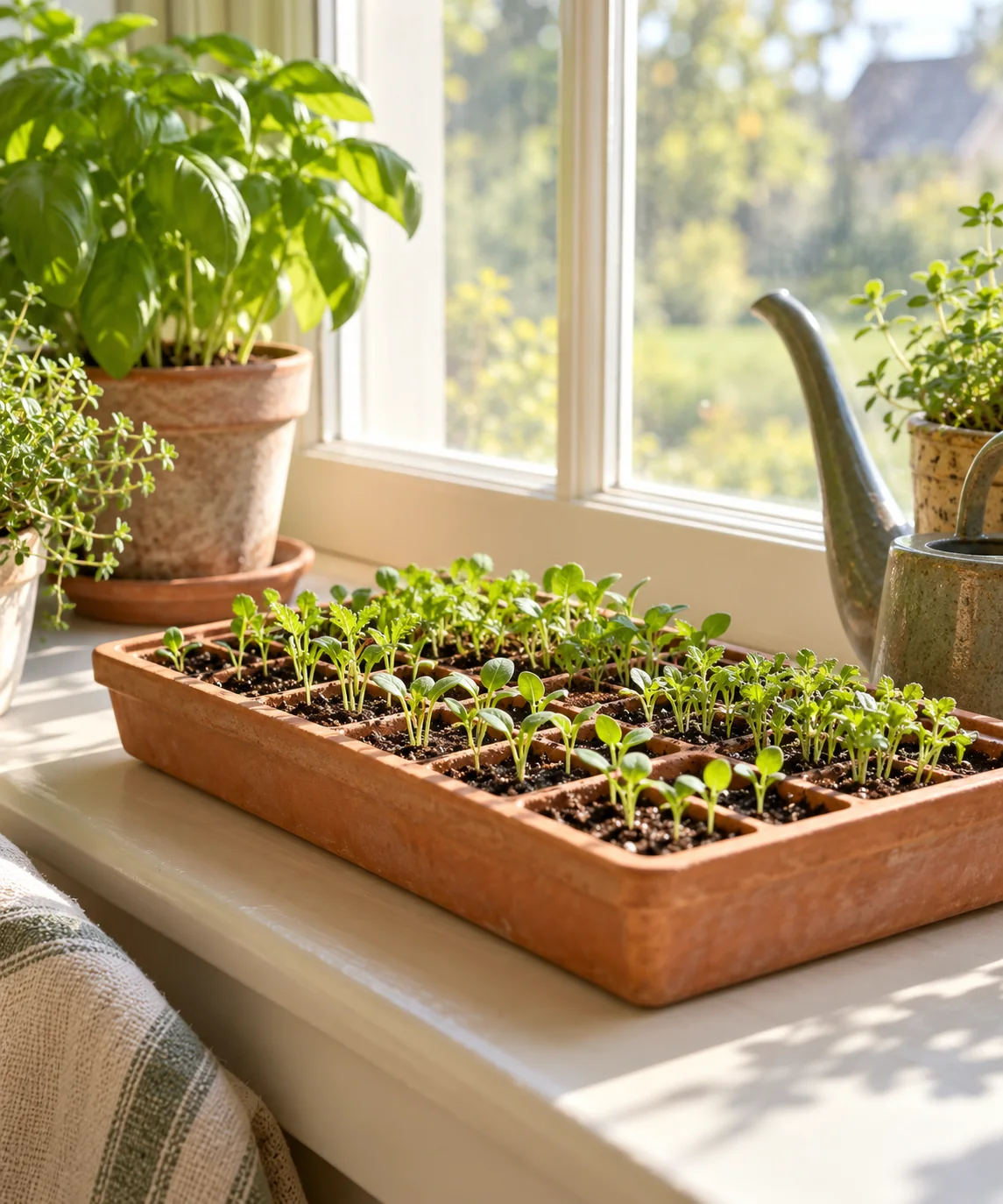
Assessing Windowsill Light Geometry
Sunlight passing through window glazing decreases in intensity across horizontal interior surfaces. While the edge nearest the pane receives the strongest directional light, the interior side of a seedling tray often receives noticeably lower exposure. Check the sill depth before setting up flats to confirm the entire tray base rests fully and evenly on the surface without overhang or instability. Watch how young sprouts react over the course of the day; noticeable leaning toward the glass indicates strong phototropism. Observing this directional growth allows you to plan regular turns before stems develop an irreversible curve, helping each row of seedlings receive balanced light over successive days.
Establishing a 180-Degree Rotation Cycle
To counteract uneven, lopsided leaning, rotate your seedling tray end-for-end once every twelve to twenty-four hours. Placing a piece of colored tape or a label on one corner of the flat provides a clear visual reminder of its current orientation. When completing a morning check, simply turn the marked side away from the glass. Over the following hours, the seedlings gradually lean back toward the natural light source, helping maintain a straighter central stem. Consistent turning encourages more uniform stem development on all sides of the plant, helping avoid the thin, bent stems that develop when starts continuously stretch in a single direction.
Thinning Crowded Sprouts Safely
When multiple seeds germinate in a single cell or small pot, the emerging seedlings immediately compete for available root space, water, and light. Rather than pulling surplus seedlings by hand—which disturbs and can tear the delicate roots of the neighboring sprout—use clean, fine-tipped snips or embroidery scissors. Select the most upright, sturdy seedling showing healthy growth, and clip unwanted competitors at the soil level. Reducing each compartment to a single strong plant improves localized air circulation, helps lower the risk of dampening off, and concentrates available windowsill light on the remaining start.
Managing Temperature and Glass Clearances
Window areas experience pronounced temperature swings, cooling down significantly overnight and warming up under direct midday sun. Position seedling trays so leaves and stems do not make direct contact with the windowpane, where extreme temperature transfer can scorch or chill tender foliage. If a windowsill is too narrow to support a tray completely flat without hanging over the edge, avoid balancing boards or shims across the sill; instead, move the flat to an adjacent, stable table or dedicated plant stand positioned near the window. Check around window frames for persistent cold drafts, which can slow root activity and compound the stress of low indoor light.
Limitations of Natural Sill Lighting
Natural window lighting is inherently constrained by seasonal sun paths, glass coatings, and outdoor obstructions such as roof overhangs, trees, or adjacent structures. If daylight is weak, heavily filtered, or inconsistent, manual rotation alone cannot prevent seedlings from stretching. Inspect foliage color and stem proportion regularly; pale, elongated stems and tiny, widely spaced leaves indicate that the plants are not receiving adequate light energy. In many indoor spaces, windowsills are practical for initial germination but may not sustain stocky, long-term vegetative growth, signaling when starts need to transition into a cold frame, an outdoor protected spot, or beneath dedicated grow lights.
YOUR STARTING POINT
A little checklist.
Original editorial guidance. Images are AI-generated concepts, not photographs of completed projects. Our sources and approach.
Questions to consider
Why should seedlings be snipped instead of pulled during thinning?
Pulling disrupts the fragile root network of neighboring plants sharing the small cell volume. Snipping stems cleanly at the soil line eliminates competition instantly without shifting the surrounding soil or exposing delicate remaining roots to drying air.
How often should I turn the seedling flat on a sunny sill?
Rotate the flat 180 degrees once every morning or twice daily if seedlings bend aggressively toward the window pane. Regular turning prompts stems to self-correct, fostering thicker, upright growth rather than permanently curved stalks.
Can a windowsill provide enough light for all vegetable starts?
While many seeds germinate reliably on bright sills, fast-growing starts often stretch quickly without overhead illumination. Sills with fewer than six hours of strong exposure may produce weak stems, requiring supplemental lighting or early garden transition.