Small Bedroom Layouts · THE GUIDE
Selecting a Storage Bed with Pull-Out Bins on Front Runners
Small bedrooms often suffer from narrow lateral clearances that make standard side-drawer storage beds unusable. When a bed frame sits tightly between a wardrobe, a radiator, or a doorway, pulling drawers outward from the side rails is physically blocked. Storage beds equipped with pull-out bins on front footboard runners solve this restriction by projecting storage directly into the main walking aisle. Selecting the right frame requires balancing runner hardware durability, under-bed depth, and foot-of-bed clearance. With measured planning, front-access drawers transform otherwise dead under-mattress space into an accessible textile and clothing repository.
Jump to the checklist ↓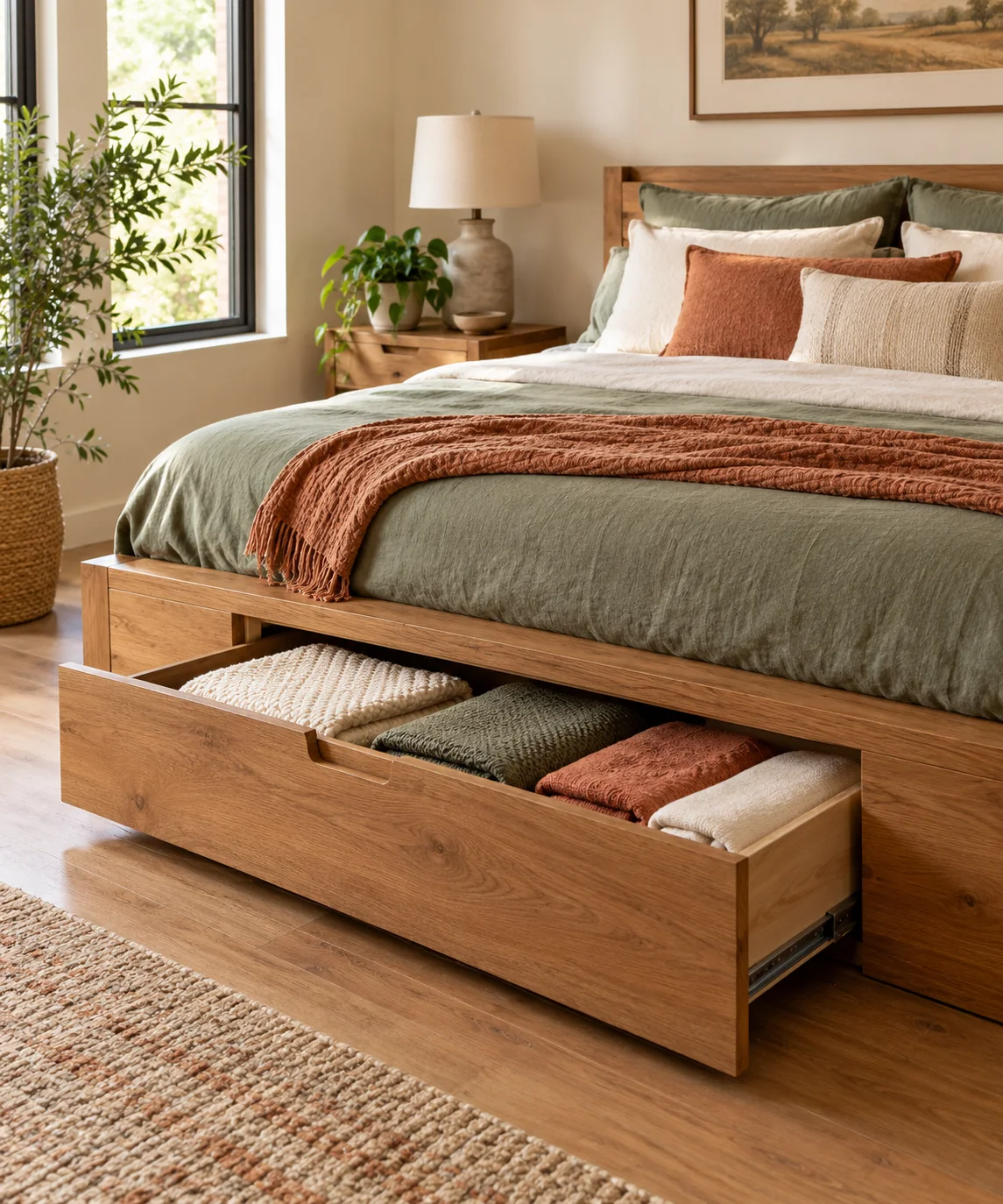
Calculating Foot-of-Bed Extension Clearances
Front-runner storage bins pull forward into the space beyond the footboard. Measure the distance between your footboard and the facing wall or dresser to guarantee functional clearance. A typical front-running drawer extends between twenty and thirty inches outward when fully opened. You will need an additional sixteen to twenty inches of standing space in front of the extended drawer to load or retrieve items comfortably. If total clearance from the footboard to the nearest obstruction is less than forty inches, accessing the bins will feel cramped and awkward.
Evaluating Runner Hardware Versus Caster Wheels
Platform storage beds utilize either guided metal drawer runners or free-rolling bottom casters. Metal ball-bearing slides keep bins aligned, prevent side-to-side racking, and prevent scratches on hardwood floors because the drawers stay suspended above the floorboards. In contrast, caster wheels sit directly on the floor and can veer off-course or snag on thick area rugs. For carpeted bedrooms, suspended metal runners ensure smooth operation, whereas caster-based bins perform adequately only on low-pile rugs or hard, level surfaces.
Internal Capacity and Compartment Organization
Because front bins travel deeply beneath the mattress platform, unpartitioned drawers quickly turn into disorganized catchalls. Look for units that feature built-in dividers or accommodate standardized fabric sorting boxes. Store off-season bedding, extra blankets, or folded jeans in the deepest rear sections of the bin. Keep everyday clothing items near the front handle for rapid access. Avoid packing items above the rim, as overflowing textiles can snag against the structural center support rail of the platform frame during closing.
Cleaning Routines and Dust Prevention
Under-bed bins collect airborne dust, lint, and pet hair over time, particularly around moving runner tracks. Choose storage units built with full enclosure boxes rather than open-topped trays sitting under slatted frames. If your bed frame has open slats above the bins, place zippered storage envelopes over textiles to protect them from descending dust. Vacuum the runner tracks every few months using a crevice attachment to prevent grit from accumulating in the bearings, which causes sticking and rough motion.
Frame Weight and Mattress Support Considerations
Front-drawer storage frames contain significant internal joinery, making them considerably heavier than minimalist open frames. Ensure your bedroom flooring can bear this concentrated weight, and assemble the base exactly where it will reside to avoid moving a heavy assembly later. Check that the platform deck provides flat, rigid support with slat gaps under three inches. Inadequate platform support will cause mattress sagging, which in turn can exert downward pressure on the internal drawer boxes and bind the front runners.
YOUR STARTING POINT
A little checklist.
Original editorial guidance. Images are AI-generated concepts, not photographs of completed projects. Our sources and approach.
Questions to consider
Are front-running storage drawers better than hydraulic lift beds?
Front drawers provide quick, compartmentalized access without lifting the heavy mattress and bedding. However, hydraulic lifts offer continuous, undivided volume for bulky items, though they require vertical clearance and substantial physical effort to operate smoothly.
Can a thick area rug block footboard storage drawers?
Yes, high-pile rugs can impede caster-based drawers or snag bottom drawer edges. If using a rug, ensure drawer runners are suspended above the floor or place the rug edge entirely outside the drawer extension path.
What items are best suited for deep front-runner drawers?
Bulky linens, seasonal clothing, extra pillows, and folded knitwear work exceptionally well. Avoid storing frequently accessed small accessories in the deep back sections, as reaching into fully extended long drawers can be cumbersome.