Kitchen Herb Gardens · THE GUIDE
Shallow Terracotta Dish for Micro-Basil and Mustard Sprouts
Producing microgreen garnishes on a kitchen counter requires minimal vertical clearance and rapid crop turnaround. An unglazed shallow terracotta dish can serve as an accessible vessel for micro-basil and spicy mustard sprouts when paired with a shallow layer of growing media. While the porous clay absorbs surface moisture, un-drained dishes still require careful moisture monitoring to avoid saturating roots. Placing a waterproof saucer, cork mat, or protective tray beneath the dish prevents moisture from sweating onto wooden counters. By managing thin substrate depths, maintaining bright ambient light, and harvesting crops within one to two weeks, you can produce consistent microgreens without specialized trays or complex gear.
Jump to the checklist ↓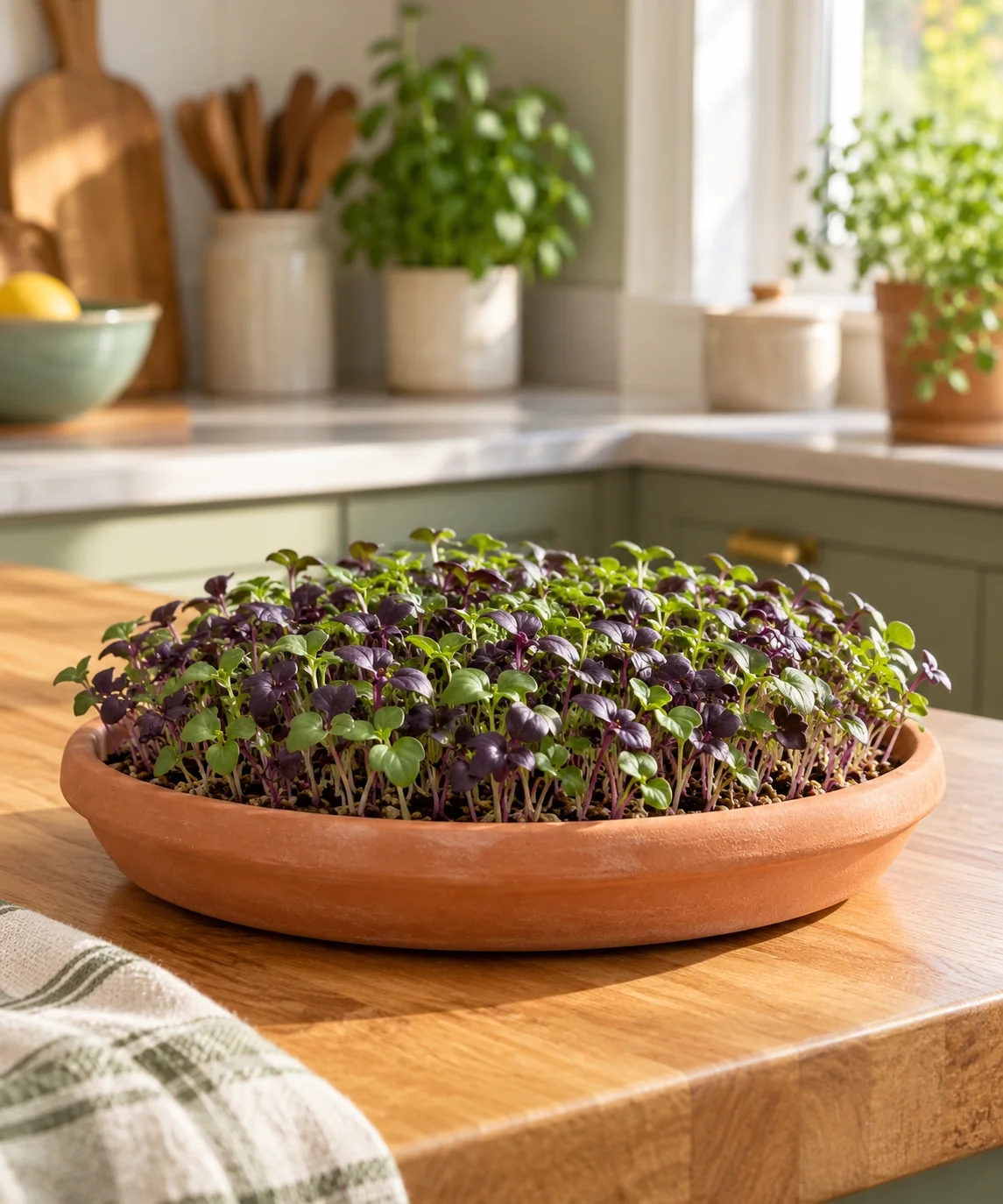
Clay Saucer Moisture Dynamics and Aeration
Microgreens develop shallow, delicate root systems that require consistent moisture without waterlogged soil. Unglazed terracotta saucers provide a porous clay body that absorbs and evaporates water along the container walls. However, because standard saucers lack drainage holes, clay porosity alone cannot prevent oversaturation if excess water pools at the bottom. Water also transpires through the base of the dish, meaning unglazed saucers placed directly on wooden tables or delicate counter finishes will leave moisture rings. Always seat the dish on a sealed liner, glazed plate, or cork trivet to protect underlying surfaces while keeping growing media lightly damp.
Substrate Layering and Sowing Distribution
Because microgreens are harvested shortly after the emergence of cotyledons or the first true leaves, seedlings depend largely on stored seed reserves rather than heavy fertilization. Spread an even layer of fine, sterile seed-starting mix roughly one-half to one inch deep across the dish. Avoid rough garden soils or coarse composts that create inconsistent sowing depths. Scatter seeds across the surface to create an even, single layer without dense piling, which can trap excess moisture between seeds. Lightly press the seeds into the media to ensure uniform contact with the moist soil.
Countertop Placement and Lighting Conditions
Seedlings quickly stretch and weaken if grown under insufficient light, resulting in tall, pale stems that easily topple. Place the shallow saucer in an area receiving strong, bright natural daylight, such as an unobstructed sill or adjacent counter. If natural light is limited by window orientation or seasonal changes, a compact, counter-rated horticultural light positioned above the crop canopy supports compact growth. Bright illumination encourages sturdy hypocotyl development and deep leaf coloration, particularly in dark purple basil cultivars.
Irrigation Technique for Non-Draining Containers
Without bottom drainage holes, irrigation must be applied sparingly and evenly to avoid water pooling beneath the root zone. Heavy pouring disrupts tiny seed positions and compacts fine substrate, heightening the risk of stem decay. Use a clean hand mister to dampen the soil surface during initial germination. Once roots penetrate the substrate, apply small, measured increments of water along the perimeter of the dish, allowing the soil to absorb moisture gradually. Check soil dampness with a fingertip before adding more water to ensure the lower layer is not continuously waterlogged.
Harvesting and Clean Dish Maintenance
Fast-growing mustard microgreens are generally ready to harvest within seven to ten days, while micro-basil typically develops over ten to fourteen days. Snip the stems cleanly just above the soil line using sanitized kitchen shears, avoiding pulling roots to keep the cut greens clean. After harvest, discard the spent root mat into municipal yard waste or compost. Wash the terracotta dish thoroughly with warm water and a scrub brush to dislodge debris. Allow the dish to air-dry completely in a well-ventilated area before starting another planting cycle; avoid heating dry clay in domestic ovens, which can cause cracking.
YOUR STARTING POINT
A little checklist.
Original editorial guidance. Images are AI-generated concepts, not photographs of completed projects. Our sources and approach.
Questions to consider
Can microgreens grow successfully in containers without drainage holes?
Yes, but it requires cautious, measured watering. Because excess moisture cannot escape through the bottom, overwatering can quickly saturate root zones and induce mold or stem rot.
How do I protect my countertops from moisture under an unglazed terracotta dish?
Unglazed terracotta absorbs water and transpires it through the bottom and sides. Always set the dish atop a waterproof drip tray, glazed ceramic plate, or non-porous coaster to shield countertops from moisture rings.
What causes micro-basil stems to collapse near the soil line?
Stem collapse is commonly caused by fungal damping-off, triggered by excessive water, poor air circulation, or overly dense sowing. Allow surface soil to dry slightly between mistings and ensure adequate airflow around seedlings.