Laundry Space Organization · THE GUIDE
Store Flat Sweaters on Stackable Mesh Drying Trays
Heavy knitwear requires horizontal drying to protect fibers from stretching, but traditional lay-flat drying can monopolize valuable table surfaces and bed tops for days. Stackable mesh drying trays solve this spatial dilemma by utilizing vertical air space rather than spreading across horizontal planes. The breathable mesh promotes continuous air circulation beneath damp woolens, speeding evaporation while preserving delicate garment shoulders and hems. Implementing a modular tray system helps maintain an orderly laundry room during cooler months, providing dedicated textile care without crowding living areas or risking fabric damage.
Jump to the checklist ↓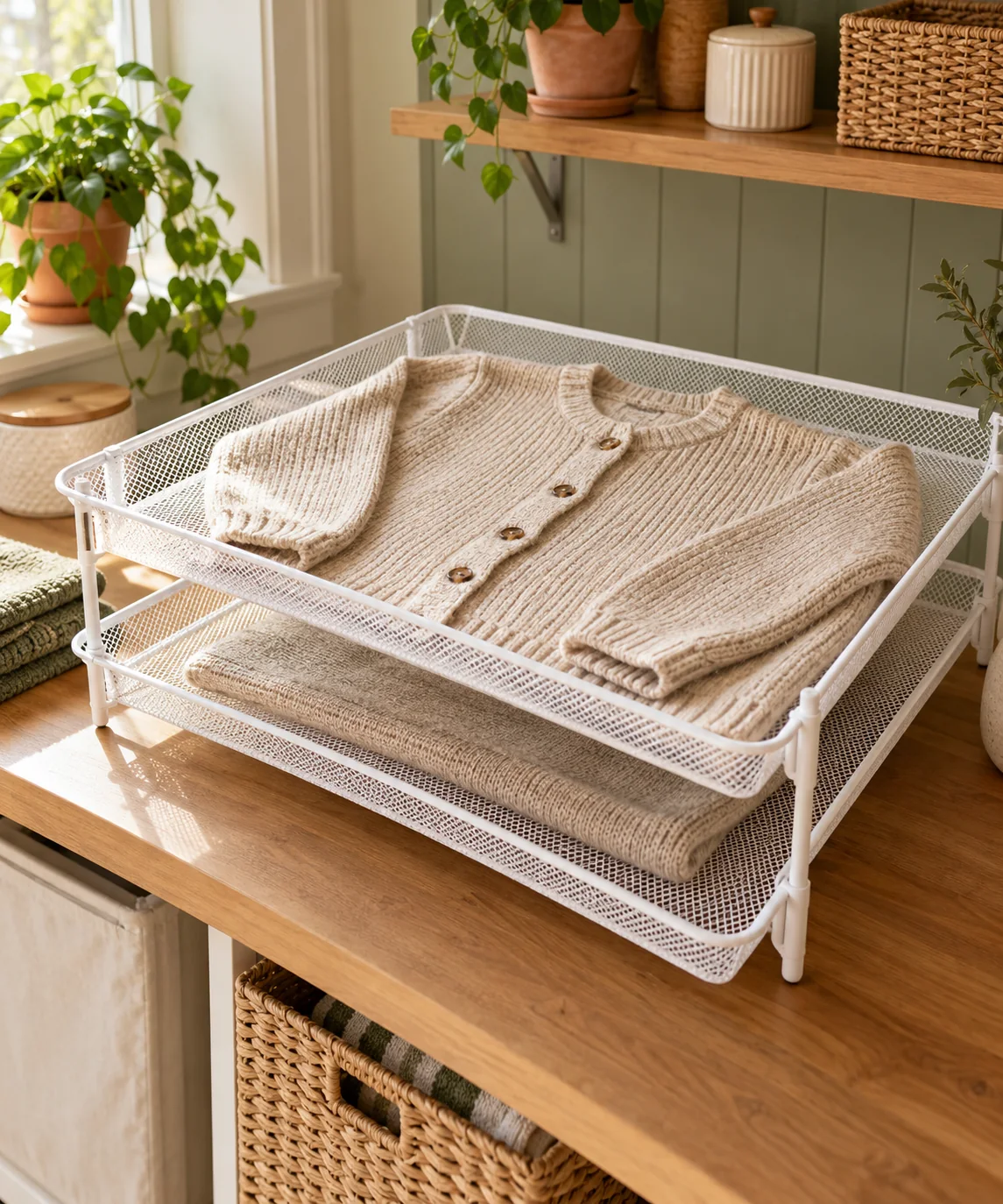
Mesh Airflow Dynamics
Wool and cashmere hold substantial water weight, making vertical hanging impossible without causing permanent shoulder misshaping and hem sagging. Mesh drying trays suspend damp fibers over an open weave, encouraging natural convection to pull air underneath and through the garment. This two-sided exposure prevents the sour odors that often develop when damp knits dry on solid surfaces like vinyl folding tables. Because air circulates freely beneath the knit, garments dry evenly without requiring aggressive heat or flipping.
Footprint Optimization in Tight Rooms
Standard freestanding drying racks spread outward, consuming substantial floor area in narrow utility corridors. Stackable mesh trays feature interlocking corner legs that nest securely, building upward instead of outward within a compact thirty-inch square. Position the assembled tier on top of a water-resistant laundry folding table or dry tiled floor. By lifting drying garments into distinct vertical tiers, you preserve room traffic lanes while still accommodating multiple sweaters or knit scarves in a single laundry session.
Proper Garment Centering
Before laying garments onto the mesh, gently press out excess water using a clean cotton towel roll rather than wringing. Smooth the sweater into its natural dimensions, aligning side seams parallel to the tray frame and centering the chest panel. Fold long sleeves loosely across the torso to ensure they stay entirely within the border of the mesh. Keeping cuffs and waistbands off the floor prevents uneven downward tension on wet yarns while drying progresses.
Collapsible Off-Season Storage
Stackable drying frames are seasonal utility tools that should not permanently clutter your laundry workspace. Look for modular units that disassemble cleanly into individual flat planes or nest tightly together when empty. Once winter knitwear gives way to warm-weather linens, break down the corner posts and slip the flat mesh frames between a machine and the adjacent wall, or slide them under a shelf. This reversible setup keeps the laundry utility zone adaptable.
Hygiene and Mesh Maintenance
Fine knit fibers shed micro-lint that can gradually collect within the porous weave of nylon or polyester mesh screens. Clean dry trays before storing by wiping them with a damp cloth or vacuuming lightly using an upholstery brush attachment. Avoid placing damp items that bleed dye together on tiered levels, as stray drips can travel to garments below. Routine surface dusting ensures your freshly washed knits rest exclusively against clean, lint-free fabric contact points.
YOUR STARTING POINT
A little checklist.
Original editorial guidance. Images are AI-generated concepts, not photographs of completed projects. Our sources and approach.
Questions to consider
Why should sweaters be dried on mesh rather than hung?
Hanging damp wool places heavy downward stress on wet fibers, resulting in stretched necklines and shoulder dimples. Flat mesh trays distribute garment weight evenly while allowing continuous underside air circulation.
Can I stack mesh trays directly on top of running washers?
Avoid placing drying trays on operating appliances. Spin-cycle vibrations can cause stacked tiers to shift or fall. Place racks on a stationary table, sturdy counter, or clean water-resistant floor instead.
How do I store stackable sweater trays during the summer?
Detach the modular corner legs and stack the flat frames together. Slide the slim assembly into the vertical gap beside your washer or beneath a base cabinet until knitwear season returns.