Kitchen Herb Gardens · THE GUIDE
Sub-Irrigated Ceramic Box for Moisture-Demanding Basil
Sweet basil requires steady root moisture to sustain its broad leaves under direct window light, where small containers can dry out rapidly. A sub-irrigated ceramic planter provides an internal water reservoir that supplies moisture upward into the potting medium through capillary wicking. This bottom-watering approach delivers consistent moisture to active roots while helping the upper soil layer remain relatively dry, which discourages common surface pests like fungus gnats. When paired with a reliable water-level gauge and an aerated growing mix, a self-watering ceramic container reduces the risk of moisture swings on sunny kitchen sills.
Jump to the checklist ↓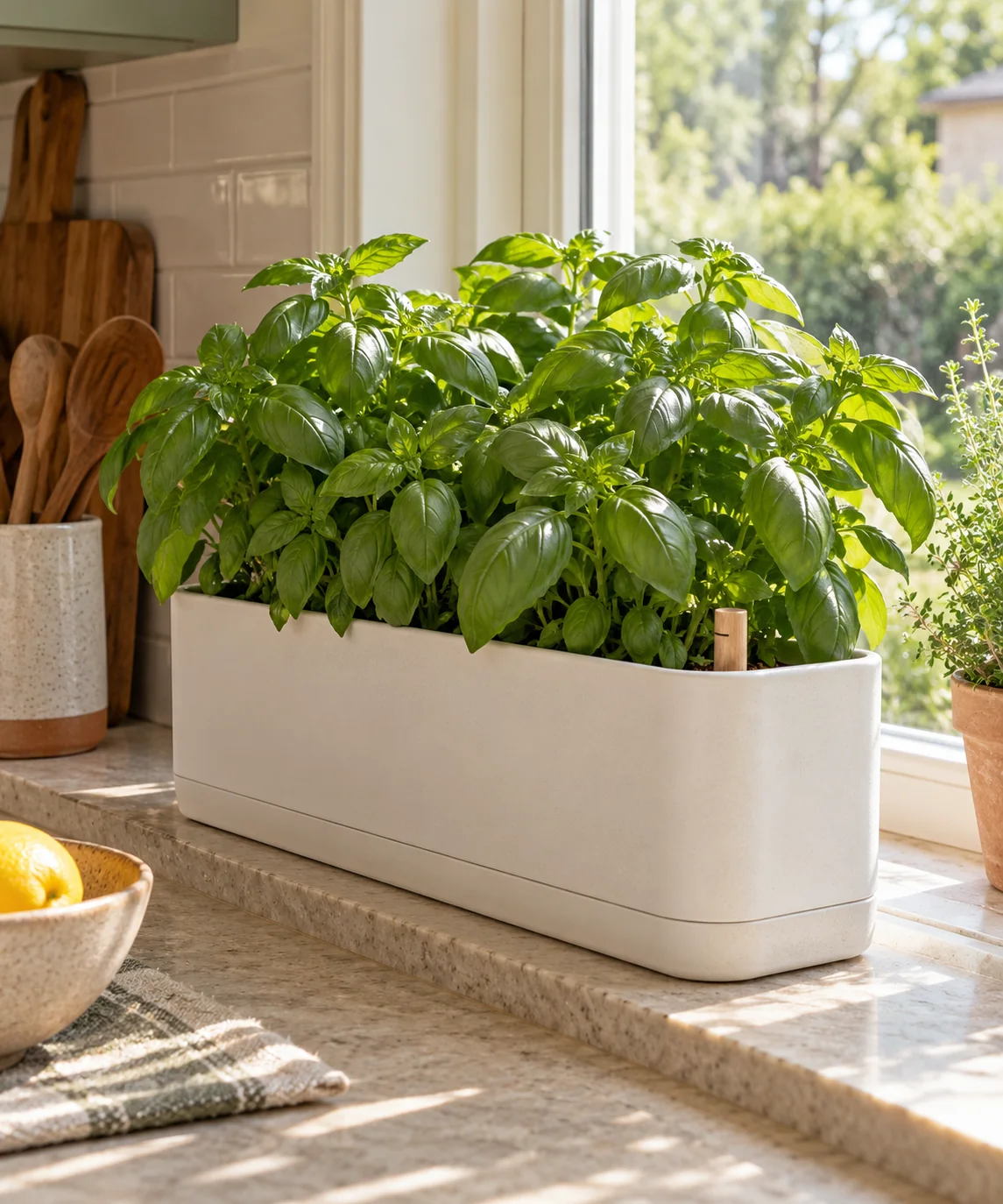
Capillary Action and Soil Moisture Dynamics
Basil transpires water quickly in warm, bright kitchen conditions, making consistent substrate hydration essential. In a sub-irrigated planter, water wicks upward from an isolated reservoir through porous media or dedicated wicks into the soil column. Capillary action distributes moisture evenly through lower root zones without requiring frequent overhead watering. Because the top centimeter of potting mix stays drier than the base, surface mold and fungus gnat breeding cycles are naturally limited. However, wicking relies on continuous capillary contact, so gaps in the potting medium can interrupt water movement.
Evaluating Ceramic Vessel Features
Ceramic self-watering planters typically feature either a glazed exterior with a porous unglazed inner cup, or a fully glazed vessel housing an internal wicking platform. Glazed exteriors prevent water from seeping onto kitchen sills, while the density of the ceramic provides physical stability against tipping as stems mature. While ceramic offers modest thermal mass, it cannot fully insulate roots from prolonged intense solar radiation on unshaded south-facing sills. Look for designs that feature a dedicated fill port and an overflow drain hole, preventing accidental reservoir flooding that could submerge lower roots.
Substrate Selection and Potting Method
Standard mineral garden soils and heavy compost blends compact in self-watering setups, restricting pore space and impeding capillary lift. A coarse, soilless container mix—typically composed of coconut coir or sphagnum peat moss blended with approximately thirty to forty percent perlite or pumice—provides the aeration necessary for root respiration. Avoid adding a bottom layer of gravel or loose shards, as non-capillary drainage layers break the moisture wick. Pre-moisten the mix uniformly prior to planting. Water lightly from the surface for the first week to settle root systems before relying strictly on the reservoir.
Monitoring Gauges and Aeration Intervals
Most sub-irrigated planters incorporate a float indicator or sight channel to track reservoir depth. Rather than keeping the reservoir topped up to maximum capacity continuously, allow the water indicator to drop to the empty mark for a short period before refilling. Letting pore water drain naturally allows air to diffuse back into substrate voids, preventing the anaerobic conditions that trigger root decay. Early symptoms of overwatering include yellowing lower leaves and soft, blackened stem bases, which indicate the medium is holding moisture too continuously.
Canopy Maintenance and Mineral Management
Consistent bottom moisture supports rapid vegetative growth, so basil requires regular pruning to avoid becoming spindly. Pinch stem tips just above healthy leaf pairs to promote compact branching and maintain airflow around the plant base. Inspect the windowsill regularly to confirm no condensation forms under the planter base. Because bottom-fed containers do not experience regular through-pot flushing, fertilizer salts and tap water minerals can gradually accumulate near the soil surface. Flush the soil mix with fresh water from above in a sink once every few months to rinse out residual salts.
YOUR STARTING POINT
A little checklist.
Original editorial guidance. Images are AI-generated concepts, not photographs of completed projects. Our sources and approach.
Questions to consider
Why do basil leaves turn pale or yellow in a self-watering planter?
Pale or yellowing foliage usually indicates prolonged saturation and insufficient root aeration. Allow the water reservoir to remain empty for a day or two between fillings so air can diffuse through the substrate, and check that the potting mix remains loose rather than compacted.
Can standard garden soil be used in a sub-irrigated container?
No. Ordinary garden topsoil compacts inside enclosed containers, reducing air spaces and halting capillary wicking. Use a porous potting mix made from peat or coco coir combined with perlite or pumice for effective wicking.
How often should the water reservoir be refilled?
Refill intervals vary based on container volume, plant size, ambient temperature, and sunlight. In warm kitchen conditions, active basil may empty a reservoir within several days, whereas cooler weather extends the interval. Monitor the mechanical gauge rather than sticking to a rigid calendar schedule.