Container Vegetable Gardens · THE GUIDE
Sunlit Kitchen Ledge Micro-Carrot Planter Box
Growing root vegetables in an apartment kitchen requires matching the crop to a container with appropriate dimensions. Round or globe-shaped carrot varieties, such as Paris Market, bypass the deep taproot requirements of standard long varieties, making them viable candidates for indoor window ledges. Achieving success depends on selecting an interior sill trough that offers sufficient root clearance without obstructing window operation or risking water spills on woodwork. By verifying window dimensions, light angles, and soil aeration before planting, you create a productive kitchen growing zone that remains entirely tidy, functional, and easily movable throughout the growing season.
Jump to the checklist ↓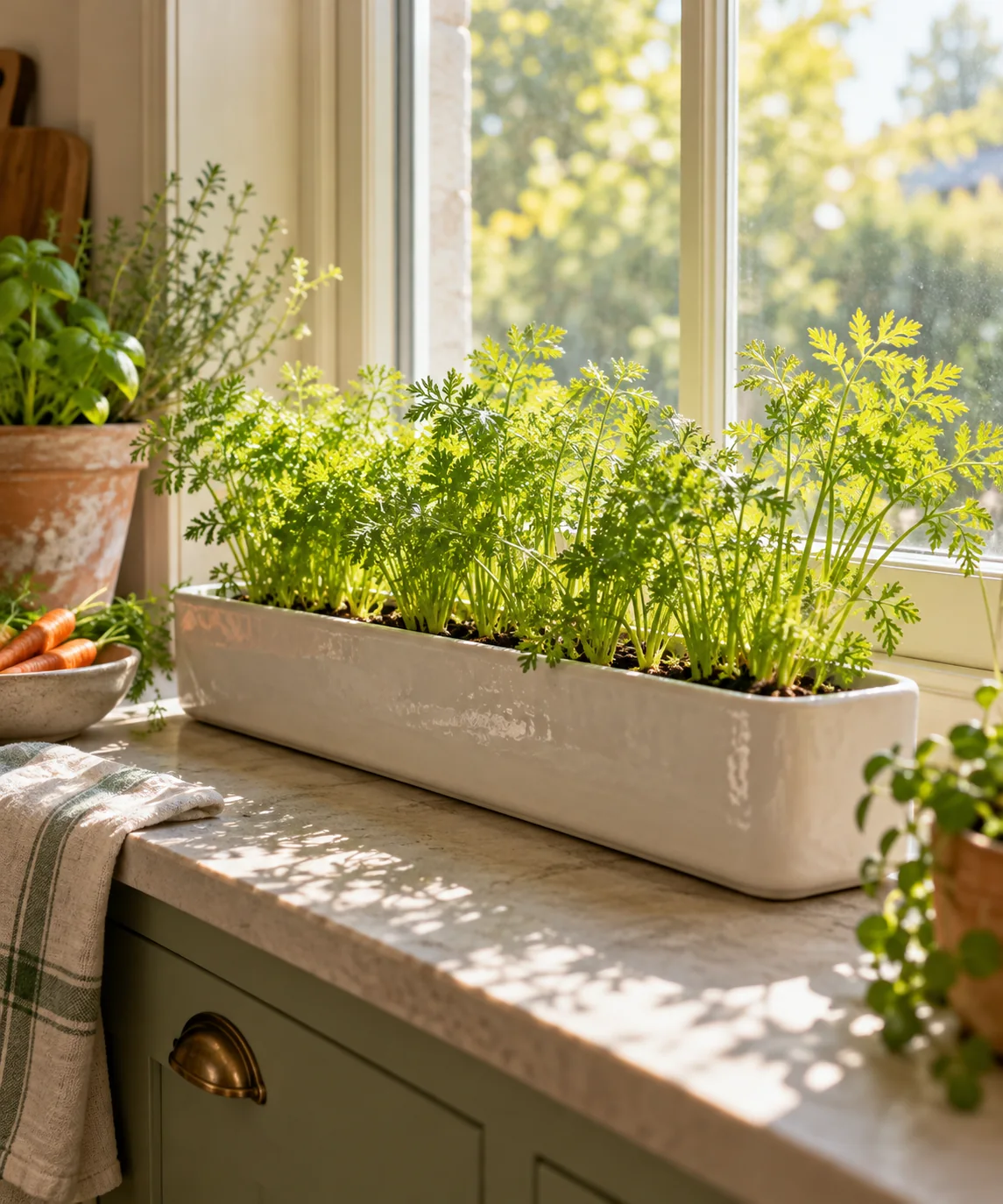
Ledge Assessment and Clearance
Measure the kitchen sill depth before choosing a planter. Standard sills often measure between ten and twenty centimeters wide. To prevent accidental tipping, the container base should not extend beyond the front edge of the ledge. Ensure that inward-opening casement windows or hung sashes can operate smoothly without hitting foliage or the planter rim. If the sill is narrow, assess adjacent kitchen island tops or sturdy side tables positioned flush against the window frame as alternative, stable surfaces that receive unobstructed natural daylight.
Trough Dimensions and Drainage Setup
Round Paris Market carrots produce spherical roots roughly three to five centimeters in diameter, but their delicate feeder roots require at least fifteen centimeters of substrate depth. Select an elongated trough that maintains this vertical clearance along its entire length. The vessel must feature functional drainage holes to prevent root rot. Pair the planter with a well-fitted, non-porous drip tray to safeguard wooden window sills from moisture damage, ensuring the tray is shallow enough to inspect and empty promptly after watering.
Substrate Consistency and Aeration
Carrots demand loose, stone-free growing media to expand without misshaping. Heavy garden soils or dense container blends cause branching and stunted growth. Fill the trough with a light, uniform potting mix amended with perlite to maintain airflow around developing taproots. Never install a gravel or shard layer at the bottom of the container, as this elevates the perched water table and reduces usable root space. Instead, place a small mesh screen over the drainage holes to retain the loose potting medium.
Light Orientation and Routine Rotation
Root crops require intense, direct light to convert solar energy into swollen edible roots rather than merely weak, leggy foliage. A south-facing or unshaded west-facing kitchen window provides the most reliable exposure. Because light entering a vertical window comes predominantly from one direction, seedlings will lean heavily toward the glass. Rotate the planter box one hundred and eighty degrees every two or three days to promote upright foliage growth and even root development across both sides of the window trough.
Thinning Technique and Moisture Maintenance
Even distribution of carrot roots prevents crowded, deformed globes. Sow seeds thinly and use micro-tip snips to trim crowded seedlings down to the soil line once they reach two centimeters in height, leaving five centimeters between remaining plants. Pulling excess seedlings by hand disrupts neighbor root systems. Check the soil moisture by inserting a finger two centimeters into the mix; water evenly along the surface when the upper layer feels dry, allowing excess liquid to drain fully into the collection tray.
YOUR STARTING POINT
A little checklist.
Original editorial guidance. Images are AI-generated concepts, not photographs of completed projects. Our sources and approach.
Questions to consider
Can I grow standard long carrots in a window ledge trough?
Standard taproot carrots require twenty-five to thirty centimeters of vertical soil depth, which makes window containers dangerously heavy and unstable. Globe varieties like Paris Market thrive in shallower troughs, making them safer and more practical for narrow indoor ledges.
Why are my windowsill carrot tops thriving while roots remain tiny?
Excess nitrogen in the potting mix or insufficient direct sunlight causes abundant leaf growth at the expense of root swelling. Ensure the ledge receives strong direct sunlight and avoid applying high-nitrogen fertilizers to container-grown root crops.
How do I prevent water damage to my indoor window sill?
Place an unbroken, glazed ceramic or waterproof plastic tray underneath your planter. Check the tray twenty minutes after watering and sponge out standing runoff so moisture never contacts the underlying painted or finished wood.