Compact Home Offices · THE GUIDE
Use an Acoustically Padded Desk Divider to Define a Shared Dining Table
Dining tables frequently serve double duty as daytime workstations, but the lack of boundary makes focus difficult and disrupts domestic rhythm. A removable, clamp-on acoustic felt divider provides an instant visual partition without permanent alterations. Clamped along the table's centerline, dense recycled PET felt absorbs ambient clatter and blocks sightlines to household distractions across the surface. This reversible setup allows one half of the table to remain an active desk while the opposite side stays clear or handles separate quiet tasks. At the end of the day, loosening the padded thumb screws restores the surface for evening dining.
Jump to the checklist ↓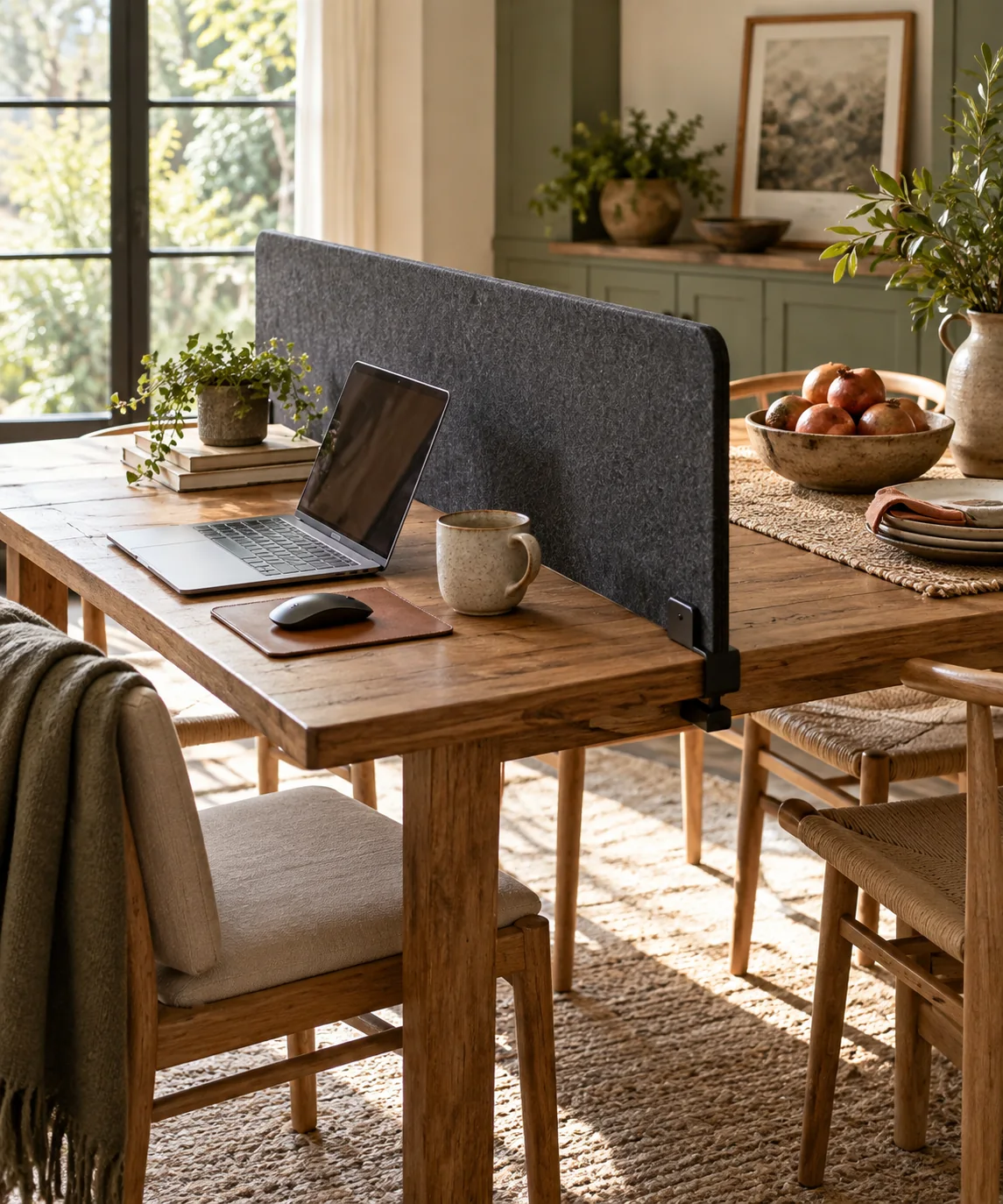
Clamp Selection and Table Protection
Select C-clamps engineered with non-marring silicone pads or thick rubber grips to prevent crushing the table edge. Measure your tabletop thickness before purchase, as dining surfaces range between 20 and 50 millimeters, often exceeding standard office desks with beveled under-bevels. If the clamp jaws contact bare wood directly, insert rectangular pieces of two-millimeter craft felt between the metal and the finish. Tighten thumb screws only until the vertical screen resists light lateral pressure; over-torquing can dent soft timber veneers or cause perimeter lacquer cracking under daily thermal shifts.
Acoustic Realities and Sightline Control
A felt divider reduces high-frequency chatter and keyboard clatter locally, but it cannot block low-frequency household noise. Its primary functional strength is perceptual isolation. A divider height of 40 to 45 centimeters above the tabletop successfully cuts off direct eye contact with people sitting opposite without creating an oppressive tunnel effect. Place the screen dead center or offset it toward the non-work side by five centimeters to gain valuable keyboard clearance. The matte surface also stops light bounce from south-facing dining room windows, improving overall screen legibility.
Depth Allocations and Cable Paths
Standard dining tables measure roughly 80 to 100 centimeters across. Splitting this footprint in half yields 40 to 50 centimeters of depth, which requires disciplined desktop organization. Position your laptop or monitor riser flush against the felt partition base to maximize forearm resting space. Route peripheral cables along the divider base using adhesive silicone clips adhered strictly to the metal clamp brackets, never the timber. Run one braided power lead downward along an outer table leg, fastening it with reusable hook-and-loop straps to prevent dining chair snags.
Rapid Transition and Storage Routine
Maintain the boundary between office hours and domestic meals by developing a five-minute pack-down habit. Loosen the thumb screws, lift the panel vertically, and slide it behind a sideboard or into a nearby closet. Store your laptop, mousepad, and chargers inside a structured canvas caddy that stows under a bench. Wiping the table surface with a slightly damp microfiber cloth removes natural hand oils accumulated near the clamp points. Keeping the storage zone within two paces of the table prevents the divider from becoming permanent.
Clear Limitations for Shared Surfaces
This configuration works best when the opposite table occupant engages in stationary, low-impact tasks such as reading, sketching, or laptop entry. Vigorous typing, food preparation, or shifting heavy servingware on one side inevitably transfers structural vibration through the shared legs, shaking external displays. If the dining table possesses an uneven planked top or a rough rustic grain, clamp bases may tilt slightly off-vertical. Test stability before placing delicate glassware nearby, and avoid hanging heavy organizer pockets from the panel top, which risks toppling the assembly.
YOUR STARTING POINT
A little checklist.
Original editorial guidance. Images are AI-generated concepts, not photographs of completed projects. Our sources and approach.
Questions to consider
Can acoustic felt panels block domestic conversation completely?
No. Porous felt absorbs direct reflections and dulls keyboard clicks within your immediate bubble, but open-room conversation will travel around the panel edges. Pair the partition with personal headphones if you require comprehensive audio isolation during busy household hours.
Will daily clamping weaken the table surface over time?
Repeated mechanical pressure can compress softwoods like pine. Using protective cork or dense felt buffers spreads the clamping force evenly. Alternate clamping locations by a few centimeters each week to distribute localized surface stress across the tabletop edge.
How do I clean dust from a felt divider panel?
Vacuum the felt surface weekly using a soft brush attachment on low suction to lift settled dust and fibers. For light surface marks, blot gently using a damp microfiber cloth with plain water; never scrub or saturate the material.