Dining Nooks · THE GUIDE
Use an Asymmetrical Pedestal Base for Effortless Bench Access
Built-in banquettes and tight dining nooks often present access challenges when traditional four-legged table frames block the pathway to the bench. Corner legs can restrict knee movement and make sliding into inner seating awkward. Pedestal tables offer an alternative by shifting vertical support toward the center or along a tailored axis, opening up perimeter floor space. However, choosing and positioning a pedestal base requires balancing ease of entry with structural stability, taking into account base weight, tabletop dimensions, and manufacturer-tested limits to prevent tipping during everyday use.
Jump to the checklist ↓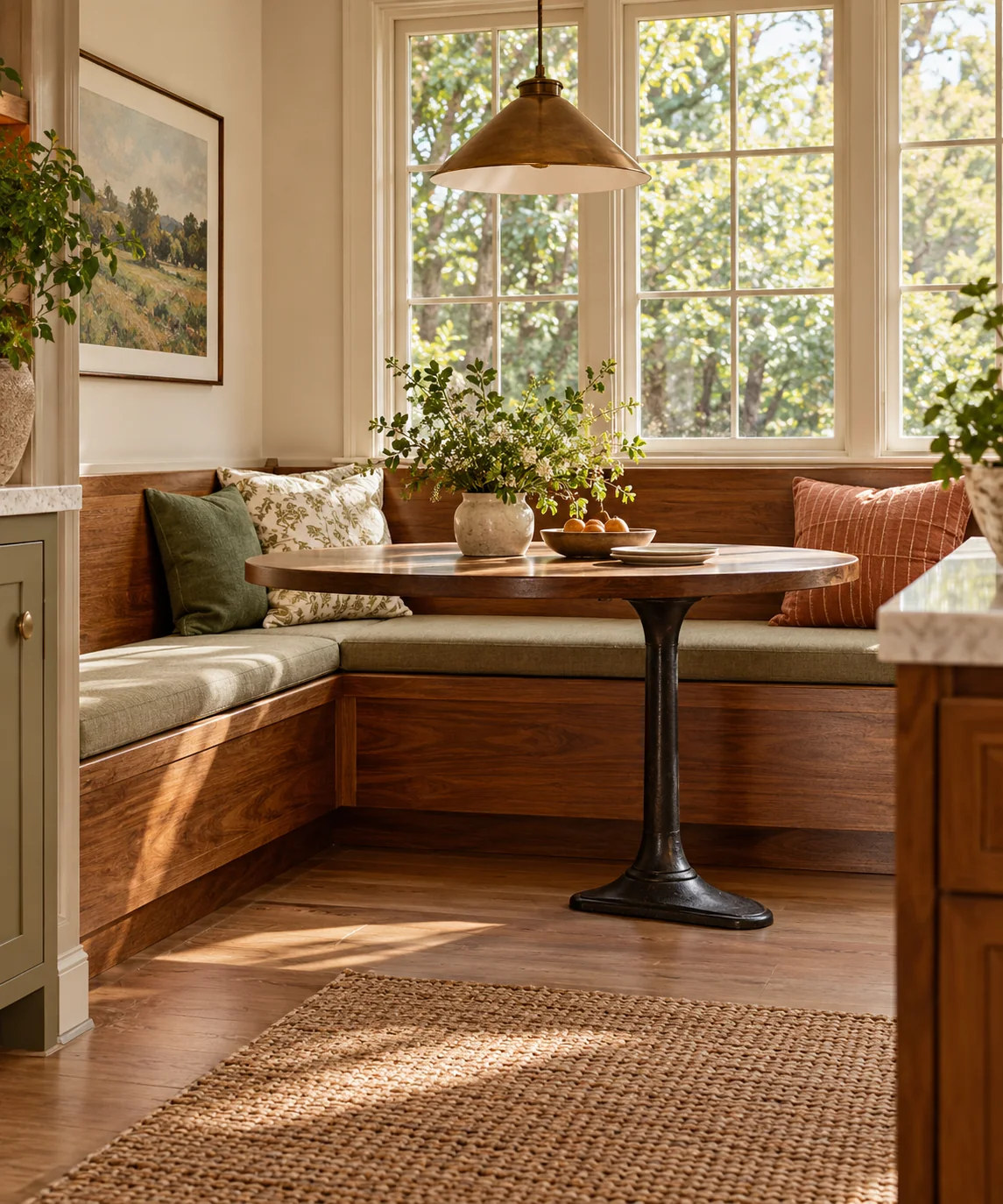
Improving Leg Clearance at Bench Entrances
Standard four-legged tables place rigid posts near the corners, which directly interferes with the natural pivot zone needed to slide onto a banquette bench. Diners must often maneuver sideways or pull the table away from the seating, which can scuff flooring and strain table joinery. Shifting to a pedestal or trestle configuration consolidates structural support toward the center. This arrangement leaves the outer table perimeter open, allowing individuals to enter and exit the seating nook without catching clothing, bumping knees, or shifting furniture.
Assessing Base Weight and Tipping Resistance
Pedestal tables rely on a concentrated footprint rather than widely spaced corner supports, making balance and weight distribution critical safety considerations. Rather than relying on arbitrary overhang rules of thumb, consult manufacturer load ratings and engineered base-to-top dimension recommendations. Heavy cast-iron or thick plate-steel bases provide a lower center of gravity than lightweight hollow columns. Always confirm that any proposed combination of base and tabletop is formally rated by the manufacturer to resist tipping under everyday downward pressure.
Aligning Offset Bases with Seating Configurations
In corner or L-shaped banquette arrangements, access points are concentrated along specific entry zones. An asymmetrical or offset pedestal base can be oriented so its widest structural support aligns with the less-traveled corner or rear bench intersection. This orientation keeps the primary floor area near the open bench edge free of obstacles while preserving necessary floor contact. When planning base placement, verify that floor vents, electrical outlets, or uneven flooring surfaces do not interfere with the base sitting completely flat.
Planning Tabletop and Bench Overlap
The horizontal relationship between the dining table rim and the front edge of the banquette cushion directly influences both seating comfort and ease of access. When a table sits too far forward, diners must lean uncomfortably across an open gap; conversely, excessive overlap restricts leg movement when sliding in. Aim for a moderate overlap where the tabletop edge extends slightly past the cushion front, typically within a few inches, while testing the clearance with your specific cushion firmness and seat depth before securing fixed bases.
Evaluating Low-Profile Base Footprints for Foot Comfort
The geometry of a pedestal base affects not only mechanical stability but also the comfort of seated diners. High-domed, conical, or bulky decorative bases can limit where diners place their feet flat, leading to awkward leg angles during meals. Flat steel plate bases or low-profile cross designs allow feet to rest naturally on the surrounding floor. Inspect the edges of metal base plates to confirm they are smoothly chamfered and fitted with non-marking protective glides that suit your flooring type.
YOUR STARTING POINT
A little checklist.
Original editorial guidance. Images are AI-generated concepts, not photographs of completed projects. Our sources and approach.
Questions to consider
Can I convert an existing four-legged dining table into a pedestal table?
Converting a traditional table to a pedestal base requires caution. Four-legged tables often lack the internal structural bracing or core thickness required to safely support central mounting plates without bowing or pulling screws loose. Consult a qualified furniture maker or structural hardware specifications before attempting modifications.
How do I determine if a pedestal base is heavy enough for a custom tabletop?
Always check the base manufacturer's maximum tabletop size and weight limits. Heavy top materials like solid stone, thick hardwood, or concrete require specially engineered commercial-grade bases with wide footprints and substantial ballast plates to prevent tipping.
What distance should be left between a banquette backrest and the table edge?
Comfortable spacing typically allows sufficient room for an adult torso while seated upright, generally around sixteen to eighteen inches from the back cushion to the table edge depending on cushion thickness. Test placement with actual cushions before permanently fixing tables or benches.