Small Kitchen Organization · THE GUIDE
Vertical Baking Sheet Storage in a Single Base Cabinet
Stacking baking sheets, cooling racks, and muffin tins horizontally creates a precarious kitchen avalanche, turning the retrieval of a single pan into an irritating chore. Converting a standard lower kitchen cupboard into a dedicated vertical organization bay eliminates friction and preserves non-stick coatings. Filing your bakeware upright transforms flat cookware into individually accessible items, much like books on an open library shelf. With deliberate slot planning, non-destructive dividers, and scratch protection, a modest base cabinet can cleanly house an entire collection of metal sheets, wooden cutting boards, and roasting trays.
Jump to the checklist ↓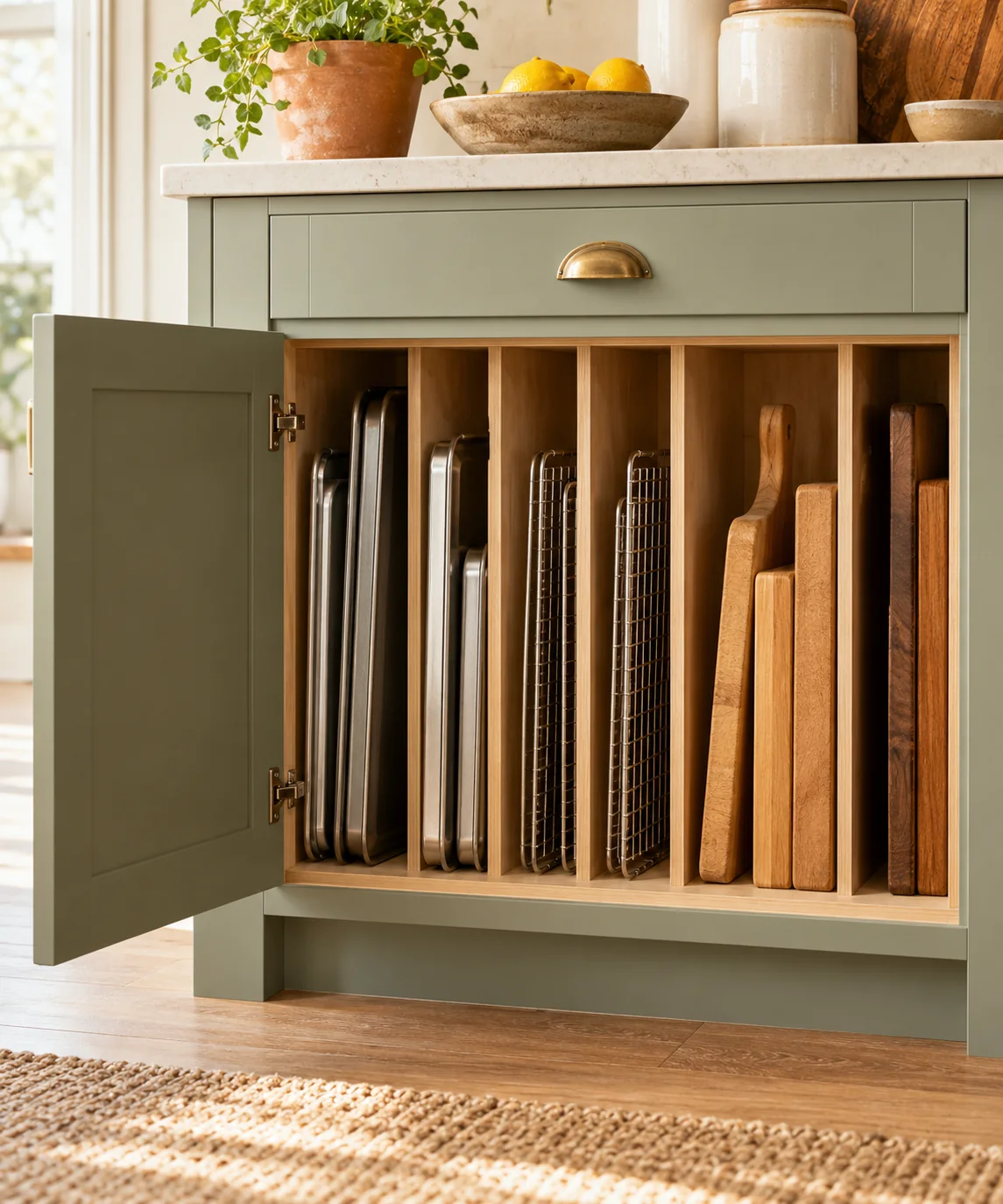
Inventory Assessment and Shelf Removal
Begin by auditing your complete baking collection to establish true storage dimensions. Measure the longest sheet pan and the widest rimmed muffin tin to verify interior cabinet clearance. In most standard base cabinets, the middle horizontal shelf must be removed or adjusted to provide the necessary vertical clearance of eighteen to twenty inches. Staging pans upright on the cabinet floor during planning reveals the total linear width required before you select or configure divider hardware.
Tension Rods Versus Drop-In Racks
Homeowners have two non-destructive paths for vertical division: heavy-duty spring-tension rods or freestanding drop-in wire racks. Spring rods install horizontally or vertically between cabinet walls without tools, but heavy cast iron or large wooden boards can dislodge them. Heavy-gauge metal drop-in organizers sit directly on the cabinet base, providing rigid dividers that withstand lateral pressure from weighty bakeware. For maximum stability, weighted freestanding dividers maintain their vertical uprights without requiring screw penetrations into cabinet panels.
Slot Widths for Varied Bakeware
Avoid uniform slot widths, as bakeware items feature wildly different profiles. Flat stainless cookie sheets and wire cooling racks fit comfortably into narrow slots measuring one to one-and-a-half inches wide. Conversely, deep roasting vessels, fluted Bundt pans, and twelve-cup muffin tins require wider compartments spanning three to four inches. Group similar depths together, placing the narrowest slots on the most accessible side to streamline retrieval during busy cooking and baking sessions.
Base Protection and Noise Reduction
Metal baking sheets sliding across bare cabinet wood will scratch paint and produce harsh clattering noises. Line the cabinet bottom with a dense, non-adhesive ribbed shelf liner or a smooth silicone mat before placing your dividers. The protective mat dampens acoustic impact, prevents metal rims from scraping cabinetry veneer, and provides subtle friction that keeps upright pans from skidding forward when the cabinet door opens or during swift cupboard retrieval.
Ergonomics of Front-to-Back Retrieval
Arrange bakeware from front to back based on usage frequency rather than strict size order. Place your everyday half-sheet pans, favorite cutting board, and standard wire rack in the center slots for immediate forward access. Shift specialty items, such as seasonal tart pans, oversized roasting racks, and spare baking stones, toward the outer perimeter or cabinet corners. This ergonomic filing ensures you never reach around cumbersome pans to grab basic daily essentials.
YOUR STARTING POINT
A little checklist.
Original editorial guidance. Images are AI-generated concepts, not photographs of completed projects. Our sources and approach.
Questions to consider
Can heavy cutting boards be stored alongside baking sheets?
Yes, provided your vertical divider is heavy-gauge steel or thick wood. Store dense wooden cutting boards in outer slots resting against the cabinet side wall to give them extra structural backing and prevent divider tipping.
What if my cabinet is too narrow for all my bakeware?
Prioritize everyday sheet pans and cooling racks inside the vertical cabinet. Store oversized items, such as large broiler pans or multi-tier cooling grids, in secondary locations like the lower drawer beneath your oven.
How do I prevent pans from sliding out when opening the door?
Place a ribbed rubber runner along the base or angle your divider rack slightly inward toward the cabinet back. The raised ribs catch pan rims, halting forward migration when the cupboard door swings open.