Small Bedroom Layouts · THE GUIDE
Zoning Sleeping and Workspace with a Natural Fiber Runner
In multi-use small bedrooms where a work desk shares square footage with the sleeping area, visual boundaries are essential for maintaining mental separation. Laying a long, natural-fiber runner along the walking aisle between the bed and desk establishes an intuitive floor division without adding physical partitions or bulky screens. Materials such as flat-weave jute, sisal, or seagrass introduce structured texture underfoot, defining dedicated paths for working and resting. With deliberate placement, careful clearance checks, and an appropriate rug pad, you can create functional clarity across a shared room.
Jump to the checklist ↓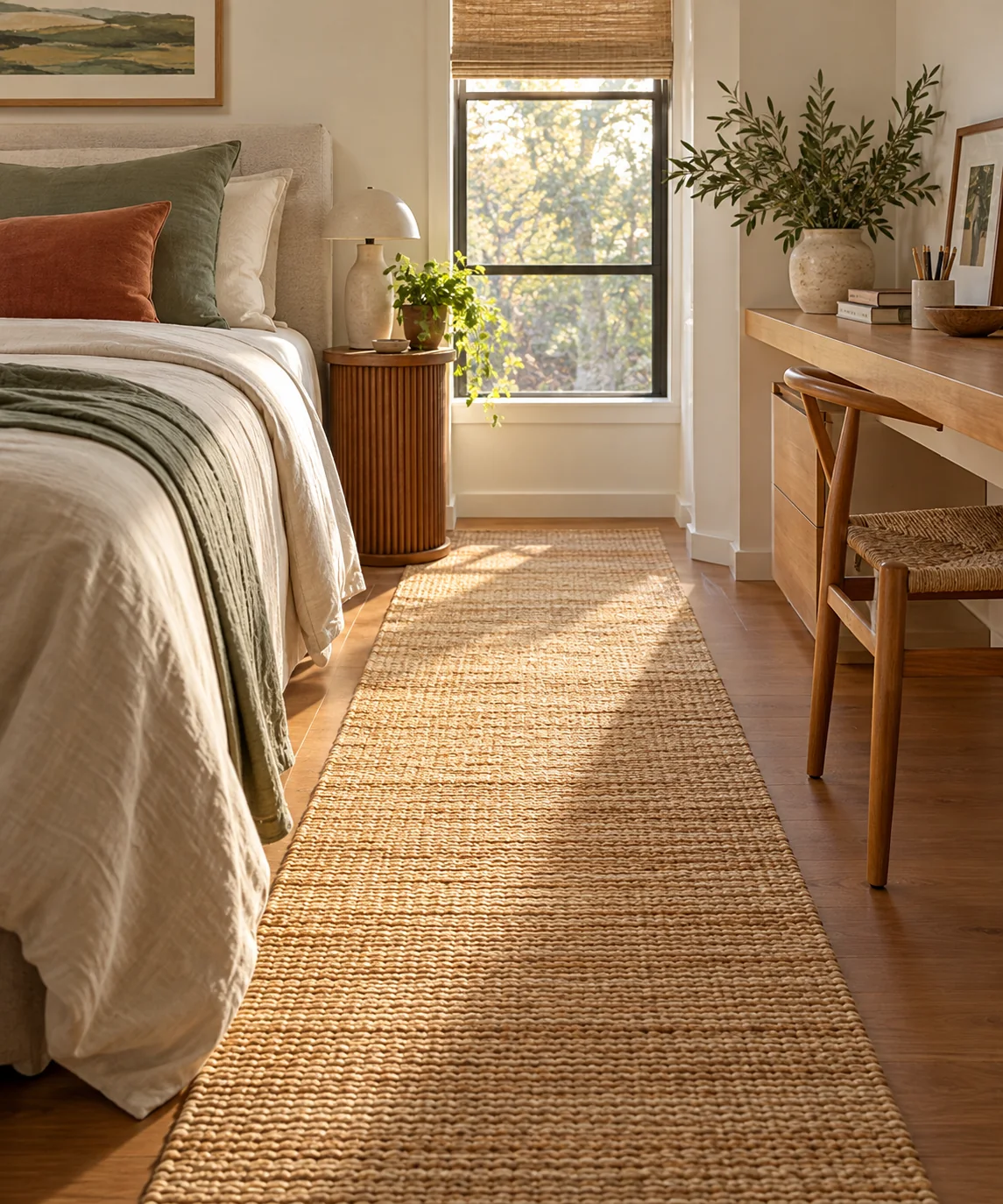
Defining the Shared Boundary
When a desk faces a wall opposite or parallel to a bed, the intermediate floor space often becomes a visually ambiguous zone. A runner rug acts as a linear axis that organizes traffic flow and clearly segments tasks. By running the rug lengthwise along the primary aisle, you ground the transition area between professional focus and evening rest. The visual line directs the eye along the room's length, visually elongating compact proportions while telling the mind where work stops and relaxation begins.
Aisle Width and Runner Dimensions
Measure the open floor aisle precisely before selecting a runner. Standard runners typically range from 60 to 80 centimeters wide. Ensure the runner leaves at least 10 to 15 centimeters of exposed bare floor on either side rather than bunching against baseboards or tucking awkwardly under bed legs. This border creates breathing room and prevents the walkway from feeling constricted. Check that bedroom doors and low-hanging desk drawers can open freely without catching the raised edge of the weave.
Underfoot Texture and Chair Movement
Natural fibers like jute, sisal, and coir bring durable structure, but weave thickness directly affects desk chair functionality. If your desk chair uses caster wheels, a thick-ribbed rug will impede rolling and wear unevenly. For desk zones, opt for a tightly woven, thin flat-weave or position the runner exclusively in the walking aisle just outside the chair’s operational sweep. This setup reserves smooth bare floor for rolling seats while giving standing feet a grounding, tactile surface when moving between zones.
Securing Placement Without Adhesives
Because runners occupy narrow walking channels, they are prone to shifting, rippling, and slipping on hardwood or laminate flooring. Always place an appropriately sized, non-adhesive felt or rubber rug pad directly underneath the entire woven surface. Trim the pad 2 to 3 centimeters smaller than the runner perimeter so edges sit flat against the floor. A quality underlay protects your existing flooring, prevents curling corners that cause tripping hazards, and cushions natural fibers against heavy daily foot traffic.
Fiber Care and Vacuum Clearance
Natural plant fibers release fine particulate matter and collect household dust over time, especially near bedding textiles. Vacuum the runner regularly using suction only; rotating beater bars can snag coarse fibers and fray woven edges. To clean spills, blot immediately with a dry cloth rather than rubbing moisture into plant strands. Periodically rotate the runner 180 degrees to equalize foot wear and natural sunlight exposure, ensuring the aisle maintains an even, uniform appearance throughout its lifespan.
YOUR STARTING POINT
A little checklist.
Original editorial guidance. Images are AI-generated concepts, not photographs of completed projects. Our sources and approach.
Questions to consider
Which natural fiber runner is best for a bedroom workspace?
Flat-weave jute or woven seagrass works best. Jute offers a softer texture for bare feet, while seagrass resists soil and features a tighter, lower profile that handles desk traffic without catching edges.
Can a rolling office chair move across a jute runner?
Rolling chairs often drag against coarse or loose weaves, which can distort the rug structure. Place the runner parallel to the chair's working path, keeping caster wheels resting on bare floor or a mat.
How do I stop a runner from curling up at the ends?
Use a dense, non-adhesive rug underlay cut slightly smaller than the rug. For persistent curling, reverse-roll the ends tightly for twenty-four hours and keep the runner clear of damp perimeter locations.